
Here are suggested study plans for you
to make the most of the course
Prepositions in English are quite tricky, especially when it comes to describing visuals in IELTS Writing Task 1 where you have to avoid making grammatical mistakes. It is important to use them properly in order to achieve a good score for ‘Grammar range and accuracy’ which makes up one-fourth of your marks for the IELTS Writing section.
In this part of the exam, you usually have to describe a graph or map that is showing some change. This means that you have to use the language for describing trends. In this article, we are going to discuss the most commonly used prepositions for describing visuals as well as provide some examples.
AT shows the level or point at which something happens:
Moreover, we can use this preposition after the following verbs before the number:
start, begin, end, finish, peak, remain constant or steady, plateau etc.
Take IELTS with confidence
Start your IELTS Grade online course
TO shows a point which a figure reaches as a result of an increase or decrease:
BY shows how much a figure has changed:
Prepositions TO and BY are often confused. What is the difference between them if the starting point is 100%, for example?
‘It declined BY 10%’ means it only dropped from 100% to 90% (100% – 10% = 90%). BY shows the difference between the two numbers.
‘It declined TO 10%’ means that it was 100% and fell down to 10%, which is a big drop. We mean the end point, which is 10%.
‘It declined to 10%’ is a short way of saying: ‘It declined from 100% to 10%.’
BY also shows who does an action:
IN shows an area in which a change takes place:
As you have seen, such nouns as ‘decrease’, ‘increase’, ‘rise’ and ‘fall’ are followed by the preposition IN. However, if we specify the number, we use the preposition OF after ‘decrease’, ‘increase’:
IN is also used when we talk about specific months, years, quarters, seasons.
BETWEEN … AND … and FROM… TO… show the starting and the finishing point of something, or the maximum and the minimum indexes:
DURING, OVER and FOR show that something was happening from the beginning to the end of a period of time:
UNTIL shows a point in time when something finished:
READ ABOUT: Top 3 IELTS grammar mistakes and how to fix them
Here are the same prepositions used in fixed expressions explained. It’s easier to learn and remember them in phrases.
‘The figures for …’ is easy to be learned as a phrase. It means ‘the index of’.
‘As for’ is a fixed phrase which means ‘Concerning’, ‘Regarding’, ‘Talking about’.
‘Turning to’ is a phrase which means ‘Moving on to’, ‘ Changing the subject to’, ‘Talking about’.
‘In contrast to’ is a phrase that means ‘in comparison with’.
‘At this point’ is a phrase which means ‘at this moment’.
‘By contrast’ is used to show that you are mentioning a very different situation from the one you have just mentioned.
Use ‘compared to/with’ and ‘in comparison with’ for contrasting the two situations or things.
Subscribe to our IELTS digest
READ ABOUT:
Whether you like it or not, grammar is crucial to both IELTS Writing and Speaking because grammar range and accuracy is the criterion that makes up 25% of your score. Obviously, you have to avoid making mistakes while writing and speaking to the examiner. Otherwise, it will be quite difficult and unlikely for you to achieve a higher band. We have selected the most frequent mistakes candidates make on the IELTS exam, and we will also suggest how to mend them.
Some mistakes can be made because of the influence of your mother tongue while others crop up regardless of the language you speak as the first language, and students around the world have these common issues. What are they?
This is a very common mistake even upper-intermediate and advanced students make in their speaking and writing. However, it’s a very basic one and very noticeable. What is considered to be a subject-verb agreement mistake?
WRONG: A person I really admire is my friend Randy. He live in Thailand and he work as a teacher, and he also run a travel blog.
CORRECT: A person I really admire is my friend Randy. He lives in Thailand and he works as a teacher, and he also runs a travel blog.
Don’t forget to add ‘s’ in Present Simple, when talking about ‘he’, ‘she’ or ‘it’ as well as change ‘have’ to ‘has’ for the 3rd person singular.
WRONG: There are two possible solutions. Each have its advantages and disadvantages.
CORRECT: There are two possible solutions. Each has its advantages and disadvantages.
Remember pronouns that always take a singular verb:
each, either, neither, one, no one, nobody, nothing, anyone, anybody, anything, somebody, something, someone, everyone, everybody everything.
However, there are pronouns that always take a plural verb:
both, few, many, several.
For example:
There are two possible solutions. Both have advantages and disadvantages.
WRONG: One of my friends are coming to visit me on holiday.
CORRECT: One of my friends is coming to visit me on holiday.
You should remember that the verb agrees with the subject, i.e. the quantity, as in:
Two of my friends are coming to visit me on holiday.
However, for some quantity phrases you have to pay attention to the noun in the prepositional phrase to decide if the verb is singular or plural:
A lot of people (plural) cycle to work.
A lot of sugar (uncountable) is not healthy.
All of the numbers (plural) are rising insignificantly.
All of the food (uncountable) is homemade and fresh.
Some of the adults (plural) travel to work by car.
Some of the local food (uncountable) is very spicy.
One-fourth of the commuters (plural) drive to work.
One-fourth of the space (uncountable) is occupied by freelancers.
Here are the pronouns that take a singular or a plural verb: some, all, any, most, a lot.
WRONG: The number of bicycles which were stolen remain stable.
CORRECT: The number of bicycles which were stolen remains stable.
In your writing or speaking, you can use relative clauses or prepositional phrases to give more information, and thus separate the subject and the verb in the sentence. What happens then is that candidates in such cases often forget about the subject of the sentence and use the wrong number of the verb. Do not agree the last noun in the phrase or clause with the verb. Make sure you agree the verb with the subject of the sentence.
READ ABOUT: How to work on your IELTS grammar

This often happens in the Speaking section of the exam, particularly in Part 2 where you are often asked to describe some past events or experiences. For example:
“I’m going to tell you about an achievement that I am very proud of. It’s pretty recent so I can still distinctly remember lots of details and my own impressions related to it. It is just a couple of months ago when my boyfriend and I go to Bali on holiday and it is my long-cherished and also long-delayed dream to try scuba diving.”
Why does this happen? More often than not it is the problem lies in forgetting. The thing is that in IELTS Speaking candidates become so focused on their vocabulary, pronunciation, and demonstrating their fluency that they forget about using proper grammar.
How can you fix it? Practice before the exam, record yourself. It’s a good idea to only focus on using the past tenses. Remember, that in the second part of the exam, you are often asked to talk about past experiences. So, when you’re given a card with the task, read it carefully, and while planning your answer, think about grammar you’re going to use to give a response.
Another very common mistake is using Past Simple instead of Present Perfect and vice versa.
WRONG: Over the last 10 years, the number of bicycle commuters increased dramatically.
CORRECT: Over the last 10 years, the number of bicycle commuters has increased dramatically.
WRONG: There have been considerable fluctuations in the number of bike commuters between 2002 and 2005.
CORRECT: There were considerable fluctuations in the number of bike commuters between 2002 and 2005.
The rule is very simple. If we are talking about events that started and finished in the past, e.g. between 2002 and 2005, we use Past Simple. If we are talking about something that started in the past but continues until the present or something that happened in the past but the result is in the present (e.g. “over the last ten years” means that it started 10 years ago and the results are related to present), use Present Perfect.
READ ABOUT: How to organize your responses on the IELTS speaking exam?
Take IELTS with confidence
Start your IELTS Grade online course
Have a look at the following example sentence taken from the cause and effect essay:
Many people think we use ‘will’ for the future, and they are right, but not most of the time.
CORRECT: If ice continues to melt, many species will become extinct.
The part of the sentence that starts with ‘if’ is the condition. The main clause says. ‘many species will become extinct’, and these are the things to happen.
The rule for 1st Conditional is: If+Present Simple, will+verb.
For example:
OR
Will+verb if+Present Simple:
Put a comma after if-clause and before the main clause.
When you imagine a situation, use a different type of conditional:
If+Past Simple, would/could/might/should+verb.
For example:
We have looked at the most common mistakes made even by advanced learners. Remember, the more you practice, the better your grammar becomes. The good news, you still have time to prepare for IELTS and you can do it thoroughly by taking our online IELTS preparation course.
Subscribe to our IELTS digest
ALSO READ ABOUT:
The IELTS Speaking section is divided into 3 parts. Most candidates find Part 2 to be the most challenging because in this part you have to give a long turn on the suggested topic. Students often lack words, do not know what to talk about, and fail the second part of the test because they do not know how to organise their responses. This part of the speaking test also seems to be quite difficult because of the unexpected questions the examiner might ask. We have already shared some useful tips on how to deal with unexpected questions in the IELTS Speaking test, so today we are going to talk about how to organise your response to get the desired score. What do you have to do to do well in this section and what things you shouldn’t do? Let’s find out.
In this section, you will be handed a card with the speaking task and you will have 1 minute to prepare. Then you will have to speak on the suggested topic for 2 minutes.
Sounds easy and quite short. However, when it comes to the exam, a lot of candidates start worrying and forget about organising their answers. They start thinking about how to impress the examiner or what the examiner might think of them, or how to speak fast and leave the room as quickly as possible. When you are in the exam room, three minutes last forever. What you have to do is to think about the prompts, organize your ideas, and take a few notes, which you are allowed to refer to when you speak.
In this part of the exam, the examiner will not ask you any questions. The main question you have to answer while preparing for the speaking is “What am I going to say?”, so make sure you read all the prompts carefully and have answers for all parts of the question.
Take IELTS with confidence
Start your IELTS Grade online course
For this part of the speaking test, you will also be given a pencil and a sheet of paper. Take your time and write down your ideas before you start speaking. The main thing you have to do here is to organise your thoughts.
Let us have a look at a sample task for IELTS Speaking Part 2.

What do you think you have to speak about here? Read the task and find the key words. They are ‘a goal’ and ‘achieved’, which means you have to talk about something you wanted to do in the past and you have already done. If you cannot remember anything about yourself, use ideas and stories about other people, e.g. your friends, family, film characters. It’s OK to give your friend’s opinions, or opinions of actors or politicians as your own.
Then read the rest of the prompts you have on the card and see what other things you have to talk about. In this sample task, you will all have to say :
And there is one more part which is also very important ‘explain why achieving this goal was important’. So, what you have to do is quickly analyse the question to make sure you will cover all parts of the task in your response.
The next step is taking notes. You are given a pencil and paper, and you have 1 minute to take notes – do it! A lot of candidates do not want or think it’s unnecessary to take notes because it’s a waste of time. However, when they start speaking they forget their key points, go off topic, and they do not stay organised. This, of course, influences their fluency and coherence. Their ideas become disorganised and are not logically linked together. They start making long pauses, searching for words. The examiner struggles to follow their thoughts. Finally, they lose their points. So, your notes are very important because they keep you on topic and they keep you organised.
How and what should you write? This is an evident question because you have only one minute to prepare your answer. Of course, this time is not enough for writing full sentences. That’s why write only keywords that will help you remember what you want to say.
Cover every point – it’s crucial and life-saving in terms of the IELTS Speaking exam. You have to talk about all the points from the card, otherwise you will not complete the task, and your score will drop.
Let’s see, for example, what your notes for the task above might look like:
| Task | Notes |
| Describe a goal you had and achieved. You should say: |
|
| what your goal was |
|
| what you did to achieve it |
|
| what was the hardest part |
|
| explain why achieving this goal was important |
|
As you have only 1 minute, this will be enough. In these sample notes, we have covered 4 points. Remember the number of points you have to talk about, and while speaking point to each, for example, with your finger or a pencil. This will help you remember what you’ve said and keep you on track.
READ ABOUT: Useful strategies for IELTS Speaking on the day of the exam

Another good tip is to keep balance, so you can divide your talking time into 4 parts, and that will take approximately 30 seconds for covering each point. What you have to do here is to expand your answer. Your notes are really helpful but they are too short. You have to give more information about each point. Make it longer by giving details, examples, using your senses, as these questions are often about describing – it’s a good idea to describe! Imagine things in your mind, think of your senses and say, for example, what it looked like, what it smelled like, what it sounded like, what you were feeling, etc.
For example:
| Your notes | Your answer |
|
Talking about what I did to achieve my goal, I must first of all say that Bali is a perfect place to try this kind of activity, and at first it seems like you don’t have to do anything, just go diving, that’s it. There is an abundance of fish and other marine species there. And the visibility underwater ranges from 20 to 50 meters, which is very far. Granted some currents around the islands can be pretty strong and pull you really, really hard, but with the professional coach and proper training, everything becomes possible and that’s what I did first. I signed up for a short beginner course which included full chapters about dive theory and 10 hours of skilled practice in confined water, that’s diving in a pool. I know some would say that it’s ridiculous to go through such rigorous training, but if I hadn’t done it, I wouldn’t have been able to enjoy my diving experience as much as I actually did. |
Organising your speech is a must. Common mistake that many candidates commit on the day of the exam is talking a lot without any organisation. When planning a speech, think about having an introduction, a main body, and a conclusion. It might seem like you are writing an essay, but in fact you are saying it: first, you introduce the topic, then address all the points from the prompt card, and finally, make a conclusion. To do this, use introductory phrases and transitions. Here’s what it might look like:
1 I’m going to tell you about an achievement that I am very proud of right now. It’s pretty recent so I can still distinctly remember lots of details and my own impressions related to it. It happened just a couple of months ago when my boyfriend and I went to Bali on holiday and it was my long cherished and also long delayed dream to try scuba diving.
2 Talking about what I did to achieve my goal, I must first of all say that …
3 It sounds funny, but the most unpleasant and difficult part for me was ….
4 Now you may wonder why I call this a goal and an achievement. The thing is that I’m scared of water and mesmerized by its beauty at the same time. And overcoming my fear was a challenge for me.
Anyway, we did it and it was just miraculous, absolutely overwhelming…
Finally, talk loudly and at a normal pace. Don’t rush. Speaking very fast doesn’t give you any extra points. Use your normal pace, or even slow down a bit. This helps organise thoughts and develop ideas. Try to use the same pace during the whole test, as if it is natural for you. Mind your intonation and speak clearly. When it comes to pronunciation, some candidates worry about their regional accent. But your accent may only be a problem if the examiner can’t understand what you say. So, focus on speaking clearly, and use intonation to get your ideas across.
If you would like to listen to the full sample answer for this task, learn more strategies for the Speaking and other sections of the IELTS Academic, do a lot of practice with instant feedback from IELTS tutors and experts, join our online IELTS preparation course.
Subscribe to our IELTS digest
READ IN OUR BLOG:
Needless to say, correct punctuation gives the right meaning to the sentence, and its wrong placement can totally change the meaning. How many punctuation marks are there in English? Period, comma, apostrophe, quotation, question, exclamation, brackets, braces, parenthesis, dash, hyphen, ellipsis, colon, semicolon! However, you don’t need to use all of them at the exam. Following the correct usage will make your IELTS writing look more appealing and easier to read.
Punctuation also influences your score. If you don’t use it properly or forget to use some punctuation marks, it will count as a grammatical mistake. Remember, grammar range and accuracy make up 25% of your score. So, it’s better to avoid making any grammatical mistakes in your IELTS Writing. In today’s blog post, we are looking at different types and proper use of punctuation for your IELTS essays and reports. Make sure you remember all of them and practise using them during your IELTS preparation.
Take IELTS with confidence
Start your IELTS Grade online course
At the end of sentences to mark a sentence’s grammatical end. For example:
At the end of abbreviations, such as Mr., Ms., etc., and so on.
You should place the period right after the last letter of the last word in the sentence and leave some space between the period and the first letter of the first word of the next sentence. It might look obvious, but many candidates don’t do this. Start the next sentence with the capital letter.
Using abbreviations in IELTS Academic Writing Task 1 and Task 2 is not a good idea. Instead, write the words out. The exception is for symbols like % and $ which you should use, as they are faster to write and very commonly used, even in formal writing. For example:
In contractions to show that letters are missing, e.g. I’m, it’s, they’ll, who’s. DO NOT use them in IELTS Academic writing. Short forms are too informal:
In possessions to indicate ownership. For example:
READ ABOUT: How to work on your IELTS grammar

To separate items in a list. For example:
To separate clauses by ‘and’ or ‘but’ if they have different subjects. For example:
When the subordinate clause goes before the main clause. For example:
When the clauses give extra, non-essential information:
When subordinate clauses or non-finite comment phrases give additional information. For example:
To introduce lists:
When the second sentence explains or justifies the first sentence:
Use single quotation marks to draw attention to a word:
To refer to titles of the books, newspapers, magazines, films, songs, poems, videos, CDs, etc.
To mark the beginning of the sentence.
For proper nouns: personal names, brand names, nationalities and languages, days of the week and months, public holidays and geographical places no matter where they fall in a sentence.
For titles of books, magazines, newspapers, plays, music, e.g. ‘Oliver Twist’, The Guardian.
Subscribe to our IELTS digest
RECOMMENDED READING:
Grammar mistakes can destroy your score not only in IELTS writing but in IELTS Listening and Speaking as well. This means it is pretty important to write correctly because if you make even little errors, you are unlikely to get more than 6 or 7. Grammatical range and accuracy make up 25% of your score for writing and speaking. Work on your grammar during your IELTS preparation, and get the desired score in 5 easy steps.
There are many key concepts of grammar different candidates might need to improve: tenses, subject-verb agreement, articles, conditional sentences, etc. As many students as many problems there are to be fixed. The majority of those who prepare for and take IELTS, have issues with 1-3 areas of English grammar. That’s why one needs to identify those in order to find out what needs to be improved.
For example, if you have difficulties with punctuation, it might reduce the score for your writing. Or if you are not good at using tenses, you are likely to fail both writing and speaking.
The simplest way to find out what problems you have is to do this with a teacher, a tutor or any high-level learner of English, etc. Share your writing with them and ask them to give you feedback on your grammar. It is likely that any devoted teacher of English would be willing to help you and make a contribution to your IELTS preparation.
Take IELTS with confidence
Start your IELTS Grade online course
This can be compared to learning the traffic regulations and road signs. Grammar rules are the laws of the English language which is the ball of roads and streets with different signs and directions. Grammar rules show us how the language works and in what directions we should or shouldn’t go. If one doesn’t know the rules which run the problematic area of grammar, he or she will never be able to use that grammar.
Luckily, there are many resources to study grammar such as websites, coursebooks, etc. Pick up the topic you find problematic, read about it, and learn the examples.
READ ABOUT: 6 best ways of getting vocabulary for IELTS

Learning and knowing the rules of grammar is good, but understanding them better and integrating them into your writing and speaking is impossible without practice. After you have read the rule, learned the examples, you have to practice applying them, i.e. master your accuracy and then fluency.
Before you actually learn to drive, you study a lot of theory and road signs. You also do typical exercises with your driving instructor to train your muscle memory. And only after you stop thinking about how the clutch works and start doing it automatically, you are allowed to drive. When you drive for the first time, you might feel stressed and confused with many cars around you, traffic lights, and all the road signs. But the more you practice, the more confident you become. The same with grammar: learn the rules, study examples, notice new grammar in reading passages or listening, do a lot of exercises, commit some mistakes, analyse, fix.
After you have worked out by doing grammar exercises, it’s time to produce your own sentences. If you know the rules, but do not use them in your oral communication or writing, you are losing them, and your grammar doesn’t improve. Practice using the grammatical structures in your speaking or writing. For example, when planning your answer in IELTS Speaking, it is a good idea to think about what grammar you are going to use. If the examiner asks you about your future plans, make sure you use Present Continuous, be going to, will, or Present Simple, probably 1st Conditional. If you are writing an essay, you will have to use complex sentences in order to achieve a higher score. When you are doing that, be conscious about using proper grammar.
You can record yourself speaking or keep your writing in order to do the next step.
How do you know that you are using grammar you have learned correctly? Of course, it would be great if you could ask for some feedback from your teacher, for example. The teacher will tell you if you are using the correct sentence structures and if you have anything else to fix. You will learn a lot from the feedback you receive and still will be able to improve. Moreover, you can use this system not only to hone your grammar skills but also other areas of IELTS.
As you can see, it is not complicated and it is very effective, that is why we have created a fully online IELTS preparation course based on this concept. Its main focus is practice, detailed analysis of all types of IELTS Academic writing, reading, listening tasks, automated instant IELTS score on writing using artificial intelligence, step-by-step guidance, feedback on your writing and speaking, online lessons with certified teachers, full mock Speaking and Writing tests with detailed feedback from IELTS preparation experts.
Subscribe to our IELTS digest
READ ABOUT:
IELTS Academic or General Training is a reasonably challenging exam and it demands thorough preparation from the students and candidates. For those who are going to take IELTS for the first time, it is something that can be compared to launching a rocket into space. You don’t know where to start and what to expect. Besides the IELTS exam itself, there are other types of tests most candidates take at different stages of their IELTS preparation. They are diagnostic, practice, and mock tests. Why, when, and how to complete them is discussed in this article.
Take IELTS with confidence
Start your IELTS Grade online course
This type of test is usually taken before you start your IELTS preparation. It can be done online or offline depending on where you are going to do a course in IELTS preparation. It helps you and the course provider to see what your current bands are in IELTS Reading, Listening, Writing, and Speaking. Some schools or teachers give their students only reading and listening tests, some may check all four language skills. It also allows you to evaluate the range of your vocabulary and grammar, and realize what you have to improve. Diagnostic tests reveal the candidate’s weaknesses and strengths and allow the teacher or the course provider to customize the preparation and make an effective plan so that you could turn your weaknesses into strengths and cover all aspects of the exam. For example, if your level of English is high enough for the desired band score, you will likely work more on exam skills. And vice versa, if your English is not good enough, you will have to focus on language first, and only then master your exam skills.
After the diagnostic test has been graded, you can also ask the teacher why your answers are wrong and even for advice on how to progress in learning the language. Knowing your own English abilities is helpful for your progress.
Diagnostic tests are recommended but not compulsory. There are alternative ways to find out what needs to be improved.
RELATED READING: How to start your IELTS preparation?

These tests are good for a few reasons:
There are many IELTS practice tests on the Internet. However, it’s always better to use the official ones such as:
These resources are free, and they will give you an indication of your band score and provide feedback on areas to improve.
READ ABOUT: IELTS Academic Writing tasks in 2021

The main difference between the practice tests and the mock test is that it’s done in exam-like conditions. That means that you should treat them as actual tests.
Mock tests help you get ready for any kind of challenge: time management, answering strategies, understanding of exam patterns, probable questions, assessment criteria, etc.
The main purpose of the mock test is to provide you with a clear demonstration of the actual examination and to help you get accustomed to all aspects of the exam.
Here is why mock tests are important:
The best time to take a mock exam is in the last stage of your full-fledged IELTS preparation. If you take at least 2 mock tests, the actual test will feel nothing new and you can do your best. In our course, the mock tests are compulsory and are done online. All mock tests are assessed by IELTS experts. After each test, you will want to know how you answered the questions, what your mistakes were and in which areas your weaknesses lie. You will receive valuable feedback and suggestions on how to fix your problems.
Finally, remember that tests are good for your IELTS preparation. However, IELTS preparation isn’t just about doing tests. It is a long and interesting journey full of unexpected curves and discoveries. Have a safe journey with us!
Subscribe to our IELTS digest
f you are at the beginning of your IELTS journey, you probably do not know what to start with and what steps to take first. Should it be an IELTS practice test or reading about IELTS assessment criteria? Or maybe writing an IELTS essay? Or maybe you should relax and prepare yourself in a week? We bet the hardest part for you is to decide how to start. Don’t panic. Our short guide is here to help you start preparing for IELTS.
Before you actually start IELTS preparation you need to understand what type of test is necessary for you to take: IELTS Academic or IELTS General Training. In short, if you are going to study abroad, you need to take the IELTS Academic. If you want to join your family in one of the English-speaking countries, you need IELTS General Training. However, if you plan to work abroad, it is always better to check what type of exam is required.
The other important thing to understand is what score you need. For example, if you are an academic student and you want to go to university, the required score depends on the level of education you are going to obtain: Bachelor’s, Master’s or PhD. However, it also depends on the actual university you are going to: the requirements are vastly varied from university to university. Most students need to get between band 5.5 and 7. So, it is a good idea to contact the educational institution or your future workplace and find out what score and what type of exam is required.
The bands that we have mentioned are describing upper-intermediate and advanced levels of English or B2 and C1 according to CEFR. If you know your current level of English, it can be a very good predictor of the score that you can expect to achieve.
As IELTS tests not only your language skills but also some academic skills such as writing essays or summarizing academic texts, it is important to understand where you start, and your IELTS preparation will greatly depend on this too, especially if your level of English is lower than expected.

This tip is useful if you prepare for any kind of exam, not only IELTS. In order to achieve excellent marks, the test-takers must be aware of the test format. This means you have to understand what the exam tasks look like if you do not want to find yourself surprised and unprepared on the day of the exam. It is good practice to learn about each section of the exam (Speaking, Reading, Listening, and Writing), question types and the amount of time you have to do the tasks.
Taking practice tests is another way to familiarize yourself with the test format. You can do one of such tests at the beginning to see what the tasks look like and to see what task types you find difficult. However, you should remember that doing the practice tests is not the equivalent of IELTS preparation. Many candidates tend to think that the more practice tests they do, the higher their score. Unfortunately, this is not the case. Practice tests are good only for practice. That’s why they are called ‘practice tests’.
IELTS preparation includes learning strategies for each type of task, learning how to answer different types of questions, learning vocabulary and grammar for IELTS tasks, learning from mistakes and tracking your progress, practising, getting feedback and more.
When doing practice tests at the end of your preparation remember to do them under exam conditions. For example, if you do the reading tasks, spend no more than 60 minutes reading the texts and answering the questions. If you do the listening tasks, listen to the recording only once, i.e. in a way you are going to do that on the day of the exam. If you practise writing, remember about the timing as well.
Take IELTS with confidence
Start your IELTS Grade online course
Once you have done the practice test, take some time to check your scores. It is quite easy to do in the Reading and Listening sections because only correct answers count in them. Use IELTS Band Score Calculator to save your time and see what your band is for each section in each type of exam.
It is more difficult to assess the tasks in the Writing section on your own, but you can read how IELTS Academic writing tasks are assessed to understand the criteria. There you will also find a sample essay analysed by our IELTS experts with some comments on the candidate’s performance.
Preparing for the Speaking section on your own is not a piece of cake either. That is again because you will not be able to check your performance on your own. However, there is nothing difficult about this part of the exam if you know and understand IELTS band descriptors for your desired level. IELTS has made them public. This means that you can see what exactly you are required to do, say and write to get the desired scores:
IELTS Speaking Band Descriptors
IELTS Writing Task 1 Band Descriptors
IELTS Writing Task 2 Band Descriptors
Needless to say that if you want to get a high score, you will need to demonstrate how wide your range of vocabulary and grammar is. If you read the assessment criteria carefully, you will see that vocabulary covers 25% of the marks for Speaking and Writing tests, so the better your vocabulary the higher the score. While the exam consists of four sections, there is one common thing in all of them – vocabulary. We have already written about the best ways of getting vocabulary for IELTS.
Although there is no section in the IELTS Academic or General that tests your grammar, it is still very important. It obviously helps you in the Speaking and Writing sections where you have to build sentences and express your thoughts using different structures. It can also help you understand the reading or listening passages, for example, when you get confused by different sentence structures or parts of speech.
One of the biggest mistakes the students make is mastering the exam skills and forgetting about improving their English skills. But IELTS is first of all a proficiency test, so your English really matters.
Another mistake is taking an exam without knowing its strategies. IELTS tasks and questions require specific strategies to be used. For example, in the Listening section candidates hear the recording only once. They also have to answer various questions and do such tasks as note completion, multiple-choice, summary completion, matching, etc. Getting lost is not a problem in such situations. But it becomes a disaster if the students do not know how to approach the tasks in this section, how to get back and continue answering them even if they got lost.
The Reading section also requires students to use specific strategies and have a wide range of reading skills such as reading for gist, scanning, skimming, reading for detail, etc. Get accustomed to each type of reading question during your exam preparation so as not to be caught by surprise on the day of the exam.
It is best to start your preparation as early as you know you need an IELTS certificate. As you can see, even at the beginning of your preparation, there are still many things to be done. It is good to have a study plan to organise and guide your IELTS Academic preparation process. In our online course, you receive a personal study plan depending on how much time you have: a week, a month or two months. In this study plan, you will find lots of ways you can benefit from the course and improve your chances of scoring higher in the IELTS test. It also helps you find out what areas need improvement the most. Finally, it shows you how to develop all of your skills gradually and guides you through the parts of the course.
Despite their level of English, sooner or later most students need some guidance at the different stages of their IELTS preparation. We have combined the three most important things in our course: focus on practice, best self-study solutions, and ongoing support.
Subscribe to our IELTS digest
READ IN OUR BLOG:
It is a common situation when some candidates are stuck between bands 6 and 7 because of their limited vocabulary. In order to get a high score both in IELTS Speaking and Writing you need to demonstrate a wide range of vocabulary as well as to succeed in the Listening and Reading sections of the exam. According to the assessment criteria, vocabulary covers 25% of the marks for Speaking and Writing tests, so the better your vocabulary the higher the score if you use it properly. How can one enhance his vocabulary within a short period of time? What are the ways to improve? Is it possible at all? Read this article to find out.
It is advisable to learn not separate words but collocations, i.e. words that native speakers commonly use together. For example, let’s take the word “vocabulary”. How many collocations with it do you know? What comes to your mind when you hear it:
Learning only words is not enough. In order to demonstrate your high level of English (above 7), you need to know how to connect these words with other words and how to use them in the right context. Phrases are better to learn because they create this context, thus it is easier for us to understand and remember them.
Take IELTS with confidence
Start your IELTS Grade online course
English-English dictionaries are a real treasure because there you can find all those phrases and collocations. There are a few good dictionaries available online, and they are absolutely free to use:
The English-English dictionaries provide you with definitions, uses, synonyms, collocations, examples, and even idioms if there are such with the word you are learning.
For example, we have taken the word “exam” and checked what Oxford Dictionary offers for this word:

There are a few more good reasons to use the English-English dictionary:
READ ABOUT: Top 30 words and phrases to avoid in IELTS Academic Writing

Learning vocabulary by topic is a good idea as you will know the most important words and phrases you can come across in the Reading or Listening sections as well as what you need to use in your essay or when answering the examiner’s questions in the Speaking section of the IELTS.
There are about 20 different topics for IELTS that you cannot change even if you do not like them or are not familiar with them. In other words, we recommend researching, learning and practicing to use the vocabulary on various topics before your exam.
You might know many words. However, those familiar words might have different meanings. This often happens, for example, with verbs that take prepositions or adverbs, and they mean a completely different thing when they are combined. Those are phrasal verbs, the trickiest verbs for all non-native learners and the most common ones for native speakers.
For example:
put (v) – to move something or someone into the stated place, position, or direction;
up (adv) – towards a higher position; out of the ground.
However, the phrasal verb “put up” has a completely different meaning:
put up – to stay somewhere for the night.
For example:
If you are not sure which phrasal verb is formal, informal or neutral, we recommend that you replace it with a single verb equivalent in your IELTS Writing. Here are some common phrasal verbs with the verbs that you can use instead.
Another example when the words you might already know change their meaning is when they are used as a part of the idiom:
put all (one’s) eggs in one basket – to invest, devote, or commit all of one’s energy or resources into a single venture, opportunity, or goal, generally at the risk of losing everything in the event that that thing fails or does not come to fruition. For example:
In the idioms, we usually cannot deduce the meaning from separate words. If you want to score higher than 7, you should use idiomatic vocabulary in the Speaking section.
READ ABOUT: 20 helpful idioms for IELTS Speaking

Being aware of the word and its meaning is good, but knowing the other word forms is more beneficial. You can easily understand it when you hear or read it in the text whichever form it is used in.
For example, let us check how many other word forms you can make for the word “different”:
Most words in English have different forms for different parts of speech, but not all words have all forms.
Some words look the same for different parts of speech:
Some words have more than one form for the same part of speech:
The idea is to learn the root of the word and make up new words, learn and use them.
Learning the new vocabulary is half of the way. If we don’t use the words we learn, our brain tends to forget them. What you can do is to use the words and phrases you learn in sentences or even stories. This is how you will create the context for the new vocabulary, personalize it and make them meaningful to you.
As you can see, a good vocabulary increases your chances to get a higher score in IELTS. While the exam consists of four sections, there is one common thing in all of them – vocabulary. Make sure you fully take advantage of IELTS preparation before the day of the exam, and then you shine bright.
Subscribe to our IELTS digest
Many students who choose to take IELTS wonder whether they can see the questions in the Listening section. IELTS has a great advantage over the other international language exams because candidates have an opportunity to read the questions before they can hear the track. If one chooses to do the paper-based IELTS, the questions will be printed in the question booklet. In the computer-delivered IELTS, the questions are displayed on the screen, and you have to answer them as you listen to the audio. In this blog post, we are going to give some tips on how to exploit this opportunity – benefit from displayed questions in the Listening section.
Usually, we listen to the audio to find the answers to the questions. However, the questions can also tell us a lot about the audio before we listen to it. For example, look at the following IELTS listening task:

If you read the information in the questions, you will know that the audio you are going to listen to will be discussing different cultural events: an opera, a film, and an art exhibition. What is more, you can predict that the speaker is going to talk about when and where the events will take place, and how much the tickets cost. Probably, the speaker will mention different types of arts or make recommendations about places to visit depending on the tastes in arts.
Aren’t you more confident enough now about what you are going to hear? This tip will surely help you with comprehension.
Take IELTS with confidence
Start your IELTS Grade online course
This might sound crystal clear because you will pay attention to the information that will help you answer the questions you have read. What is meant by ‘paying attention to information is being more specific about what you have to listen for. By reading the questions you can sharpen your ears, become more selective and choose only the information that provides or is the answer to the question.
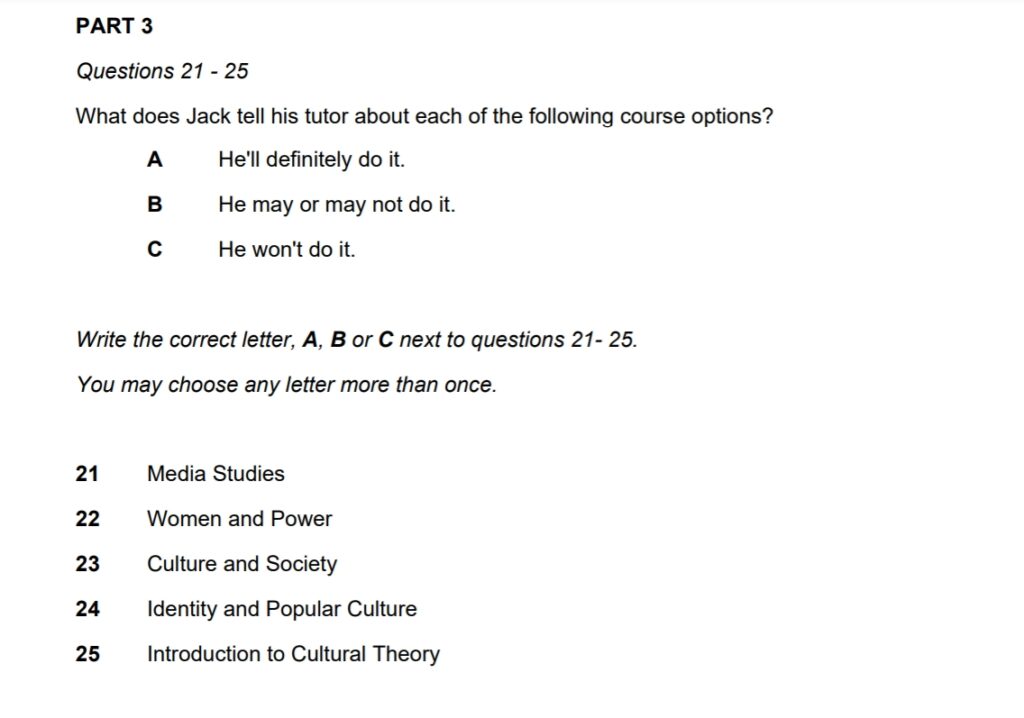
In the task above, you have only three options for answer. It is obvious that Jack will be talking to the tutor about all courses, but you will have to choose only the option (A, B, or C) which is his final decision for each of the courses (21-25). This means that you can repeat the answer if, for example, he decides not to do two of them, etc. So you know you have to listen for words and phrases that either mean he agrees, refuses or hasn’t decided yet (hesitates). Or the speaker can first decide to do the course and then change his mind. So, listen for the final decision.
Reading questions before listening is, of course, beneficial. However, reading too much is also not very good for you. In the IELTS exam, there can be two sets of questions that refer to the same lecture or conversation. These questions are usually of different types. However, each set of questions is based on a separate part of the conversation or lecture. This means that there are two separate audios as well. That is why it is not a good idea to read all sets of questions before listening because you might get lost and will not remember what to focus on. This automatically will lead you to making mistakes and losing scores.
Read only the list of questions based on the part of a lecture or conversation you are going to hear. How do you know? The instructions are played before every part, and the numbers of questions you have to answer are specified.
Of course, questions in the next parts of the IELTS Listening section become longer, and candidates do not have much time to read and analyse every word. We recommend skimming the questions for keywords and phrases that will help select the most important things and concentrate while listening. To learn the strategies for each question type and to practise with instant feedback from IELTS experts join our online IELTS Academic preparation course.
Subscribe to our IELTS digest
READ IN OUR BLOG:
Many words we use in English would be inappropriate in IELTS Writing. We have selected common words students and candidates keep using in their writing you should avoid. These words are too informal for IELTS unless you write a letter to a friend in IELTS General. However, Writing Task 2 and writing tasks in IELTS Academic require more formal language.
The problem is that you don’t always know which words in English are informal, and which are formal. That is why we are going to show you some of the most common ones you should avoid in IELTS writing. This will help you achieve a high score.
Read and learn the words below. We have provided some informal examples and suggested how you can substitute them with more formal words or phrases.
In the nutshell, while equality of opportunity is an attractive concept, attempting to put this idea into practice can do more harm than good.
To conclude, while equality of opportunity is an attractive concept, attempting to put this idea into practice can do more harm than good.
A couple of members have not replied for over three years.
Several members have not replied for over three years.
The resort has kind of changed over the last few years.
The resort has changed somewhat over the last few years.
A lot of people think that boys are naturally more aggressive than girls.
Many people maintain that boys are naturally more aggressive than girls.
Take IELTS with confidence
Start your IELTS Grade online course
If you give appropriate guidance to children, they won’t be adversely affected.
Provided children are given appropriate guidance, they are unlikely to be adversely affected.
If one is given appropriate guidance, they are unlikely to be adversely affected.
People spend hours and hours on the phone.
People spend much of their time on the telephone.
a colour/black-and-white photograph
The report contains diagrams and colour photographs.
The book includes numerous colour photographs, but many are not sharp or their colours are washed out.
You can find the info about upcoming local events in the newspaper
Information about upcoming local events is printed in the newspaper.
a university campus/degree/professor
The majority of the employees have university degrees.
We should consider the cultural context, the physical environment, the personalities of those involved, etc.
The cultural context, the physical environment, and the personalities of those involved should be considered.
At the end of the day, parents should help their children to develop self-control and respect for others.
To conclude, parents should help their children to develop self-control and respect for others.
I talk to my neighbours once in a blue moon.
Nowadays people rarely communicate with their neighbours.
The country has been exposed to many cultural influences since the dawn of time.
For centuries, the country has been exposed to many cultural influences.
The country has been exposed to many cultural influences throughout its history.
Most patients don’t think that getting enough sleep is a big deal but study after study shows how important it is for good health.
The majority of patients do not consider getting enough sleep to be important but the research reveals how important it is for good health.
READ ABOUT: How to recognise signals and signposts in IELTS Listening

In the second experiment, they got a very clear result.
In the second experiment, they obtained a very clear result.
The author gives no documentary references to support her assertions.
The author provides no documentary references to support her assertions.
These antiques are so beautiful and so valuable.
These antiques are both beautiful and extremely valuable.
The graph shows the breakdown of actual expenses by two categories.
The graph illustrates the breakdown of actual expenses by two categories.
The warm winter has had a very bad impact on the ski industry.
The warm winter has had a very negative effect/impact on the ski industry.
a sizeable amount/area/house
a large amount of work
a large house
Its purpose is to find out the truth of what happened and identify any lessons that may help to prevent a repetition.
Its purpose is to discover the truth of what happened and identify any lessons that may help to prevent a repetition.
Many people think about the film as a controversial one.
Many people consider the film controversial.
Forensic scientists are looking at the wreckage for clues about the cause of the explosion.
Forensic scientists are examining the wreckage for clues about the cause of the explosion.
Various studies point out that some forms of alternative medicine are extremely effective.
Various studies indicate that some forms of alternative medicine are extremely effective.
It’s a general rule that applies to all those dudes and benefits them.
This is a general rule that applies to everyone and benefits everyone.
environmental/ethical/personal issues
Lighting is a very important thing in filmmaking.
Lighting is a vitally important aspect of filmmaking.
So, awareness measures and training were crucial.
Awareness measures and training were therefore crucial.
And, there are excellent photos in each chapter.
Additionally, there are excellent photographs in each chapter.
But that is not a reason to avoid taking action.
However, that is not a reason to avoid taking action.
Also, traditional foods are an important aspect of culture and social life.
Moreover, traditional foods are an important aspect of culture and social life.
Remember, you may not lose scores if you use these words and expressions. However, it can be the reason why you are stuck between 6 and 6.5. In order to prevent you from this, we have created a unique fully online IELTS preparation course.
Subscribe to our IELTS digest