
Here are suggested study plans for you
to make the most of the course
f you are at the beginning of your IELTS journey, you probably do not know what to start with and what steps to take first. Should it be an IELTS practice test or reading about IELTS assessment criteria? Or maybe writing an IELTS essay? Or maybe you should relax and prepare yourself in a week? We bet the hardest part for you is to decide how to start. Don’t panic. Our short guide is here to help you start preparing for IELTS.
Before you actually start IELTS preparation you need to understand what type of test is necessary for you to take: IELTS Academic or IELTS General Training. In short, if you are going to study abroad, you need to take the IELTS Academic. If you want to join your family in one of the English-speaking countries, you need IELTS General Training. However, if you plan to work abroad, it is always better to check what type of exam is required.
The other important thing to understand is what score you need. For example, if you are an academic student and you want to go to university, the required score depends on the level of education you are going to obtain: Bachelor’s, Master’s or PhD. However, it also depends on the actual university you are going to: the requirements are vastly varied from university to university. Most students need to get between band 5.5 and 7. So, it is a good idea to contact the educational institution or your future workplace and find out what score and what type of exam is required.
The bands that we have mentioned are describing upper-intermediate and advanced levels of English or B2 and C1 according to CEFR. If you know your current level of English, it can be a very good predictor of the score that you can expect to achieve.
As IELTS tests not only your language skills but also some academic skills such as writing essays or summarizing academic texts, it is important to understand where you start, and your IELTS preparation will greatly depend on this too, especially if your level of English is lower than expected.
This tip is useful if you prepare for any kind of exam, not only IELTS. In order to achieve excellent marks, the test-takers must be aware of the test format. This means you have to understand what the exam tasks look like if you do not want to find yourself surprised and unprepared on the day of the exam. It is good practice to learn about each section of the exam (Speaking, Reading, Listening, and Writing), question types and the amount of time you have to do the tasks.
Taking practice tests is another way to familiarize yourself with the test format. You can do one of such tests at the beginning to see what the tasks look like and to see what task types you find difficult. However, you should remember that doing the practice tests is not the equivalent of IELTS preparation. Many candidates tend to think that the more practice tests they do, the higher their score. Unfortunately, this is not the case. Practice tests are good only for practice. That’s why they are called ‘practice tests’.
IELTS preparation includes learning strategies for each type of task, learning how to answer different types of questions, learning vocabulary and grammar for IELTS tasks, learning from mistakes and tracking your progress, practising, getting feedback and more.
When doing practice tests at the end of your preparation remember to do them under exam conditions. For example, if you do the reading tasks, spend no more than 60 minutes reading the texts and answering the questions. If you do the listening tasks, listen to the recording only once, i.e. in a way you are going to do that on the day of the exam. If you practise writing, remember about the timing as well.
Take IELTS with confidence
Start your IELTS Grade online course
Once you have done the practice test, take some time to check your scores. It is quite easy to do in the Reading and Listening sections because only correct answers count in them. Use IELTS Band Score Calculator to save your time and see what your band is for each section in each type of exam.
It is more difficult to assess the tasks in the Writing section on your own, but you can read how IELTS Academic writing tasks are assessed to understand the criteria. There you will also find a sample essay analysed by our IELTS experts with some comments on the candidate’s performance.
Preparing for the Speaking section on your own is not a piece of cake either. That is again because you will not be able to check your performance on your own. However, there is nothing difficult about this part of the exam if you know and understand IELTS band descriptors for your desired level. IELTS has made them public. This means that you can see what exactly you are required to do, say and write to get the desired scores:
IELTS Speaking Band Descriptors
IELTS Writing Task 1 Band Descriptors
IELTS Writing Task 2 Band Descriptors
Needless to say that if you want to get a high score, you will need to demonstrate how wide your range of vocabulary and grammar is. If you read the assessment criteria carefully, you will see that vocabulary covers 25% of the marks for Speaking and Writing tests, so the better your vocabulary the higher the score. While the exam consists of four sections, there is one common thing in all of them – vocabulary. We have already written about the best ways of getting vocabulary for IELTS.
Although there is no section in the IELTS Academic or General that tests your grammar, it is still very important. It obviously helps you in the Speaking and Writing sections where you have to build sentences and express your thoughts using different structures. It can also help you understand the reading or listening passages, for example, when you get confused by different sentence structures or parts of speech.
One of the biggest mistakes the students make is mastering the exam skills and forgetting about improving their English skills. But IELTS is first of all a proficiency test, so your English really matters.
Another mistake is taking an exam without knowing its strategies. IELTS tasks and questions require specific strategies to be used. For example, in the Listening section candidates hear the recording only once. They also have to answer various questions and do such tasks as note completion, multiple-choice, summary completion, matching, etc. Getting lost is not a problem in such situations. But it becomes a disaster if the students do not know how to approach the tasks in this section, how to get back and continue answering them even if they got lost.
The Reading section also requires students to use specific strategies and have a wide range of reading skills such as reading for gist, scanning, skimming, reading for detail, etc. Get accustomed to each type of reading question during your exam preparation so as not to be caught by surprise on the day of the exam.
It is best to start your preparation as early as you know you need an IELTS certificate. As you can see, even at the beginning of your preparation, there are still many things to be done. It is good to have a study plan to organise and guide your IELTS Academic preparation process. In our online course, you receive a personal study plan depending on how much time you have: a week, a month or two months. In this study plan, you will find lots of ways you can benefit from the course and improve your chances of scoring higher in the IELTS test. It also helps you find out what areas need improvement the most. Finally, it shows you how to develop all of your skills gradually and guides you through the parts of the course.
Despite their level of English, sooner or later most students need some guidance at the different stages of their IELTS preparation. We have combined the three most important things in our course: focus on practice, best self-study solutions, and ongoing support.
Subscribe to our IELTS digest
READ IN OUR BLOG:
You’ve been preparing for the IELTS Academic exam for months, you’ve spent so many sleepless nights, you’ve done so many practice tests, you’ve written so many essays, you’ve even done the mock test, and then there is the day of the exam. You get to the venue on time, walk into the hall, check-in, and you feel nervous. Moreover, some candidates start thinking they don’t know anything and are worse than others. What happens next? You lose your confidence, start making mistakes, or even worse – you lose your tongue.
If you don’t want this nightmare to come true, follow our advice on exam day, and you will not only overcome your fear but score higher in IELTS Speaking.
If you did not catch the question because the examiner was speaking too fast or you were too nervous, ask the examiner to repeat it for you.
Make sure you understand the keywords on the prompt and know what or who you have to talk about.
Think about 2-3 ideas for each prompt and make sure you write them down. Don’t write in full sentences. Use keywords, shortenings, phrases, abbreviations, symbols, etc.
It’s a good idea to visualize what or who you are going to talk about in Part 2: your friend, your family member, a famous person, etc. Try to remember that event or the object you are talking about.
Apart from the ideas, you also have to think about what grammar to use. Some grammar structures are appropriate for describing the present, some for the past, some for the future, etc.
Take IELTS with confidence
Start your IELTS Grade online course
The normal length for Part 1, for example, should be 3-4 sentences. This means that you just have to answer the question. You can use the following order:
For example, the examiner asks you ‘Do you have many friends?’
| Opening | To be honest, family comes first. |
| Answer | However, I have more than 10 friends and I am not sure if I should say this is many! |
| Reason or example | I had more than 30 friends in my school days. As time went by, the number reduced. |
| Closing | If I count my Facebook friends as real friends, the number is quite big! |
The key to this is organization. You should deliver some ideas and develop them. It is much easier to stay on topic in Part 2, because there you have a cue card with prompts, and they provide a structure for your response.
This means you have to avoid saying ‘yes’ or ‘no’. The assessment starts straight away from Speaking Part 1, so your full answers count.
For example, if the question is “Do you watch cookery programs on TV?”, saying ‘no’ is not enough, because you won’t demonstrate the range of vocabulary you have and whether you can use various grammar structures or not. Answering with one word is likely to reduce your score.
It is a good idea to answer those questions by explaining why or why not. Make it your habit during your IELTS preparation, and you will easily tackle yes/no questions. And remember to structure your response.
READ ABOUT: What will the examiner be listening for at the IELTS Speaking test?

“Parroting” is repeating the exact words from the question. You have to demonstrate you are fluent, but parroting does not sound natural. For example:
Examiner: What’s your favourite book?
Candidate: Well, my favourite book is…
Instead of this, you could use “My number one is …”, “I believe it’s…”, etc. this means you have to paraphrase the question.
If you don’t want to miss anything, follow the order of the prompts you have on the cue card.
They will help the examiner follow your thoughts without effort while you are speaking. It is called coherence. In order to make your answer more coherent, you should use different discourse markers and linking words. They are usually simple and less formal and help you sound more natural. Here is a list of over 80 linking words for IELTS Speaking with examples.
Sometimes, you might get an unexpected question. Don’t worry and use your language to buy you thinking time. Answering unexpected questions in the IELTS Speaking test is easy if you know how to do it. Most topics at the exam are general in nature; they are everyday familiar topics that everyone has some experience with and should be able to give an opinion on.
It is always a good idea to answer more than you were asked, i.e. to extend your answer. You can do this by:
If you have answered and you realise the time is left, give more details. This strategy will help you.
For example, if the question is “Do you like listening to music?”, you could say:
“Oh yes, I enjoy it because it makes me feel like…/ it makes me forget about everyday problems”
“Yes, I really love rock music. I always listen to Radio Rocks when I am driving my car or working, for example.”
“No, but when I was in my teens I used to listen to music a lot. I even played in a school band. I was a bass guitarist. Now I don’t have much time for that.”
“Well, I do, but I don’t have much time for that. If I had more time, I would listen to music more, and, probably, would go to gigs or concerts. I love the atmosphere.”
In Part 3, make sure your answers are related to other people, not you or your personal experience. Here it is a good idea to look at different aspects, thus exploring the topic. You can do this by:
For example, let’s answer the following question “What is the effect of everyone having their own cars?”. You could say:
“Well, it has both positive and negative effects. In the case of positive effects, they are as follows…. In the case of negative effects,….”
“ In the short term, …. However, in the long term,…”
“It depends. In the case of …., but in the case of…”
Subscribe to our IELTS digest
READ MORE IN OUR BLOG:
Matching sentence endings is a less common type of question that you can come across in the Reading section of IELTS Academic. Such tasks as matching features, matching headings, true or false questions, multiple-choice come up more often, but that does not mean you needn’t know how to complete this task. It also requires applying a certain strategy and knowing some tips. So, we are going to provide you with some useful tips and tricks to help you get a higher score.
This type of task requires the candidates to complete the sentences, but they often despise this type of question because they see that there are a lot of options and these options are quite long.
So, what does the task look like? Usually, you will see two lists in the task: a list of sentences that you have to complete and a list of possible sentence endings to choose from. For example:

You have to match the items from the lists together based on reading the passage. If you look at the task above, you will notice that there are more options than sentences. This means that you will have to read the text, find the corresponding information, and choose the correct answer.
It’s a common misconception that this type of reading task can be answered without actually reading the passage. This type of task does not check whether you know how to combine sentences. What it tests is if you are able to understand how the ideas in the sentences are connected to the ideas in the reading passage.
To complete this task successfully you will need to scan the passage, notice various grammatical structures, spot paraphrased sentences and recognize synonyms, and be able to make predictions based on the particular context.
Once again, if you try doing the task without reading the passage, you are likely to fail it. Follow the suggested steps to know how to approach this task.
READ ABOUT: How to do matching tasks in IELTS Listening

The way we suggest answering the matching sentence endings questions is the most effective. Try and check if it works for you.
Step 1. Read the passage quickly.
Scanning the text is important because it gives you a general idea, and you can also see how it is organised.
Step 2. Underline the keywords in the sentences.
After reading the passage, go to the list of incomplete sentences, and highlight the most important words in them. By doing so you will concentrate on the meaning of the sentence and will be able to find the right words when you will be scanning the text later on. Remember, you won’t be looking for the exact words in the text, instead, you will have to find synonyms and paraphrasing.
Step 3. Make predictions and check them by reading the passage.
As you read the sentences try to think about what can be the endings. Next, read the endings and make any possible matches. Focus on meaning and grammatical connection between sentence halves. For example, this can be tense forms, number of verbs, gerunds, or infinitives that go after particular verbs, collocations, etc.
After that, read the text to find the information about each question in the passage. Check your predictions. Choose the best answer.
Step 4. Read the complete sentence.
As you match the beginning of each sentence to the correct ending, read the sentence again. Does it have correct grammar? Does it make sense? If so, you have completed the task.
Take IELTS with confidence
Start your IELTS Grade online course
READ ABOUT: How to deal with unexpected questions in the IELTS Speaking test
Go to our course where we provide a detailed explanation of this strategy and more examples based on real exam tasks. You will also practise doing this and other types of IELTS Reading tasks, get instant feedback from our IELTS experts and improve not only reading but other skills for the IELTS exam. Our course is designed for those who want to learn IELTS essentials, practise anytime from anywhere, as much as possible, receive valuable feedback, and build confidence. Besides the ongoing support, you will take full mock Speaking and Writing tests with detailed feedback to feel the taste of a real exam.
Subscribe to our IELTS digest
READ IN OUR BLOG:
There are different types of essays in IELTS Academic Writing Task 2. They can be divided into advantages and disadvantages essays, opinion essays, two-views-and-opinion essays, mixed and cause-and-effect essays. Many students and candidates fail to get the desired score because they are not aware of how to approach the task. We are going to look at what makes a good essay, and you will learn how to unpack the cause-and-effect essay task in order to write an appropriate response.
Not understanding what to do in the task and not knowing what two write as well as not identifying the type of an essay correctly might lead to losing the scores. This means it is crucial to identify the type of essay in IELTS Writing task 2. The tasks for cause-and-effect essays can have different wordings. For example:
In cause-and-effect essays, you will be given a problem and asked to write about the main causes of this problem as well as discuss what effects it might have.

The task above looks at the problem of people who use the Internet to look for ways to cure different medical conditions instead of seeing the doctor. In your essay, you will have two write about 2 or 3 reasons why they do so as well as think about 2 or 3 effects such behaviour might lead to. Moreover, you will have to provide examples.
If you do all three items, you are likely to get a higher score for the Task Achievement criterion.
READ ABOUT: IELTS two-views-and-opinion essay tips
The cause-and-effect essay requires you to think critically about the problem and outline your ideas orderly. You are likely to complete the task successfully if you follow the steps we suggest.
Step 1. Analysing the task.
As it has already been said, your success depends on understanding the task. That is why you have to read the statement carefully and underline key information in it. Next, read the questions and identify what they ask you to write about. Paraphrasing the statement for yourself using simple language will help you understand it better.
Take IELTS with confidence
Start your IELTS Grade online course
Step 2. Planning your essay.
While planning your essay you should decide on the number of paragraphs. Your essay will consist of the introduction, main body, and conclusion.
Next, spend a few minutes on brainstorming ideas for your essay. Think about the details or examples to support your ideas and answer the questions in the task, and take notes.
For example, your notes might look like this:
| Introduction |
|
| Paragraph 1 | WHY people do this Idea 1it takes less time than to visit a doctor,e.g. you can avoid blood tests, check up, etc. and do everything by clicking a mouseIdea 2you can find reviews on the Internet, e.g. people write about symptoms, medicines they had and where to buy them |
| Paragraph 1 | CONSEQUENCES
Idea 1 reviews can be unreliable (non-professional) => waste your time and money Idea 2 without doctor’s prescription => it can get worse => new condition+complications |
| Conclusion |
|
Step 3. Writing an essay.
At this stage, we recommend that you keep looking at the task and the plan of your essay. This will help you stay on topic and write only relevant ideas.
Usually, we start writing an essay with an introduction. However, if you are struggling with writing it, leave some space, and write the body of your essay. You will return to the introduction later. Here you will have to paraphrase the task and write what the essay will discuss.
It is recommended that the main body of your cause-and-effect essay consists of 2 paragraphs:
In the case with our essay, your first paragraph will answer the question ‘Why are people looking for ways to cure their medical conditions on the Internet?’. The second paragraph will answer the question ‘What are the consequences of looking for ways to cure their medical conditions on the Internet?’.
Finally, write the conclusion where you need to summarize the answers to questions 1 and 2.
Step 4. Checking your essay.
This is the essential step in doing any writing assignment. It is also the best way to increase your score within a few minutes. After you finished writing your essay, check it for:
Read our guide on how to check your IELTS Writing.
READ ABOUT: What will the examiner be listening for at the IELTS Speaking test?
The way you organize your essay will help the examiner follow your thoughts and will also give you a better score for coherence and cohesion. Remember to structure your writing in paragraphs. Here is the outline of the cause-and-effect essay structure:
INTRODUCTION:
|
| MAIN BODY
Paragraph 1:
Paragraph 2:
|
CONCLUSION:
|
Go to our course to find the sample answer to this and many other tasks. You will also learn and practise strategies for all four skills tested in IELTS: reading, listening, writing, and speaking. Our platform provides instant feedback from experienced IELTS experts. At the end of the course, you will have the opportunity to take a mock test and receive feedback on what should be improved and what you are good at.
Subscribe to our IELTS digest
READ IN OUR BLOG:
Among several different question types such as notes or summary completion, multiple-choice, etc. in the IELTS Listening section, matching tasks are the most common. That is why you should always be prepared to get one in your test, i.e. you have to learn and practice the strategy of answering this type of question. Many students and candidates struggle to answer such questions because they do not understand what to do in the task and how to approach it. Read further, and you will find out how to do matching tasks in a few easy steps.
Most often you may come across this type of question in parts 1 or 3 of the Listening section, which means that you will be listening to the conversation between two or more people.
Let us have a look at the following example:

Here you can see a numbered list of items from the listening text and a set of options (A, B, C). While listening, you have to match these pieces of information together. There will always be a list with numbers — these are questions, and a list with letters — these are options to choose from. The list of options can sometimes be shorter as in the example above. What does this mean? Yes, you can use one option for more than one question.
This task type checks if you can understand the details and notice the relationships and connections between different facts in the listening passage. It also checks if you can follow a conversation with a few speakers.
READ ABOUT: How to identify the type of essay in IELTS Writing Task 2?
Take IELTS with confidence
Start your IELTS Grade online course
Here are a few tips that will help you to answer the matching questions easily.
Remember that the list with numbers follows the order of the listening passage. This means you will hear the information about each question one by one. This will help you not to get lost in the recording. If you cannot work out an answer, be ready for the next question.
What you read in questions and what you hear will come in different words. This means that everything is paraphrased, and you will have to look for synonyms. Listen for the same meaning, not only the same words.
Remember about distractors. They are here to confuse you and to check if you really understand the details of the conversation. The speakers might mention several options. However, only one of them is the answer to the question.

READ ABOUT: Can computers really grade your IELTS Writing and Speaking?
Now when you are aware of what is required to be done to complete the task, we will look at some strategies for successfully answering any matching question. Follow these easy steps in order to complete the task.
Step 1. Read the instructions carefully.
This step will help you understand what exactly you need to do and how many options you can use. So, what you have to do is to check if there are any extra options. Besides, you may be allowed to choose any letter more than once. This is usually mentioned in the instructions.
Step 2. Look at the lists of questions and options to make predictions.
If you read the two lists carefully, you will likely guess what the recording is about and what you might hear in it.
In the case of our sample task, the names of the courses will probably be the same in the recording and in the task. What will be different are the options. They will definitely be paraphrased. This means you have to predict what words Jack might tell his tutor about these courses. What are the other ways to say ‘I’ll definitely do it’, for example? Jack might say, ‘I’m sure this course is perfect for me’, ‘I’ll go for this course’, ‘That’s a definite for me’, etc.
Try to paraphrase each option before you listen. By doing so you will prepare yourself for the listening.
Step 3. Listen and match information.
As you will hear the recording once, it is important to remember that the answers are usually paraphrased and come in order. Choose one answer to each question. For example:
| You will see: | You will hear: |
| What does Jack tell his tutor about each of the following course options?
A He’ll definitely do it. B He may or may not do it. C He won’t do it. Write the correct letter, A, B or C next to questions 1 — 5. You may choose any letter more than once. 1 Media Studies – C 2 Women and Power 3 Culture and Society 4 Identity and Popular Culture 5 Introduction to Cultural Theory |
Dr Ray: So for example the Media Studies Option will cover quite a lot of the same area you did in the core module on mass communications this semester — the development of the media through the last two centuries, in relation to political and social issues.
Jack: Mmm. Well that was interesting, but I’ve decided I’d rather do something completely new. There’s a Women’s Studies option, isn’t there? |
Step 4. Check that you have answered all the questions.
If you have not answered all the questions, the guesswork will help. You should not leave any blank answers if you want to get a better score for the listening section.
Go to our course to learn and practise strategies for all the parts of the IELTS Academic exam. Not only you will learn and practise, but save all the tips and tools in your personal Knowledge Bank, get 24/7 support and instant feedback from our IELTS experts. Depending on how much time you have, we provide you with a study-plan to help you make the most of your IELTS preparation. The more you practise, the more confidence you have on the day of the exam.
Subscribe to our IELTS digest
READ IN OUR BLOG:
If you want to do well in the Reading section of the IELTS Academic test, make sure you practice doing different tasks: matching features, matching headings, true or false questions, multiple-choice, etc. Among more than ten question types you can be given in the IELTS Reading section note completion is one of the most frequently seen ones. Therefore, it is advisable to understand how to deal with such a type of question if you get in your test. In our today’s blog, we are going to guide you through the process of answering note completion questions step by step.
In this type of task, you will have to complete a summary of some information in the text you will read. This summary may look like this:
Take IELTS with confidence
Start your IELTS Grade online course
You will have to fill in the gaps with the words and/or numbers from a part of the text. The task tests your ability to understand the details or main ideas of the reading passage. It is also required that you to know what type of words will fit into a given gap (for example, whether it is a noun or a verb, adjective or adverb, etc).
The passages for such types of questions are usually descriptive. The answers might occur in the same order as in the passage, but not necessarily. However, they will usually come from one part of the passage rather than being spread across the entire text.
READ ABOUT: How are IELTS Listening and Reading scores calculated?
Step 1. Quickly read the title and the text.
You shouldn’t spend much time on this. Reading the text quickly will allow you to gain an idea of what it is about. Don’t worry about the words you don’t understand.
Step 2. Check the instructions.
The instructions not only give us a clue that you need to fill in the blanks, but they also provide us with very important information regarding the number of words you have to write in your answer. In addition, make sure you know what you can and cannot write for each gap.
For example, you can see the instructions worded like these:
If the instruction says, ‘WRITE NO MORE THAN TWO WORDS’ and you write three, the answer will be incorrect, and you will not get any points.

Step 3. Read the sentences. Underline keywords in them.
Keywords will allow you to understand the focus of the questions. They can include names, places, figures, nouns, verbs, adjectives, etc.
Step 4. Use the keywords to find the part of the text you need.
You will have to scan the text to find the right information for each sentence from the task starting from the first one.
Step 5. Predict what kind of word(s) you need for the gap.
By looking at the words before and after the gap, you can work out what part of speech is missing, whether it is a noun or a verb, an adjective or an adverb, etc. Try to predict the answer. After that, read the part of the passage attentively paying attention to the keywords.
Step 6. Find the word(s) for the gap.
As you read the paragraph, you will notice the keywords and some of them will be paraphrased. As you find the word in the text, copy it into the gap exactly as it is in the text. Check you spell it correctly because answers with the wrong spelling are counted as wrong ones.
Step 7. Read the sentence again.
Finally, you have to read the sentence again and check if it is grammatically correct. Make sure it makes sense. If so, move on to the next sentence and do steps 3 to 7.
READ ABOUT: How to prepare for IELTS Speaking and get the highest score
In summary completion, you will have to fill in the gaps in a summary that is a short text giving the main information about a longer text without giving all the detail. In order to complete the task, you should understand the main points of the text. The information in the summary may be about one paragraph or about a longer part of the text, but not about the whole passage.
The steps and tips for summary completion are pretty the same as the ones you have to do for sentence completion questions above.
However, sometimes, in summary completion, you have to use the words not from the passage, but from a list of suggested options.

In this case, you need to follow all the same steps as with the sentences or a simple summary completion. However, once you found the answer in the passage, compare it with the suggested options and choose a synonym.
There is another timesaving trick. You can predict the answers before reading the passage more easily. If you see that you are running out of time, this may be very handy.
Anyway, it is highly recommended that you read the passage and make sure you have answered correctly.
There are other types of completion: table, flow-chart, and diagram. Nevertheless, the same strategies that we’ve just learnt can easily be applied to them. Of course, some peculiarities depend on the type of visual you get. Go to our online complete IELTS Academic self-study course, if you want to do a detailed analysis of all types of IELTS Academic Listening, Reading, Writing and Speaking tasks, do sample IELTS tasks, practice tasks with an automated checking system, get access to the exclusive Facebook community where we share more life-saving tips and tricks for IELTS Academic.
Subscribe to our IELTS digest
READ IN OUR BLOG:
Many students and test-takers get cold feet when they see this task in the IELTS Reading section on the day of the exam. Matching headings seems to be one of the trickiest types of questions in the IELTS Academic exam besides those where you have to answer multiple choice and true or false questions. Today, we are going to share an action plan with you so that you could solve this type of task more easily.
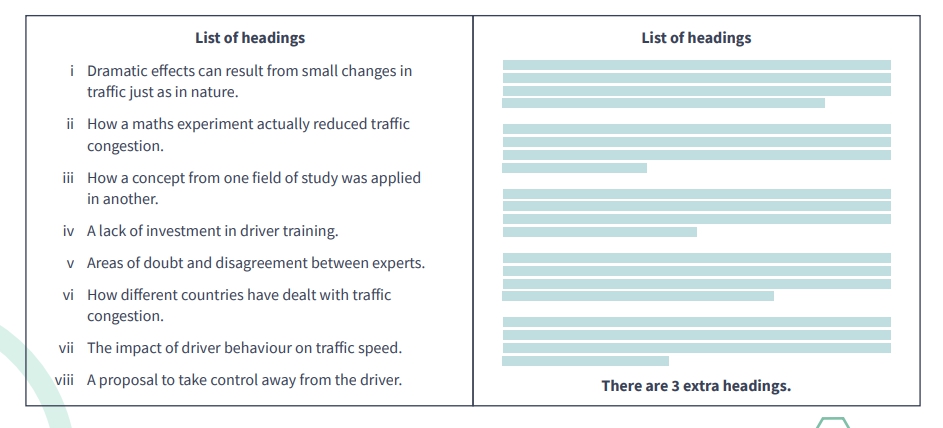
In the task, you will see a list of headings with Roman numbers, and a number of questions at the bottom. You need to find a suitable heading for each section. Sometimes, a section is a paragraph, or it may include several paragraphs. And, you there are always more headings than sections, for example, seven sections and eight headings or eight sections and nine headings. This also means that some headings will not be used. Remember, you can use each heading only once.

This type of question tests if you are able to understand the main idea of each paragraph. This suggests that in this question type you have to match each paragraph in the reading text to one heading, based on the general information in the text.
Take IELTS with confidence
Start your IELTS Grade online course
Matching headings type of questions may cause difficulties for many test-takers for a number of reasons:
Read further, and we will go through the action plan that will help you match headings more successfully step by step.
READ ABOUT: How to check your IELTS writing
In order to answer matching headings questions, you have to be good at skimming. This means you have to able to read a text quickly to get a general idea of its meaning. The answer strategy we offer explains how you can utilize skimming skills to tackle this question type.
Step 1. Quickly read the title and the text.
If matching headings goes as the first task, you will need to read the title and the passage quickly to get the general gist of what the text is about. You should not worry about the words you do not understand.
Step 2. Check how many headings and paragraphs you have in the task.
Remember, there are always more headings than paragraphs, so find out how many of them you will not need to use. For example, in the task below there are 8 headings and only 5 paragraphs, i.e. there are 3 extra headings:
Step 3. Cross out the example paragraph and heading.
There is sometimes an example given for you. Do not waste your time on it, cross it out from the headings and the passage.
Step 4. Read the headings and underline the keywords.
You need to completely understand the meaning of each heading. This can be made easier by paraphrasing, i.e. if difficult, ‘translate’ the heading into simple English.
Underline the keywords in each heading. They are names, places, dates, and nouns, once you have read them thoroughly. This step will help you connect the correct heading to the appropriate paragraph.
READ ABOUT: Tips for note completion questions in IELTS Listening

Step 5. Read the first paragraph quickly. Underline the main ideas. Choose the best heading.
Your aim is to identify the main idea of the paragraph. As a rule, the first one or two sentences and the last sentence introduce and summarise this main idea. Remember, you do not need to know the detail for this type of question. However, the headings are usually worded in such a way that you need to know that thing right in the middle of the paragraph to find the answer.
Next, briefly sum up the main idea of the paragraph in your own words as if you were writing your own heading. Do it in just a few words or a short phrase at the most. You can write this beside it.
The key words are the clues but also synonyms are very likely to be used. When choosing a heading do not just select the first one that seems to match as there may be two that are very similar in meaning. Pay attention to the meaning.
The same words in headings and paragraphs may distract you. However, the similar idea in the paragraph may only be a detail, not the main idea. When matching a heading, ask yourself if it is the main idea of the paragraph.
Step 6. Do the same for all other paragraphs.
The next step is to do the same for all paragraphs that are left. Keep in mind that you can use the same heading only once. If it is difficult to decide on a heading, write several possible ones and a question mark, and move on to the next paragraphs. When you finish with the rest, there will be only a few headings left, so it will be easier for you to choose. Once you have finished the first round, you have read the whole passage, come back to the questions you could not answer. If you were hesitating between two options, it is likely that you have already used one of them for another section or paragraph, i.e. the answer becomes obvious.
When you are reading a paragraph, focus on the main ideas, not minor details or the same words.
In our IELTS Grade online course, we explore examples and provide you with strategies to deal with each type of questions of the IELTS Reading section as well as practice tasks and valuable feedback. It is a complete IELTS Academic self-study course with an extensive Writing practice and detailed analysis, automated instant feedback on writing using artificial intelligence, video comments and a full mock test imitating the conditions of a real exam. You can try the free version to feel the benefits of the course.
Subscribe to our IELTS digest
READ IN OUR BLOG:
– 8 strategies to achieve a perfect score in IELTS Listening
– What to expect at the IELTS Speaking test
– 25 phrasal verbs to avoid in IELTS Academic Writing
Most of the students and candidates consider this type of questions in IELTS Reading to be the trickiest. Have you already guessed which one it is? They are ‘True-False-Not Given’ or ‘Yes-No-Not Given’ questions. You must admit that it would be good if there were only true and false statements. However, what shall we do with the third option? Such questions often cause problems because of the difficulty in understanding the difference between answers that are ‘false’ or ‘not given’. Today, we are going to share some tricks and show some patterns that will help you find answers to those questions without much effort.
Almost all tests contain such questions, and chances are high that you will have them in your reading exam as well. Usually, True-False-Not Given questions come in the first passage, which is believed to be the easiest one, or sometimes in the second. Yes-No-Not Given questions appear in the second or the third passage most of the time. There are 3 to 5 questions of this type in a set, and you have to use all the answers.
What do we have to do for this type of questions? In the exam, you will get the paper where there will be the article you need to read and the questions. Here is the official sample task from the IELTS Academic exam.

READ ABOUT: How to deal with multiple choice questions in IELTS Reading
As you can see, each question is a statement. You need to look at that statement, read through the passage, and decide if this information is in the passage:
One more thing to remember is that ‘True-False-Not Given’ questions are about factual information while the ‘Yes-No-Not Given’ questions are all about the writer’s opinion.
Those are the basic requirements of this type of questions. Read further, and we will look at the difference between ‘True’, ‘False’ and ‘Not Given’ as well as at some examples.
Take IELTS with confidence
Start your IELTS Grade online course
The action plan for tackling ‘Yes-No-Not Given’ and ‘True-False-Not Given’ questions is exactly the same.
This is a step for all types of questions in IELTS Reading if they go first in the passage. It helps you find answers to questions in it more easily later on when you will need to read in detail the part of the text where you think the answer is.
For example: Marie became interested in science when she was a child.
For this, you will need to scan the text and find similar words and synonyms in it. The same words help locate facts in the passage. Synonyms help us choose the answer.
The only paragraph where we can read about her childhood, goes like this:

Now, let us read more carefully and watch out for the synonyms or the opposite meanings to choose the answer.
‘From childhood’ has the same meaning as ‘when she was a child’. Then we read about ‘medical studies’ which is also related to ‘interested in science’. However, does this information coincide with what we read in the statement? No, it doesn’t. Does the passage say anything that contradicts with our statement? Not really. What we can learn about Marie as a child is that she ‘was remarkable for her prodigious memory’, and it was her sister whose medical studies Marie financed. Can we find any information about what she was interested in when she was younger? No, we can’t. What does this mean? The answer is simply NOT GIVEN in the reading passage.
After you have chosen the answer, return to Step 2 with the rest of the statements and follow the same procedure.
In our course, we look at more examples in detail and analyse various answers for this type of questions in the IELTS Reading exam. Our IELTS experts share other useful tips on tackling ‘True-False-Not Given’ questions. Join our course if you want to know all of them and skyrocket your IELTS result.

Recently we have written about checking you IELTS Writing.
Subscribe to our IELTS digest
Students and candidates who prepare for IELTS know that you get scores for each part of the test. What is your perfect score in IELTS Listening? Of course, you aim at 7+, and it is trouble-free if you know the strategies to achieve it.
Test-takers also believe that the challenge of the Listening test is increasing as you progress through it. To some extent, it does. What is the catch then? Candidates make many mistakes in part 1, which seems to be the less complicated. This is because there you need to write down the exact information such as numbers or names, or dates or spell words correctly. So, this increase in the level of difficulty is quite disputable. This means you should be attentive in each part of the test. And here comes our foremost strategy for the IELTS Listening test.
Take IELTS with confidence
Start your IELTS Grade online course
Unlike Reading or Writing sections of the IELTS Academic, you will not have time to think about what you have read, written or heard. You will hear the recording only once, so you won’t have a chance to hear what was said again.
Moreover, while listening, you will have to read the questions and give your answers. Here you have to be on your toes, because you will often hear a paraphrased version of what you read in the questions, i.e. you will read the different words, but the meaning will be the same. If you do not catch it, you will not be able to match it with the questions.
The truth is you will do a monumental work for around 30 minutes by paraphrasing and answering questions. But now, you know the tip.
In our course, we will teach you how to paraphrase, and you will learn how you can benefit from paraphrasing at the exam.
At the beginning of part 1, the speaker on the recording will tell some information. You will also hear, ‘now you have some time to look at Part 1’. You do not need to wait for this command. Instead, start reading the questions immediately.
As soon as you have answered the questions from the previous part, do so in each part of the Listening test. Before anything else, focus on keywords such as nouns, verbs, adjectives that carry the meaning (underline them in the paper-based version).
Also, try to predict the answers. If the task is to fill in the gaps, try to guess what type of word is missing. In a map, look at all the objects that have names, and think what names you could give to other objects.
Once you have read the task, try to remember about it while answering. The most common mistakes happen due to lack of attention. For example, the candidates forget the number of options they have to choose, or how many words they should write in a gap, or even if they have to write numbers or letters. You do not need to spend too much time on reading the instructions, but check up on what to do.
They are wrong answers that are similar to the correct ones, designed to see whether the person being tested can notice the difference. For example, there is one form of distractor that is very common in part 1 of the IELTS Listening test. This is when you hear a speaker correct him/herself, or the other speaker will correct them. In order to avoid mistakes, do not assume the first thing you hear as the answer is the actual answer – listen carefully to what comes after that.
When you are listening for one question, you never know when the information about it will start and when it will finish, and the speaker will move on to the next question. In order not to miss this transition, always keep in mind two questions that go one after another.
READ ABOUT: What to expect at the IELTS Speaking test

Don’t keep thinking about the previous question even if you’re not sure about the answer you’ve given. The speaker is already talking about another one. If you continue thinking about the previous questions, chances are you will not answer the following ones and lose your scores.
Even if you have selected a wrong answer, but listen further, there is more chance for you to score higher, than if you keep thinking about the same question and lose track of the recording.
Sometimes test-takers do not hear all the answers. If this happens to you, apply your logic. There might be hints in speaker’s intonation, for example. Very often speakers use linking devices that help you follow their thoughts. Even you are not sure, answer ALL questions. What if the answer you write turns to be correct? Candidates are not penalized for the wrong ones.
At the end of the test, you will have from 2 to 10 minutes to look through your answers, depending on the version of the IELTS exam you choose. Use this time to scan your answers for grammar mistakes and spelling. If you do not spell the words correctly, or, for example, write a singular noun instead of plural, you will lose points.
These were the basic strategies on IELTS Listening. They are easy to follow. However, in our course we give candidates more specific guidance on each question type. Join us to get more confidence, learn more tips and tricks, do practice tasks and get feedback from experienced IELTS tutors.
Subscribe to our IELTS digest
We also recommend you reading:
Key facts you need to know about the IELTS Listening test
6 typical mistakes in IELTS essays
Helpful idioms for IELTS Speaking