
Here are suggested study plans for you
to make the most of the course
You’ve been preparing for the IELTS Academic exam for months, you’ve spent so many sleepless nights, you’ve done so many practice tests, you’ve written so many essays, you’ve even done the mock test, and then there is the day of the exam. You get to the venue on time, walk into the hall, check-in, and you feel nervous. Moreover, some candidates start thinking they don’t know anything and are worse than others. What happens next? You lose your confidence, start making mistakes, or even worse – you lose your tongue.
If you don’t want this nightmare to come true, follow our advice on exam day, and you will not only overcome your fear but score higher in IELTS Speaking.
If you did not catch the question because the examiner was speaking too fast or you were too nervous, ask the examiner to repeat it for you.
Make sure you understand the keywords on the prompt and know what or who you have to talk about.
Think about 2-3 ideas for each prompt and make sure you write them down. Don’t write in full sentences. Use keywords, shortenings, phrases, abbreviations, symbols, etc.
It’s a good idea to visualize what or who you are going to talk about in Part 2: your friend, your family member, a famous person, etc. Try to remember that event or the object you are talking about.
Apart from the ideas, you also have to think about what grammar to use. Some grammar structures are appropriate for describing the present, some for the past, some for the future, etc.
Take IELTS with confidence
Start your IELTS Grade online course
The normal length for Part 1, for example, should be 3-4 sentences. This means that you just have to answer the question. You can use the following order:
For example, the examiner asks you ‘Do you have many friends?’
| Opening | To be honest, family comes first. |
| Answer | However, I have more than 10 friends and I am not sure if I should say this is many! |
| Reason or example | I had more than 30 friends in my school days. As time went by, the number reduced. |
| Closing | If I count my Facebook friends as real friends, the number is quite big! |
The key to this is organization. You should deliver some ideas and develop them. It is much easier to stay on topic in Part 2, because there you have a cue card with prompts, and they provide a structure for your response.
This means you have to avoid saying ‘yes’ or ‘no’. The assessment starts straight away from Speaking Part 1, so your full answers count.
For example, if the question is “Do you watch cookery programs on TV?”, saying ‘no’ is not enough, because you won’t demonstrate the range of vocabulary you have and whether you can use various grammar structures or not. Answering with one word is likely to reduce your score.
It is a good idea to answer those questions by explaining why or why not. Make it your habit during your IELTS preparation, and you will easily tackle yes/no questions. And remember to structure your response.
READ ABOUT: What will the examiner be listening for at the IELTS Speaking test?
“Parroting” is repeating the exact words from the question. You have to demonstrate you are fluent, but parroting does not sound natural. For example:
Examiner: What’s your favourite book?
Candidate: Well, my favourite book is…
Instead of this, you could use “My number one is …”, “I believe it’s…”, etc. this means you have to paraphrase the question.
If you don’t want to miss anything, follow the order of the prompts you have on the cue card.
They will help the examiner follow your thoughts without effort while you are speaking. It is called coherence. In order to make your answer more coherent, you should use different discourse markers and linking words. They are usually simple and less formal and help you sound more natural. Here is a list of over 80 linking words for IELTS Speaking with examples.
Sometimes, you might get an unexpected question. Don’t worry and use your language to buy you thinking time. Answering unexpected questions in the IELTS Speaking test is easy if you know how to do it. Most topics at the exam are general in nature; they are everyday familiar topics that everyone has some experience with and should be able to give an opinion on.
It is always a good idea to answer more than you were asked, i.e. to extend your answer. You can do this by:
If you have answered and you realise the time is left, give more details. This strategy will help you.
For example, if the question is “Do you like listening to music?”, you could say:
“Oh yes, I enjoy it because it makes me feel like…/ it makes me forget about everyday problems”
“Yes, I really love rock music. I always listen to Radio Rocks when I am driving my car or working, for example.”
“No, but when I was in my teens I used to listen to music a lot. I even played in a school band. I was a bass guitarist. Now I don’t have much time for that.”
“Well, I do, but I don’t have much time for that. If I had more time, I would listen to music more, and, probably, would go to gigs or concerts. I love the atmosphere.”
In Part 3, make sure your answers are related to other people, not you or your personal experience. Here it is a good idea to look at different aspects, thus exploring the topic. You can do this by:
For example, let’s answer the following question “What is the effect of everyone having their own cars?”. You could say:
“Well, it has both positive and negative effects. In the case of positive effects, they are as follows…. In the case of negative effects,….”
“ In the short term, …. However, in the long term,…”
“It depends. In the case of …., but in the case of…”
Subscribe to our IELTS digest
READ MORE IN OUR BLOG:
Matching sentence endings is a less common type of question that you can come across in the Reading section of IELTS Academic. Such tasks as matching features, matching headings, true or false questions, multiple-choice come up more often, but that does not mean you needn’t know how to complete this task. It also requires applying a certain strategy and knowing some tips. So, we are going to provide you with some useful tips and tricks to help you get a higher score.
This type of task requires the candidates to complete the sentences, but they often despise this type of question because they see that there are a lot of options and these options are quite long.
So, what does the task look like? Usually, you will see two lists in the task: a list of sentences that you have to complete and a list of possible sentence endings to choose from. For example:

You have to match the items from the lists together based on reading the passage. If you look at the task above, you will notice that there are more options than sentences. This means that you will have to read the text, find the corresponding information, and choose the correct answer.
It’s a common misconception that this type of reading task can be answered without actually reading the passage. This type of task does not check whether you know how to combine sentences. What it tests is if you are able to understand how the ideas in the sentences are connected to the ideas in the reading passage.
To complete this task successfully you will need to scan the passage, notice various grammatical structures, spot paraphrased sentences and recognize synonyms, and be able to make predictions based on the particular context.
Once again, if you try doing the task without reading the passage, you are likely to fail it. Follow the suggested steps to know how to approach this task.
READ ABOUT: How to do matching tasks in IELTS Listening

The way we suggest answering the matching sentence endings questions is the most effective. Try and check if it works for you.
Step 1. Read the passage quickly.
Scanning the text is important because it gives you a general idea, and you can also see how it is organised.
Step 2. Underline the keywords in the sentences.
After reading the passage, go to the list of incomplete sentences, and highlight the most important words in them. By doing so you will concentrate on the meaning of the sentence and will be able to find the right words when you will be scanning the text later on. Remember, you won’t be looking for the exact words in the text, instead, you will have to find synonyms and paraphrasing.
Step 3. Make predictions and check them by reading the passage.
As you read the sentences try to think about what can be the endings. Next, read the endings and make any possible matches. Focus on meaning and grammatical connection between sentence halves. For example, this can be tense forms, number of verbs, gerunds, or infinitives that go after particular verbs, collocations, etc.
After that, read the text to find the information about each question in the passage. Check your predictions. Choose the best answer.
Step 4. Read the complete sentence.
As you match the beginning of each sentence to the correct ending, read the sentence again. Does it have correct grammar? Does it make sense? If so, you have completed the task.
Take IELTS with confidence
Start your IELTS Grade online course
READ ABOUT: How to deal with unexpected questions in the IELTS Speaking test
Go to our course where we provide a detailed explanation of this strategy and more examples based on real exam tasks. You will also practise doing this and other types of IELTS Reading tasks, get instant feedback from our IELTS experts and improve not only reading but other skills for the IELTS exam. Our course is designed for those who want to learn IELTS essentials, practise anytime from anywhere, as much as possible, receive valuable feedback, and build confidence. Besides the ongoing support, you will take full mock Speaking and Writing tests with detailed feedback to feel the taste of a real exam.
Subscribe to our IELTS digest
READ IN OUR BLOG:
Have you ever been lost in a new city? If yes, how did you get directions? If no, imagine you had no map or technology. How would you get to your destination? Probably you are going to read signs on the road. They can tell you about the distance to the spot and whether you have to go straight or turn left or right.
Many students and candidates often get lost when they listen to lecture portions of the IELTS Listening test. They struggle to understand everything that is being said and give up the task. However, there is a solution to this problem. It is quite simple, and it works not only for lectures but for longer conversations as well. It is a good idea to listen to signposts.
Signposts or signposting language are the words and expressions speakers usually use to guide the listener through what they are saying. In the IELTS Listening section, they signal a specific type of information in a listening passage. For example, there are signposts that signal that a new topic is going to be introduced or that the speaker is going to give a definition of some key term, etc. Look at the following task and the script of the conversation. What do these signposts tell us?

Take IELTS with confidence
Start your IELTS Grade online course
Here the speaker warns us that he is going to talk about the process now. That means, he is moving from the first part of the conversation to the next one where we have to complete the diagram.
Here we are ready to hear that the speaker will be talking about the first step in the process.
By talking about the distance first, and then making a contrast, the speaker emphasizes that he is telling the correct answer to the question.
Here the speaker explains what ‘salinity’ is and immediately provides us with the word we need to complete the gap, also by giving us the definition.
So, can you see now that the IELTS Listening test tries desperately to show you where the answers are?
Signpost words and expressions help you to predict what is going to be said next. Finally, as you listen to them, you get a clear understanding of the point the speaker is making, be it comparing, contrasting, adding information, or just sequencing, and you start seeing the whole picture. Even if you get lost in the lecture or a conversation, listening for signposts will definitely help you get a better sense of what is happening in the lecture, which will help you become focused again.
READ ABOUT: Linking words for IELTS Speaking
|
Signposting words and expressions |
What they indicate |
|
Introducing a definition |
|
Giving examples |
|
Repetition (repeated information
is often tested on the IELTS test ) |
|
Main idea |
|
Starting a new topic/part/point |
|
Describing process |
|
Advantages and disadvantages |
|
Cause and effect |
|
Finishing a topic/part/point |
|
Contrasting and comparing |
|
Summing up |
Once you learn to listen to signposting language during your IELTS preparation, you are likely to reduce stress on the day of your exam and answer more questions correctly.
Subscribe to our IELTS digest
READ IN OUR BLOG:
There are different types of essays in IELTS Academic Writing Task 2. They can be divided into advantages and disadvantages essays, opinion essays, two-views-and-opinion essays, mixed and cause-and-effect essays. Many students and candidates fail to get the desired score because they are not aware of how to approach the task. We are going to look at what makes a good essay, and you will learn how to unpack the cause-and-effect essay task in order to write an appropriate response.
Not understanding what to do in the task and not knowing what two write as well as not identifying the type of an essay correctly might lead to losing the scores. This means it is crucial to identify the type of essay in IELTS Writing task 2. The tasks for cause-and-effect essays can have different wordings. For example:
In cause-and-effect essays, you will be given a problem and asked to write about the main causes of this problem as well as discuss what effects it might have.

The task above looks at the problem of people who use the Internet to look for ways to cure different medical conditions instead of seeing the doctor. In your essay, you will have two write about 2 or 3 reasons why they do so as well as think about 2 or 3 effects such behaviour might lead to. Moreover, you will have to provide examples.
If you do all three items, you are likely to get a higher score for the Task Achievement criterion.
READ ABOUT: IELTS two-views-and-opinion essay tips
The cause-and-effect essay requires you to think critically about the problem and outline your ideas orderly. You are likely to complete the task successfully if you follow the steps we suggest.
Step 1. Analysing the task.
As it has already been said, your success depends on understanding the task. That is why you have to read the statement carefully and underline key information in it. Next, read the questions and identify what they ask you to write about. Paraphrasing the statement for yourself using simple language will help you understand it better.
Take IELTS with confidence
Start your IELTS Grade online course
Step 2. Planning your essay.
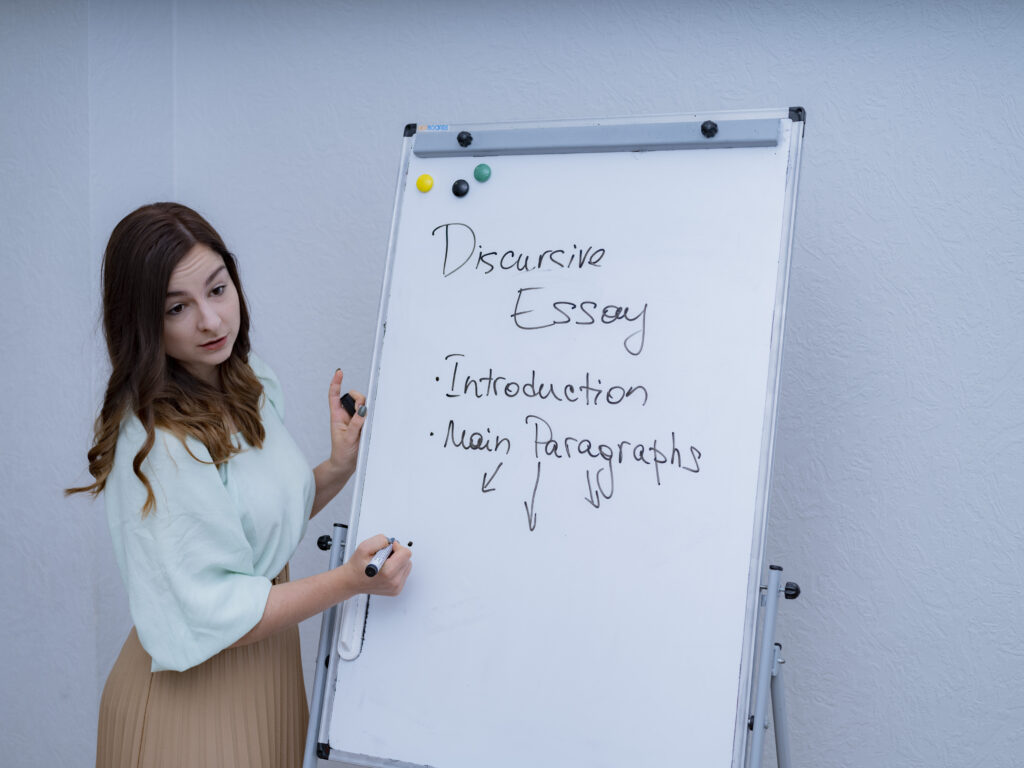
While planning your essay you should decide on the number of paragraphs. Your essay will consist of the introduction, main body, and conclusion.
Next, spend a few minutes on brainstorming ideas for your essay. Think about the details or examples to support your ideas and answer the questions in the task, and take notes.
For example, your notes might look like this:
| Introduction |
|
| Paragraph 1 | WHY people do this Idea 1it takes less time than to visit a doctor,e.g. you can avoid blood tests, check up, etc. and do everything by clicking a mouseIdea 2you can find reviews on the Internet, e.g. people write about symptoms, medicines they had and where to buy them |
| Paragraph 1 | CONSEQUENCES
Idea 1 reviews can be unreliable (non-professional) => waste your time and money Idea 2 without doctor’s prescription => it can get worse => new condition+complications |
| Conclusion |
|
Step 3. Writing an essay.
At this stage, we recommend that you keep looking at the task and the plan of your essay. This will help you stay on topic and write only relevant ideas.
Usually, we start writing an essay with an introduction. However, if you are struggling with writing it, leave some space, and write the body of your essay. You will return to the introduction later. Here you will have to paraphrase the task and write what the essay will discuss.
It is recommended that the main body of your cause-and-effect essay consists of 2 paragraphs:
In the case with our essay, your first paragraph will answer the question ‘Why are people looking for ways to cure their medical conditions on the Internet?’. The second paragraph will answer the question ‘What are the consequences of looking for ways to cure their medical conditions on the Internet?’.
Finally, write the conclusion where you need to summarize the answers to questions 1 and 2.
Step 4. Checking your essay.
This is the essential step in doing any writing assignment. It is also the best way to increase your score within a few minutes. After you finished writing your essay, check it for:
Read our guide on how to check your IELTS Writing.
READ ABOUT: What will the examiner be listening for at the IELTS Speaking test?
The way you organize your essay will help the examiner follow your thoughts and will also give you a better score for coherence and cohesion. Remember to structure your writing in paragraphs. Here is the outline of the cause-and-effect essay structure:
INTRODUCTION:
|
| MAIN BODY
Paragraph 1:
Paragraph 2:
|
CONCLUSION:
|
Go to our course to find the sample answer to this and many other tasks. You will also learn and practise strategies for all four skills tested in IELTS: reading, listening, writing, and speaking. Our platform provides instant feedback from experienced IELTS experts. At the end of the course, you will have the opportunity to take a mock test and receive feedback on what should be improved and what you are good at.
Subscribe to our IELTS digest
READ IN OUR BLOG:
The IELTS Speaking section is the same for all candidates regardless of the module they choose to take: general or academic. It consists of three parts and is assessed according to the four criteria: fluency and coherence, lexical resource, grammatical range and accuracy, and pronunciation. As you answer the questions, you also have to organise your ideas logically and link them in a proper way. The examiner must follow your thoughts without effort while you are speaking. It is called coherence. In order to make your answer more coherent, you should use different discourse markers and linking words.
The linking words and phrases for speaking are different from those we use in writing. They are usually simple and less formal and help you sound more natural. So, the main tip here is not to try to impress the examiner with them. Now, let’s look at their functions and meaning.
and
I’m afraid those days are gone and they’ll never come again.
also
She’s a photographer and also writes books.
as well as
We have a responsibility to our community as well as to our families.
another reason/example
There was another reason why he loved this spot.
indeed
I am happy, indeed proud, to be associated with this project.
in addition
In addition to his apartment in Manhattan, he has a villa in Italy and a castle in Scotland.
likewise
Just water these plants twice a week, and likewise the ones in the bedroom.
moreover
He enjoys selling and, moreover, is good at it.
Take IELTS with confidence
Start your IELTS Grade online course
yet
Melissa was not doing well in her physics course, yet overall she had a B average.
but
She’s very hard-working but not very imaginative.
or
There were ten or twelve people in the room.
otherwise
They had to leave early, otherwise, the children would have been up too late.
rather
The ending of the war is not a cause for celebration, but rather for regret that it ever happened.
still
Even though she doesn’t really have the time, she still offered to help.
although / even though
She walked home by herself, although she knew that it was dangerous.
despite
I still enjoyed the week despite the weather.
on the one hand…on the other hand
On the one hand, I’d like a job that pays more, but on the other hand, I enjoy the work I’m doing now.
comparatively
Comparatively speaking, this machine is easy to use.
however
This is one possible solution to the problem. However, there are others.
for example / for instance
Offices can easily become more environmentally-friendly by, for example, using recycled paper.
such as
That money is to cover costs such as travel and accommodation.
like
She looks best in bright, vibrant colours, like red and pink.
chiefly / mainly
The island chiefly attracts upmarket tourists.
READ ABOUT: How to deal with unexpected questions in the IELTS Speaking test

as a rule
As a (general) rule, I don’t read detective novels.
as usual
As usual, she was wearing jeans.
generally speaking
Generally speaking, people like her as a leader.
no doubt
He will no doubt tell you all about his vacation.
of course
We arrived at the restaurant 30 minutes late so, of course, our reservation had been cancelled.
especially
Parents of young children often become depressed, and this is especially true of single parents.
indeed
We live in strange times indeed.
so that
I opened the door so that she could come in.
for this reason
It is partly for this reason that he is refusing to rush any recruitment moves.
that’s why
You didn’t study well. That’s why you didn’t pass the exam
because
The journey was quite quick because the road was clear.
first/ second /for a start
We’ll take names and phone numbers for a start, then, later on, we can get more details.
at first
At first, I thought he was joking but then I realized he meant it.
after that
Like nothing I ever did after that was of any significance.
following sth
Following the dinner, there will be a dance.
then
Give her the letter to read, then she’ll understand.
next
What happened next?
finally
We finally got home at midnight.
at long last
At long last, the government is starting to listen to our problems.
meanwhile
Carl’s starting college in September. Meanwhile, he’s travelling around Europe.
when
I was just getting into the shower when the phone rang.
while
While I was in Italy I went to see Alessandro.
as soon as
We’ll come as soon as we can.
at the same time
No one likes conflict, but at the same time, we have to deal with this problem.
now / right now /at the moment
She used to be a teacher, but now she works in publishing.
years ago
What we saw 16 years ago was horrible.
before
It was an hour before the police arrived.
when I was…
I wanted to go to school when I was younger, but my mother was told that children like me couldn’t go to school.
in the past
You must have had similar situations in the past.
during
They work during the night and sleep by day.
as yet
No ambulances had as yet managed to get across the river.
Actually, I have to say…
I must admit…
I must admit, I admire your courage… staying with Ezra while his life turns upside down.
I think…/ I guess…/ I suppose…/ I believe…
What I want to say is… / What I mean is…/What I was saying is…
As far as I am concerned
As far as I am concerned, the problem is not a simple one.
In my opinion
Games are also more interesting in my opinion.
To tell you the truth
To tell the truth, I couldn’t hear a word he said.
To be honest
To be honest, I don’t think it will be possible.
If you ask me
If you ask me, people should go on a training course before they become parents.
frankly
Quite frankly, I think this whole situation is ridiculous.
READ ABOUT: How to avoid repetition at the IELTS Speaking test

apparently
Apparently, he’s had enough of England and is going back to Australia.
perhaps
“I never remember people’s birthdays.” “Well, perhaps you should.”
sort of /kind of
I was sort of hoping to leave early today.
arguably
She was, arguably, the best female basketball player of all time
maybe
Maybe you were right after all.
probably
I’m probably going – it depends on the weather.
surely
Surely they could have done better than that (= I believe they could have done better).
just
I just wanted to ask you if you’re free this afternoon.
So
So we leave on Thursday and get back the next Tuesday, is that right?
After all
I do like her – after all, she is my sister.
In any case
You should be able to catch a bus, but in any case, you can always take a taxi home.
In short
He’s disorganized, inefficient, never there when you want him – in short, the man’s a pain.
In other words
He was economical with the truth – in other words, he lied.
Anyway
Anyway, in the end, we just agreed to stop seeing each other.
Subscribe to our IELTS digest
READ IN OUR BLOG:
Many students and candidates consider the IELTS Speaking section to be the most difficult and the most stressful part of the exam. Others think it is quite simple because it bears resemblance to a conversation with a teacher. Both views have a right to exist. Knowing the format of the IELTS Speaking test, the assessment criteria, and what the examiner is listening for while you are speaking will definitely help to avoid mistakes, reduce stress, and achieve the highest possible score. So, how can you make your response sound ‘more pleasant’ for the examiner’s ears? Let’s find out.
As you may know, the examiner will be attentively listening to everything you will be saying, and rating your response on a scale from 1 to 9 on the following criteria:
| IELTS Speaking criteria | What they mean |
| Fluency and Coherence |
|
| Lexical resource |
|
| Grammatical range and accuracy |
|
| Pronunciation |
|
Does this mean that all the parts of the Speaking section are equally important? Yes, it does. These four aspects influence your score in all 3 parts of the test.
READ ABOUT: Which part of IELTS Speaking is most important?
Take IELTS with confidence
Start your IELTS Grade online course
IELTS criteria are your guide to what should and shouldn’t be done after you enter the Speaking Exam room and the examiner greets you. Remember these tips and you will achieve excellent results.
READ ABOUT: How to deal with unexpected questions in the IELTS Speaking test

According to the first aspect, which is ‘Fluency and Coherence’, the examiner will be listening to whether you are able to speak independently and naturally for some period of time, usually a minute or two. This means that you should not hesitate or speak too fast or too slowly. If you do not search for words, speak at your natural pace, add relevant information to the topic, use a variety of linking words and phrases or fillers, you are likely to get a good mark for fluency.
Remember, even if you didn’t do well in one part of the test, the examiner assesses your overall performance. Keep going, and you might do well in the following part.
The next aspect, ‘Lexical resource’, allows the examiner to evaluate how wide your range of vocabulary is. What is more, the examiner will be listening if you can use those words properly. What does this mean? You should pay attention to the correct forms of the words. Sometimes candidates might use nouns instead of verbs, or adjectives instead of adverbs, past tenses instead of the present, singular nouns instead of plural, etc. In addition, you should use proper word combinations as natives do. They are called collocations. If you have doubts, pay special attention to them during your IELTS preparation.
What might help you demonstrate your range of vocabulary to the examiner? First of all, using the words you are 100% sure about. Often candidates make things more complicated for themselves by trying to impress the examiner with some extraordinary vocabulary without knowing how to use it. In most cases, this will only help you to reduce your score. Using familiar vocabulary will bring you more scores if you do it properly.
Secondly, try to add more detail to your response. This will help you showcase more vocabulary.
Thirdly, try to speak about your own or the experiences of people you know well. This will help you reduce stress and reveal a wider range of vocabulary.
To achieve a high score for ‘Grammatical range and accuracy ’, you should use different tenses and longer sentences. However, this does not mean you have to show off your grammar. If you try to speak in deliberately long sentences all the time, you will sound unnatural. The examiner will listen to the variety of structures you use and if you can do it properly. The main tip here is to use only appropriate tenses you are confident about. For example, if you use the structures you don’t usually use, you are likely to make a wrong step. This might influence your band score. On top of that, you’d better concentrate on answering the questions the examiner asks you rather than on the grammar you are using. Candidates who get band 6+ make some mistakes but they can be understood.
‘Pronunciation’ matters in this section of the exam as well. However, pronunciation is not the synonym of accent. In fact, this is how you link sounds, words, if you speak with the proper intonation, and if you are able to speak clearly. Remember, you have to answer the examiner’s questions at your natural pace. If you speak too fast, you are likely to make more mistakes and mispronounce some words. Even if you have an accent, which is just a part of your identity, but it does not interfere with comprehension, the examiner is likely to give you a good score. On the other hand, if you pronounce the words in a way when the examiner cannot understand what you are saying, this can reduce your score. Record yourself speaking and see what mistakes you are making.
The Speaking section of IELTS is challenging, but now you know what is required from you. What is left is practice. Join our online IELTS Academic preparation course to practice, do a mock test and get instant feedback from IELTS experts.
Subscribe to our IELTS digest
READ IN OUR BLOG:
Among several different question types such as notes or summary completion, multiple-choice, etc. in the IELTS Listening section, matching tasks are the most common. That is why you should always be prepared to get one in your test, i.e. you have to learn and practice the strategy of answering this type of question. Many students and candidates struggle to answer such questions because they do not understand what to do in the task and how to approach it. Read further, and you will find out how to do matching tasks in a few easy steps.
Most often you may come across this type of question in parts 1 or 3 of the Listening section, which means that you will be listening to the conversation between two or more people.
Let us have a look at the following example:

Here you can see a numbered list of items from the listening text and a set of options (A, B, C). While listening, you have to match these pieces of information together. There will always be a list with numbers — these are questions, and a list with letters — these are options to choose from. The list of options can sometimes be shorter as in the example above. What does this mean? Yes, you can use one option for more than one question.
This task type checks if you can understand the details and notice the relationships and connections between different facts in the listening passage. It also checks if you can follow a conversation with a few speakers.
READ ABOUT: How to identify the type of essay in IELTS Writing Task 2?
Take IELTS with confidence
Start your IELTS Grade online course
Here are a few tips that will help you to answer the matching questions easily.
Remember that the list with numbers follows the order of the listening passage. This means you will hear the information about each question one by one. This will help you not to get lost in the recording. If you cannot work out an answer, be ready for the next question.
What you read in questions and what you hear will come in different words. This means that everything is paraphrased, and you will have to look for synonyms. Listen for the same meaning, not only the same words.
Remember about distractors. They are here to confuse you and to check if you really understand the details of the conversation. The speakers might mention several options. However, only one of them is the answer to the question.

READ ABOUT: Can computers really grade your IELTS Writing and Speaking?
Now when you are aware of what is required to be done to complete the task, we will look at some strategies for successfully answering any matching question. Follow these easy steps in order to complete the task.
Step 1. Read the instructions carefully.
This step will help you understand what exactly you need to do and how many options you can use. So, what you have to do is to check if there are any extra options. Besides, you may be allowed to choose any letter more than once. This is usually mentioned in the instructions.
Step 2. Look at the lists of questions and options to make predictions.
If you read the two lists carefully, you will likely guess what the recording is about and what you might hear in it.
In the case of our sample task, the names of the courses will probably be the same in the recording and in the task. What will be different are the options. They will definitely be paraphrased. This means you have to predict what words Jack might tell his tutor about these courses. What are the other ways to say ‘I’ll definitely do it’, for example? Jack might say, ‘I’m sure this course is perfect for me’, ‘I’ll go for this course’, ‘That’s a definite for me’, etc.
Try to paraphrase each option before you listen. By doing so you will prepare yourself for the listening.
Step 3. Listen and match information.
As you will hear the recording once, it is important to remember that the answers are usually paraphrased and come in order. Choose one answer to each question. For example:
| You will see: | You will hear: |
| What does Jack tell his tutor about each of the following course options?
A He’ll definitely do it. B He may or may not do it. C He won’t do it. Write the correct letter, A, B or C next to questions 1 — 5. You may choose any letter more than once. 1 Media Studies – C 2 Women and Power 3 Culture and Society 4 Identity and Popular Culture 5 Introduction to Cultural Theory |
Dr Ray: So for example the Media Studies Option will cover quite a lot of the same area you did in the core module on mass communications this semester — the development of the media through the last two centuries, in relation to political and social issues.
Jack: Mmm. Well that was interesting, but I’ve decided I’d rather do something completely new. There’s a Women’s Studies option, isn’t there? |
Step 4. Check that you have answered all the questions.
If you have not answered all the questions, the guesswork will help. You should not leave any blank answers if you want to get a better score for the listening section.
Go to our course to learn and practise strategies for all the parts of the IELTS Academic exam. Not only you will learn and practise, but save all the tips and tools in your personal Knowledge Bank, get 24/7 support and instant feedback from our IELTS experts. Depending on how much time you have, we provide you with a study-plan to help you make the most of your IELTS preparation. The more you practise, the more confidence you have on the day of the exam.
Subscribe to our IELTS digest
READ IN OUR BLOG:
We have already written about typical mistakes candidates make in IELTS essays, but starting to write your response straight away should also be added to that list. If you start writing without thinking about what to write and how to write, you will likely lose points for coherence and cohesion as well as for the task achievement criteria.
Before you actually write an essay, you have to think about what ideas to develop and what examples you will provide to support them. Brainstorming is a very important part of essay planning, and it is a skill that can help you complete the task. At the exam, you will have only a few minutes to generate ideas for your essay, so it is advisable to practice brainstorming during your IELTS preparation. The more you practice, the easier it will become for you to generate ideas for IELTS Academic Writing Task 2. In the beginning, it might take some time, but you will notice that it will get quicker allowing more time for task completion. Here are some ways that will help you become a pro in generating ideas for your essays and get a higher score for the exam.
The most common problems students and candidates name when planning an essay are:
If you face one of these difficulties, the first thing you have to remember is that IELTS is a language test, not a knowledge test. You do not have to make your ideas “interesting”. IELTS checks if you can use a wide range of vocabulary and grammar, how logically you can structure your essay and organize your ideas, and whether you can write about the topic or not. You do not receive extra points if your ideas are more interesting than the ideas of another candidate, i.e. you should not overthink. What you have to do is to come up with the best ideas as quickly as possible, and then extend and explain each of those ideas with examples and supporting details.
For example, if you receive the following task, you do not have to think about five reasons why it is necessary to be naturally talented to become successful and five reasons why being hard-working matters in sports and list them one after another. Do not write 10 sentences with ten different reasons. What you have to do is to pick up one or two ideas and support them with good examples from your personal or someone else’s experience, or study, or research, or a news item, etc.

Take IELTS with confidence
Start your IELTS Grade online course
Read the task carefully, find the main topic and decide how many parts the question has. For example, in the task above the topic is ‘It is necessary to be talented or hard-working to achieve results in sports’. There are three parts in the question: give reasons, include examples, and give your opinion.
Turn the topic and the two parts of the task into questions:
The next step is to brainstorm answers to these questions.
Another way to come up with the ideas is to use special questions such as ‘Who?’, ‘Where?’, ‘Why?’, ‘When?’, ‘How?’, ‘How much/many?’, ‘What?’, Which?’.
This is a very useful and popular technique. While you practise writing essays during your preparations, try to look at the problem from different angles, i.e. consider what different people might say about the issue and why.
For example, ‘Is it necessary to be talented or hard-working to achieve results in sports?’:
READ ABOUT: Tips for note completion questions in IELTS Reading

This way helps you organize your ideas visually. Start with brainstorming keywords, and then place the micro-keywords on the branches, for example.
Another way to organize a mind map is to place the main idea in the middle, then write the views, examples, and details on the branches. This strategy will definitely help you empty your brain onto the page.
A doodle is a kind of drawing you make while your attention is otherwise occupied. Doodles are simple, they can represent some ideas, have some concrete meaning, or may just be composed of random and abstract lines. What you need to do to doodle is take a pen or a pencil, and paper, and allow your mind to have control of it. Use lines and shapes instead of words. You don’t need to draw any particular image–images will start to take shape as you move the pen over the paper.
Even such outstanding people as a poet and physician John Keats, an American poet, novelist, and short-story writer Sylvia Plath, and the Nobel laureate in literature, 1913 poet Rabindranath Tagore, were doodling in their manuscripts and margins of notes. Some doodles and drawings were found in notebooks of Leonardo da Vinci. Many American Presidents, including Thomas Jefferson, Ronald Reagan, and Bill Clinton, used to doodle during meetings.
Of course, you won’t have much time for drawing pictures because the examiner probably won’t give you a good band score no matter how impressive they are. However, if you take a minute or two to draw what you are going to write or speak about will get you thinking again. Use this technique while your IELTS preparation.
This technique will definitely turn out to be the most effective because when we talk to our friends we do not always feel stressed. If you reduce tension, you will be able to concentrate on what you have o write or say. What you have to do is to imagine that you want to explain your point of view or the problem to your friend or a family member if they ask what you think. When you have to write about two different views imagine that your friend has the opposite one and write down what he or she would say.
Subscribe to our IELTS digest
READ IN OUR BLOG:
Writing essays is an important part of the Writing section of the IELTS test. Many candidates sitting the test struggle to get the desired score. The reason is obvious: they fail to understand the essay task properly. There are five common types of essay in the IELTS Academic exam:
What do you have to write in each of them? Read this article and you will learn how to unpack the essay task in order to write an appropriate response.
Take IELTS with confidence
Start your IELTS Grade online course
What you have to do first before you actually start writing an essay is to read the task carefully. You cannot omit this step otherwise you will fail the task and will lose your points for the task achievement criterion. If you look at any IELTS Academic Writing Task 2, you are likely to notice and interesting detail. No matter what type of essay it is, the task will have a statement, a question or several questions to answer, and guidance (or instruction) for you. Let us have a look at the following task:
The statement is the topic of the essay. The questions tell you what you have to write about. The guidance tells you how to write your essay and what to include.
For example, in the task above the topic is “using the Internet to find solutions to health problems is becoming more popular”. You have to write the reasons and consequences of doing so because the questions ask you “Why do people do that?” and “What are the results of such actions?”. You will also have to give details to answer and provide good examples because the guidance asks you to give reasons and include relevant examples.
The questions and the guidance also assist you in understanding what type of essay it is. If you are aware of whether you have to write an opinion or a mixed essay, etc., you will know how to structure it, i.e. the score for coherence and cohesion will be higher.
READ ABOUT: 6 typical mistakes in IELTS essays

This type of essay usually asks you to state the main causes of the problem and discuss what effects it might have. For example:
It can also be worded in other ways:
Statement + Discuss the causes and effects of …
Statement + What do you think are the causes of …? What effect will this have on …?
Statement + Outline the reasons for … and discuss what effects …?
Statement + What are the positive and negative impacts of … and what can be done to minimize the bad effects?
In this type of IELTS essay, you are asked to give your opinion on a given statement. For example:

You will have to clearly state your opinion and develop it without suddenly changing your mind in the middle of the essay, i.e. you have to remain true to what you state in the introduction. You will also have to provide some reasoning and support it with good examples of your own or someone’s experience.
You can come across different wordings of this type of IELTS Writing Task 2 though:
Statement + What is your opinion…?
Statement + Do you agree or disagree…?
Statement + To what extent do you agree or disagree…?
Sometimes at the IELTS exam, you have to answer more than one question. A ‘mixed essay’ is the type of task where you have to write about your opinion and answer another question about another aspect of the same topic. For example:

During the test, always check if the task asks you to give your opinion. Questions about opinion may be very obvious if you look at the previous type of essay. However, there may be some other questions that also ask you to write what you think. They can be worded in the following ways:
Is it a positive or negative trend?
Is this the worst problem that humanity is facing nowadays?
Should the media be controlled in such a way?
Do the advantages outweigh the disadvantages?
When you look at them more carefully, you will easily work out that they all require a YES or NO answer, or ask you to choose between the two alternatives.
This task usually looks like this:
Statement + Question 1 + Question 2 +Guidelines
One of the questions is always a question about your opinion. For example:

READ ABOUT: 25 phrasal verbs to avoid in IELTS Academic Writing

In such type of task, you will find a statement that gives you two different views on the same problem. You will have to discuss both opinions as well as give your opinion about the issue. It’s important to support both views with the detail and examples equally no matter which one you choose to approve later in your essay.

As you can see from the sample task above, such type of task usually consists of:
Statement (with 2 opposing ideas) + 2 questions (to discuss both views + give your opinion) + Guidelines (give reasons and examples)
Other wordings might look the following way:
Statement + Discuss both these views and give your own opinion.
Statement + Discuss both sides of this argument and give your own opinion.
It is likely that you will use the wrong structure for your essay if you misidentify the type of question. Once you have identified the type of essay, use our tips on how to write it.
In this type of IELTS Writing Task 2, you have to analyse the benefits and drawbacks of a particular matter or problem. For example, you can come across such wordings:
Statement + What are the advantages and disadvantages of…?
Statement + Do you think the advantages outweigh the disadvantages…?
Statement + Discuss the advantages and disadvantages and give your opinion.
Generally, we can divide advantages & disadvantages essays into two types:

Type 1 asks you to simply discuss the advantages and disadvantages.
Type 2 asks you to discuss the advantages and disadvantages AND give your opinion on whether the advantages outweigh the disadvantages or vice versa. We have already written about the essay structure and the main tips on how to write it.
Now, when you know everything about the possible types of questions you might have to answer in IELTS Writing Task 2 and we are sure you can spot them without much effort, it’s time to stick to your IELTS preparation and skyrocket your results.
Subscribe to our IELTS digest
Have you ever imagined the situation when you are in the middle of the IELTS Speaking exam, the examiner asks you a question, and your mind goes blank because you have no idea how to answer it? Another fear most candidates have is to forget the word. Once it was there, on the tip of your tongue, but you lost it. What should you do to answer the question if you do not know much about the topic? Read and find out.
Many students and candidates worry that the examiner will ask them questions about topics they have never thought about before. Instead of panicking, let us learn more about the topics of the IELTS Speaking test.
Most topics are general in nature; they are everyday familiar topics that everyone has some experience with and should be able to give an opinion on. For example, in Part 1 the examiner can ask you about your job, studies, family, the place where you live, ways you travel around, your hobbies, likes, and dislikes.
Take IELTS with confidence
Start your IELTS Grade online course
Topics usually fall into 4 general types in Part 2:
The examiner may occasionally ask trickier questions on more unfamiliar topics. However, the chances of getting an unfamiliar topic are directly proportional to the time invested in the IELTS preparation.
Also, remember that this is a speaking test, not a knowledge test. It tests your fluency, pronunciation, range of vocabulary, grammar, and not how well you know this or that topic. If you use our tips, you will be able to answer any question of the IELTS Speaking exam.
READ ABOUT: How to prepare for IELTS Speaking and get the highest score

There are two main reasons why candidates cannot answer the question:
However, this can happen even when you speak your native tongue, and it does not demonstrate how fluent you are. What really matters is your reaction. The worst things you can do to “help the situation” are freezing, falling silent, or simply saying ‘I don’t know’. This answer is too short to assess your English skills. What can you do instead?
Tip #1. Use placeholders.
If you cannot find the right word because you forgot it or simply do not know it, you can use special words instead. Speakers use them to signal that they do not know or cannot remember a more precise word for something:
e.g. We wanted to have a glass of wine. We brought a bottle of exotic wine with us, but we couldn’t open it. Luckily, there was a restaurant in the hotel where they had this thing to open the bottle. (a corkscrew)
e.g. This is my favourite silverplated copper jewelry, a gift from my friend that she brought from Bosnia and whatsitsname? (Bosnia and Herzegovina)
e.g. I bought this kind of light green and blue dress at the night market in Thailand. (turquoise)
Tip #2. Describe the word.
You can expand or explain complex words by using other words. For example:
‘I’ve never seen such a stubborn person.’= ‘I’ve never seen such a person does what he wants and refuses to do anything else.’
The only thing is that you have to incorporate these things into your speech quickly, and you will sound natural.
Tip #3. Give an honest reaction and explain why.
Again, IELTS does not test your knowledge of a particular subject or area of studies. You might not be familiar with the topic. Do not panic, and give your answer even it is short. However, you will also have to explain. This will help extend your answer.
Another good strategy is to rephrase the question. Even you do not know what to say, for example, about your favourite car if you could buy any vehicle, you have to introduce the topic and turn it around your own language. For example, “I don’t know a lot about it but I would assume that…”, and then start talking about another kind of transportation. Give examples of other people who could be interested in this subject, use the related vocabulary. Focus on the aspect of the question you do know and move your answer onto related but more familiar topics.
Other helpful phrases to use in such situations:
Tip # 4. Use fluency markers.
They are expressions native speakers use to buy time when they are thinking about what to answer. By using them you will give yourself time to think about what you have to say. This is a really nice way to improve your score for fluency and coherence because it is a natural way of speaking.
Use these expressions if you really need time to think. It’s a bad idea to use them in every answer.
Tip # 5. Ask the examiner to repeat the question.
You can buy yourself even more time. You could say:
Use those for emergencies only. However, if you really did not understand the question, you should ask the examiner to repeat it.
Remember, the most important tip #6 is not to waste your valuable time worrying about unfamiliar topics – spend it on focused preparation.
Subscribe to our IELTS digest
READ IN OUR BLOG: