
Here are suggested study plans for you
to make the most of the course
The Writing section appears to be the most difficult for the candidates who choose IELTS Academic, as it is necessary to show not only a high level of proficiency in academic English, but also the ability to analyze information and express their opinions about a particular subject. According to statistics, candidates from Ukraine receive an average of 5.8 band score for this part of the exam, 6.5 for Speaking, and 6.6 for Listening and Reading, respectively. At the same time, the average band score for all four skills at IELTS Academic in Ukraine is 6.5.
There are two tasks in Writing section, and you are given 1 hour to complete these 2 tasks. In the first task, you need to describe a graph, process, or image. You have to write at least 150 words. In the second task, you must write an essay on a given topic of at least 250 words. Task 2 is more important than Task 1. It is recommended that you spend 20 minutes on Task 1 and the remaining 40 minutes on Task 2. Both tasks aim to test your writing skills in various aspects such as grammar, content, vocabulary, line graphs, tables, charts, etc. Let’s talk more about each of the tasks below.
In the first part of IELTS Academic Writing, you will usually need to describe information that looks like a particular visual object, such as:
line graph
bar chart

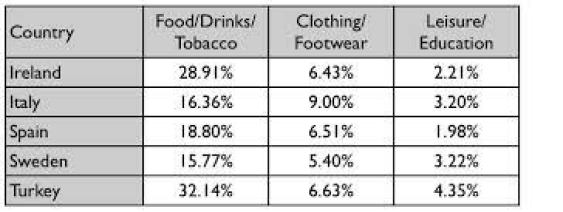
table
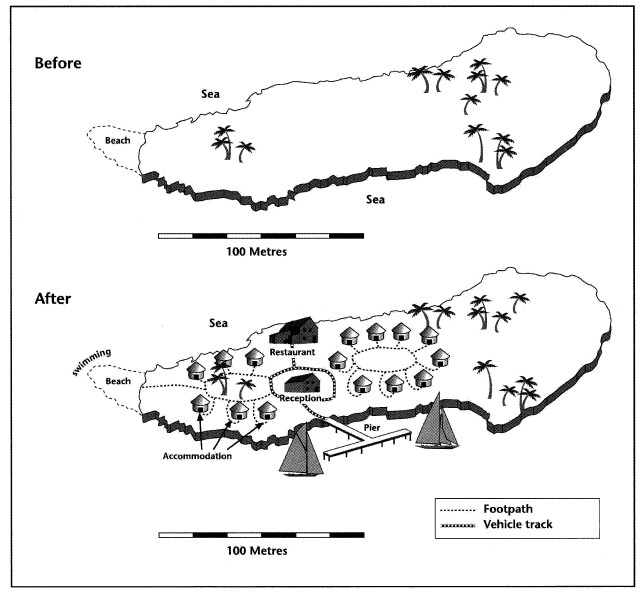
map
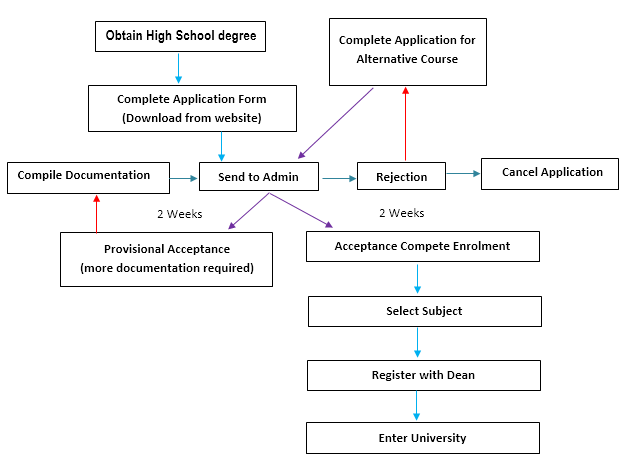
flow chart
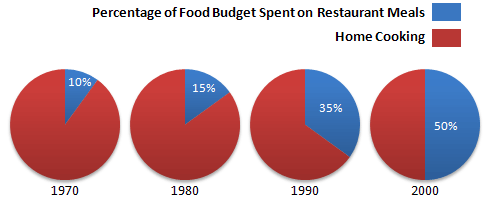
pie chart

IELTS Writing Task 1 sometimes requires you to describe two figures. Before writing your response it is important to ask yourself the following:
For example:
You should spend about 20 minutes on this task.
The charts below show the percentage of their food budget the average family spent on restaurant meals in different years. The graph shows the number of meals eaten in fast food restaurants and sit-down restaurants.
You should write at least 150 words.
Give reasons for your answer and include any relevant examples from your own knowledge or experience.
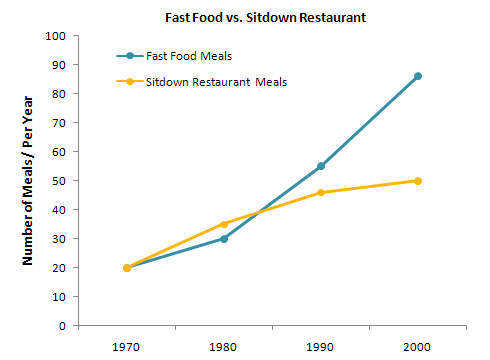
When writing the answer to this task, you should follow a certain structure. The answer text should have: an introduction, one or two main paragraphs and a conclusion. Introductory paragraph briefly describes what a graph or figure shows (1-3 sentences). The following paragraphs highlight basic information. The final paragraph summarizes the most important information (1-2 sentences).
Take IELTS with confidence
Start your IELTS Grade online course
Only choose the most important things. For example, after you have paraphrased the information from the task in the introduction, you can write about the first graph. The next paragraph is about the second graph. This way you will not get confused and the examiner will have no problem with reading your response. In conclusion, we can show how two graphs are related.
You will increase your chances of getting a high score if you:
In the second task, there are several types of essays, each with its own structure, questions, twists and turns. The most common essay types and examples of questions are listed below:
You should spend about 40 minutes on this task.
Write about the following topic:
In the modern world, the image (photograph or film) is becoming a more powerful way of communicating than the written word.
To what extent do you agree or disagree?
Give reasons for your answer and include any relevant examples from your own knowledge or experience.
Write at least 250 words.
Computers are being used more and more in education. Some people say that this is a positive trend, while others argue that it is leading to negative consequences.
Discuss both sides of this argument and then give your own opinion.
In some countries, young people are encouraged to work or travel for a year between finishing high school and starting university studies.
Discuss the advantages and disadvantages for young people who decided to do this.
In some high schools, part of the curriculum requires students to participate in community work such as helping the elderly or disabled.
In what way do children benefit from this?
Do you think it should be part of the curriculum?
Global warming is one of the biggest threats humans face in the 21st Century and sea levels are continuing to rise at alarming rates.
What problems are associated with this and what are some possible solutions.
The number of people who are at risk of serious health problems due to being overweight is increasing.
What is the reason for the growth of overweight people in society?
How can this problem be solved?
Some universities now offer their courses on the Internet so that people can study online.
Is this a positive or negative development?
You will increase your chances of getting a high score if you:
Subscribe to our IELTS digest
Many students who choose to take IELTS wonder whether they can see the questions in the Listening section. IELTS has a great advantage over the other international language exams because candidates have an opportunity to read the questions before they can hear the track. If one chooses to do the paper-based IELTS, the questions will be printed in the question booklet. In the computer-delivered IELTS, the questions are displayed on the screen, and you have to answer them as you listen to the audio. In this blog post, we are going to give some tips on how to exploit this opportunity – benefit from displayed questions in the Listening section.
Usually, we listen to the audio to find the answers to the questions. However, the questions can also tell us a lot about the audio before we listen to it. For example, look at the following IELTS listening task:

If you read the information in the questions, you will know that the audio you are going to listen to will be discussing different cultural events: an opera, a film, and an art exhibition. What is more, you can predict that the speaker is going to talk about when and where the events will take place, and how much the tickets cost. Probably, the speaker will mention different types of arts or make recommendations about places to visit depending on the tastes in arts.
Aren’t you more confident enough now about what you are going to hear? This tip will surely help you with comprehension.
Take IELTS with confidence
Start your IELTS Grade online course
This might sound crystal clear because you will pay attention to the information that will help you answer the questions you have read. What is meant by ‘paying attention to information is being more specific about what you have to listen for. By reading the questions you can sharpen your ears, become more selective and choose only the information that provides or is the answer to the question.
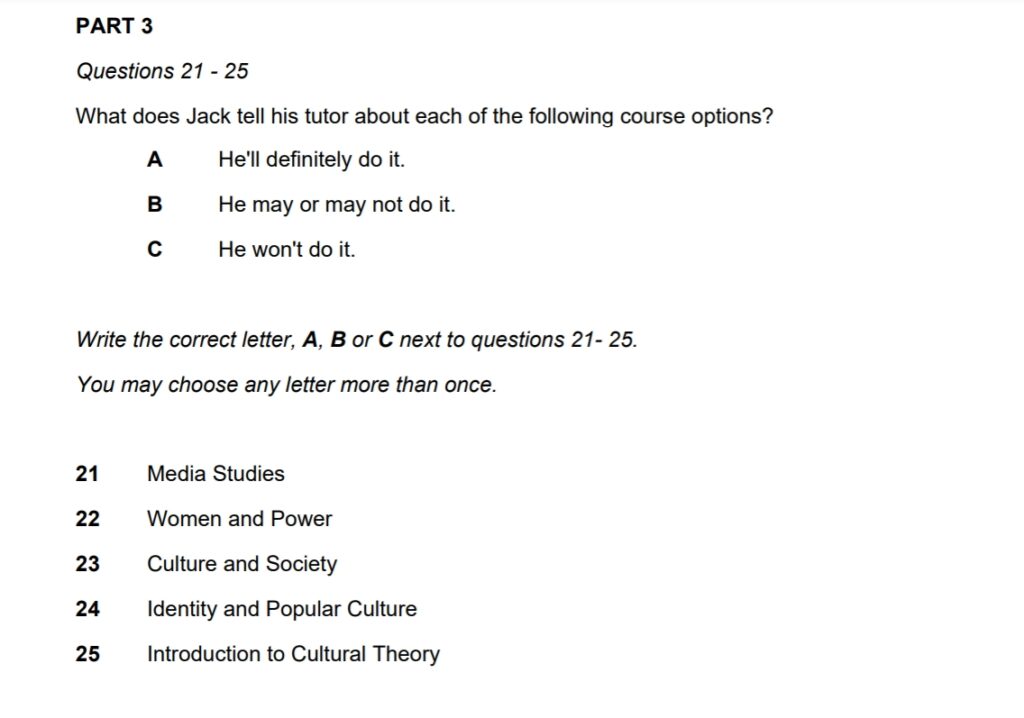
In the task above, you have only three options for answer. It is obvious that Jack will be talking to the tutor about all courses, but you will have to choose only the option (A, B, or C) which is his final decision for each of the courses (21-25). This means that you can repeat the answer if, for example, he decides not to do two of them, etc. So you know you have to listen for words and phrases that either mean he agrees, refuses or hasn’t decided yet (hesitates). Or the speaker can first decide to do the course and then change his mind. So, listen for the final decision.
Reading questions before listening is, of course, beneficial. However, reading too much is also not very good for you. In the IELTS exam, there can be two sets of questions that refer to the same lecture or conversation. These questions are usually of different types. However, each set of questions is based on a separate part of the conversation or lecture. This means that there are two separate audios as well. That is why it is not a good idea to read all sets of questions before listening because you might get lost and will not remember what to focus on. This automatically will lead you to making mistakes and losing scores.
Read only the list of questions based on the part of a lecture or conversation you are going to hear. How do you know? The instructions are played before every part, and the numbers of questions you have to answer are specified.
Of course, questions in the next parts of the IELTS Listening section become longer, and candidates do not have much time to read and analyse every word. We recommend skimming the questions for keywords and phrases that will help select the most important things and concentrate while listening. To learn the strategies for each question type and to practise with instant feedback from IELTS experts join our online IELTS Academic preparation course.
Subscribe to our IELTS digest
READ IN OUR BLOG:
There are different types of essays in IELTS Academic Writing Task 2. They can be divided into advantages and disadvantages essays, opinion essays, two-views-and-opinion essays, mixed and cause-and-effect essays. Many students and candidates fail to get the desired score because they are not aware of how to approach the task. We are going to look at what makes a good essay, and you will learn how to unpack the cause-and-effect essay task in order to write an appropriate response.
Not understanding what to do in the task and not knowing what two write as well as not identifying the type of an essay correctly might lead to losing the scores. This means it is crucial to identify the type of essay in IELTS Writing task 2. The tasks for cause-and-effect essays can have different wordings. For example:
In cause-and-effect essays, you will be given a problem and asked to write about the main causes of this problem as well as discuss what effects it might have.

The task above looks at the problem of people who use the Internet to look for ways to cure different medical conditions instead of seeing the doctor. In your essay, you will have two write about 2 or 3 reasons why they do so as well as think about 2 or 3 effects such behaviour might lead to. Moreover, you will have to provide examples.
If you do all three items, you are likely to get a higher score for the Task Achievement criterion.
READ ABOUT: IELTS two-views-and-opinion essay tips
The cause-and-effect essay requires you to think critically about the problem and outline your ideas orderly. You are likely to complete the task successfully if you follow the steps we suggest.
Step 1. Analysing the task.
As it has already been said, your success depends on understanding the task. That is why you have to read the statement carefully and underline key information in it. Next, read the questions and identify what they ask you to write about. Paraphrasing the statement for yourself using simple language will help you understand it better.
Take IELTS with confidence
Start your IELTS Grade online course
Step 2. Planning your essay.
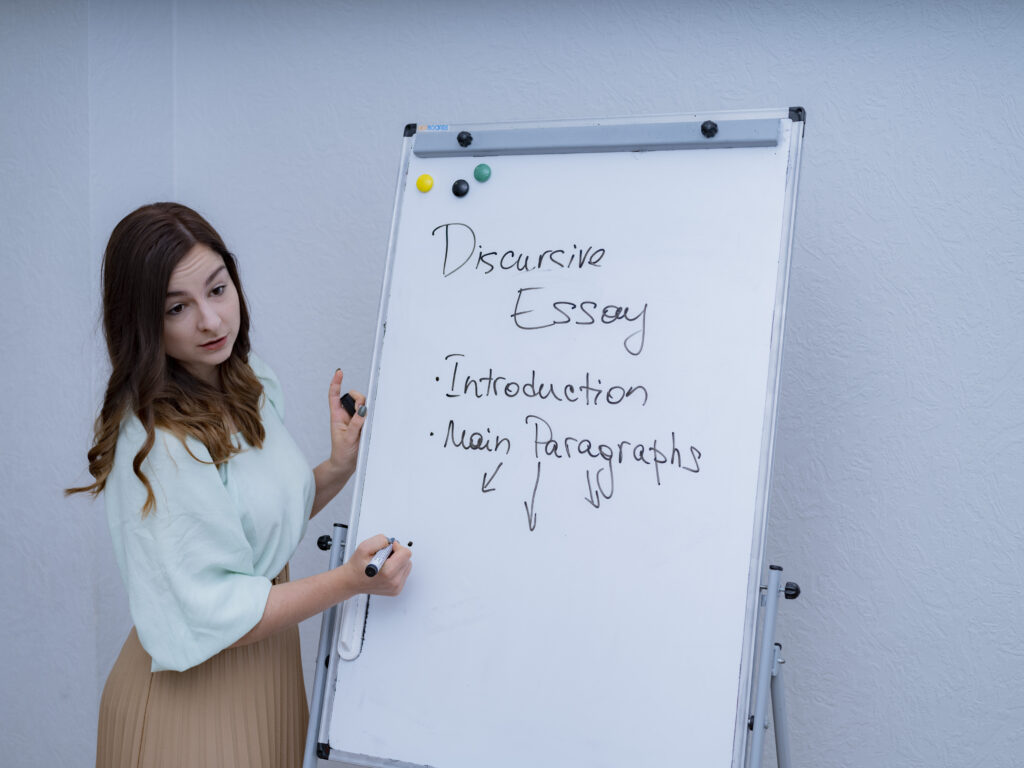
While planning your essay you should decide on the number of paragraphs. Your essay will consist of the introduction, main body, and conclusion.
Next, spend a few minutes on brainstorming ideas for your essay. Think about the details or examples to support your ideas and answer the questions in the task, and take notes.
For example, your notes might look like this:
| Introduction |
|
| Paragraph 1 | WHY people do this Idea 1it takes less time than to visit a doctor,e.g. you can avoid blood tests, check up, etc. and do everything by clicking a mouseIdea 2you can find reviews on the Internet, e.g. people write about symptoms, medicines they had and where to buy them |
| Paragraph 1 | CONSEQUENCES
Idea 1 reviews can be unreliable (non-professional) => waste your time and money Idea 2 without doctor’s prescription => it can get worse => new condition+complications |
| Conclusion |
|
Step 3. Writing an essay.
At this stage, we recommend that you keep looking at the task and the plan of your essay. This will help you stay on topic and write only relevant ideas.
Usually, we start writing an essay with an introduction. However, if you are struggling with writing it, leave some space, and write the body of your essay. You will return to the introduction later. Here you will have to paraphrase the task and write what the essay will discuss.
It is recommended that the main body of your cause-and-effect essay consists of 2 paragraphs:
In the case with our essay, your first paragraph will answer the question ‘Why are people looking for ways to cure their medical conditions on the Internet?’. The second paragraph will answer the question ‘What are the consequences of looking for ways to cure their medical conditions on the Internet?’.
Finally, write the conclusion where you need to summarize the answers to questions 1 and 2.
Step 4. Checking your essay.
This is the essential step in doing any writing assignment. It is also the best way to increase your score within a few minutes. After you finished writing your essay, check it for:
Read our guide on how to check your IELTS Writing.
READ ABOUT: What will the examiner be listening for at the IELTS Speaking test?
The way you organize your essay will help the examiner follow your thoughts and will also give you a better score for coherence and cohesion. Remember to structure your writing in paragraphs. Here is the outline of the cause-and-effect essay structure:
INTRODUCTION:
|
| MAIN BODY
Paragraph 1:
Paragraph 2:
|
CONCLUSION:
|
Go to our course to find the sample answer to this and many other tasks. You will also learn and practise strategies for all four skills tested in IELTS: reading, listening, writing, and speaking. Our platform provides instant feedback from experienced IELTS experts. At the end of the course, you will have the opportunity to take a mock test and receive feedback on what should be improved and what you are good at.
Subscribe to our IELTS digest
READ IN OUR BLOG:
Among several different question types such as notes or summary completion, multiple-choice, etc. in the IELTS Listening section, matching tasks are the most common. That is why you should always be prepared to get one in your test, i.e. you have to learn and practice the strategy of answering this type of question. Many students and candidates struggle to answer such questions because they do not understand what to do in the task and how to approach it. Read further, and you will find out how to do matching tasks in a few easy steps.
Most often you may come across this type of question in parts 1 or 3 of the Listening section, which means that you will be listening to the conversation between two or more people.
Let us have a look at the following example:

Here you can see a numbered list of items from the listening text and a set of options (A, B, C). While listening, you have to match these pieces of information together. There will always be a list with numbers — these are questions, and a list with letters — these are options to choose from. The list of options can sometimes be shorter as in the example above. What does this mean? Yes, you can use one option for more than one question.
This task type checks if you can understand the details and notice the relationships and connections between different facts in the listening passage. It also checks if you can follow a conversation with a few speakers.
READ ABOUT: How to identify the type of essay in IELTS Writing Task 2?
Take IELTS with confidence
Start your IELTS Grade online course
Here are a few tips that will help you to answer the matching questions easily.
Remember that the list with numbers follows the order of the listening passage. This means you will hear the information about each question one by one. This will help you not to get lost in the recording. If you cannot work out an answer, be ready for the next question.
What you read in questions and what you hear will come in different words. This means that everything is paraphrased, and you will have to look for synonyms. Listen for the same meaning, not only the same words.
Remember about distractors. They are here to confuse you and to check if you really understand the details of the conversation. The speakers might mention several options. However, only one of them is the answer to the question.

READ ABOUT: Can computers really grade your IELTS Writing and Speaking?
Now when you are aware of what is required to be done to complete the task, we will look at some strategies for successfully answering any matching question. Follow these easy steps in order to complete the task.
Step 1. Read the instructions carefully.
This step will help you understand what exactly you need to do and how many options you can use. So, what you have to do is to check if there are any extra options. Besides, you may be allowed to choose any letter more than once. This is usually mentioned in the instructions.
Step 2. Look at the lists of questions and options to make predictions.
If you read the two lists carefully, you will likely guess what the recording is about and what you might hear in it.
In the case of our sample task, the names of the courses will probably be the same in the recording and in the task. What will be different are the options. They will definitely be paraphrased. This means you have to predict what words Jack might tell his tutor about these courses. What are the other ways to say ‘I’ll definitely do it’, for example? Jack might say, ‘I’m sure this course is perfect for me’, ‘I’ll go for this course’, ‘That’s a definite for me’, etc.
Try to paraphrase each option before you listen. By doing so you will prepare yourself for the listening.
Step 3. Listen and match information.
As you will hear the recording once, it is important to remember that the answers are usually paraphrased and come in order. Choose one answer to each question. For example:
| You will see: | You will hear: |
| What does Jack tell his tutor about each of the following course options?
A He’ll definitely do it. B He may or may not do it. C He won’t do it. Write the correct letter, A, B or C next to questions 1 — 5. You may choose any letter more than once. 1 Media Studies – C 2 Women and Power 3 Culture and Society 4 Identity and Popular Culture 5 Introduction to Cultural Theory |
Dr Ray: So for example the Media Studies Option will cover quite a lot of the same area you did in the core module on mass communications this semester — the development of the media through the last two centuries, in relation to political and social issues.
Jack: Mmm. Well that was interesting, but I’ve decided I’d rather do something completely new. There’s a Women’s Studies option, isn’t there? |
Step 4. Check that you have answered all the questions.
If you have not answered all the questions, the guesswork will help. You should not leave any blank answers if you want to get a better score for the listening section.
Go to our course to learn and practise strategies for all the parts of the IELTS Academic exam. Not only you will learn and practise, but save all the tips and tools in your personal Knowledge Bank, get 24/7 support and instant feedback from our IELTS experts. Depending on how much time you have, we provide you with a study-plan to help you make the most of your IELTS preparation. The more you practise, the more confidence you have on the day of the exam.
Subscribe to our IELTS digest
READ IN OUR BLOG:
Writing essays is an important part of the Writing section of the IELTS test. Many candidates sitting the test struggle to get the desired score. The reason is obvious: they fail to understand the essay task properly. There are five common types of essay in the IELTS Academic exam:
What do you have to write in each of them? Read this article and you will learn how to unpack the essay task in order to write an appropriate response.
Take IELTS with confidence
Start your IELTS Grade online course
What you have to do first before you actually start writing an essay is to read the task carefully. You cannot omit this step otherwise you will fail the task and will lose your points for the task achievement criterion. If you look at any IELTS Academic Writing Task 2, you are likely to notice and interesting detail. No matter what type of essay it is, the task will have a statement, a question or several questions to answer, and guidance (or instruction) for you. Let us have a look at the following task:
The statement is the topic of the essay. The questions tell you what you have to write about. The guidance tells you how to write your essay and what to include.
For example, in the task above the topic is “using the Internet to find solutions to health problems is becoming more popular”. You have to write the reasons and consequences of doing so because the questions ask you “Why do people do that?” and “What are the results of such actions?”. You will also have to give details to answer and provide good examples because the guidance asks you to give reasons and include relevant examples.
The questions and the guidance also assist you in understanding what type of essay it is. If you are aware of whether you have to write an opinion or a mixed essay, etc., you will know how to structure it, i.e. the score for coherence and cohesion will be higher.
READ ABOUT: 6 typical mistakes in IELTS essays

This type of essay usually asks you to state the main causes of the problem and discuss what effects it might have. For example:
It can also be worded in other ways:
Statement + Discuss the causes and effects of …
Statement + What do you think are the causes of …? What effect will this have on …?
Statement + Outline the reasons for … and discuss what effects …?
Statement + What are the positive and negative impacts of … and what can be done to minimize the bad effects?
In this type of IELTS essay, you are asked to give your opinion on a given statement. For example:

You will have to clearly state your opinion and develop it without suddenly changing your mind in the middle of the essay, i.e. you have to remain true to what you state in the introduction. You will also have to provide some reasoning and support it with good examples of your own or someone’s experience.
You can come across different wordings of this type of IELTS Writing Task 2 though:
Statement + What is your opinion…?
Statement + Do you agree or disagree…?
Statement + To what extent do you agree or disagree…?
Sometimes at the IELTS exam, you have to answer more than one question. A ‘mixed essay’ is the type of task where you have to write about your opinion and answer another question about another aspect of the same topic. For example:

During the test, always check if the task asks you to give your opinion. Questions about opinion may be very obvious if you look at the previous type of essay. However, there may be some other questions that also ask you to write what you think. They can be worded in the following ways:
Is it a positive or negative trend?
Is this the worst problem that humanity is facing nowadays?
Should the media be controlled in such a way?
Do the advantages outweigh the disadvantages?
When you look at them more carefully, you will easily work out that they all require a YES or NO answer, or ask you to choose between the two alternatives.
This task usually looks like this:
Statement + Question 1 + Question 2 +Guidelines
One of the questions is always a question about your opinion. For example:

READ ABOUT: 25 phrasal verbs to avoid in IELTS Academic Writing

In such type of task, you will find a statement that gives you two different views on the same problem. You will have to discuss both opinions as well as give your opinion about the issue. It’s important to support both views with the detail and examples equally no matter which one you choose to approve later in your essay.

As you can see from the sample task above, such type of task usually consists of:
Statement (with 2 opposing ideas) + 2 questions (to discuss both views + give your opinion) + Guidelines (give reasons and examples)
Other wordings might look the following way:
Statement + Discuss both these views and give your own opinion.
Statement + Discuss both sides of this argument and give your own opinion.
It is likely that you will use the wrong structure for your essay if you misidentify the type of question. Once you have identified the type of essay, use our tips on how to write it.
In this type of IELTS Writing Task 2, you have to analyse the benefits and drawbacks of a particular matter or problem. For example, you can come across such wordings:
Statement + What are the advantages and disadvantages of…?
Statement + Do you think the advantages outweigh the disadvantages…?
Statement + Discuss the advantages and disadvantages and give your opinion.
Generally, we can divide advantages & disadvantages essays into two types:

Type 1 asks you to simply discuss the advantages and disadvantages.
Type 2 asks you to discuss the advantages and disadvantages AND give your opinion on whether the advantages outweigh the disadvantages or vice versa. We have already written about the essay structure and the main tips on how to write it.
Now, when you know everything about the possible types of questions you might have to answer in IELTS Writing Task 2 and we are sure you can spot them without much effort, it’s time to stick to your IELTS preparation and skyrocket your results.
Subscribe to our IELTS digest
Do you agree that IELTS preparation can be nerve-racking, time-consuming and expensive? Nevertheless, you have to take this exam if you want to get a degree from an English-speaking university or pursue a career where you need to have some academic background. Being an IELTS preparation centre for more than 10 years, we have had a lot of experience helping students pass the exam and have seen what difficulties our students face and what they lack in order to get their desirable score. Writing has always been the most challenging part of the test and usually it is Writing where students have had lower scores than in the other sections of the test. A few years ago, this urged us to launch a project helping learners get the most of their preparation time and together with improving their test performance get what they aim at. Today, the insiders, creators and coordinators of IELTS Grade self-study course, Andrii Pigariev and Anfisa Kramarenko, are sharing their insights and ideas to give you a better understanding of what IELTS Academic preparation is and how to make it more effective.
Andrii: Of course, an online is not a face-to-face course with a tutor who could identify and fix your weak areas, but the idea we had was to develop a course that would provide well-rounded preparation that could help learners understand all the varieties of tasks and train completing them within the allotted exam time. Therefore, we started with Writing and then focused on other parts of the test so that our students could receive everything they need in one place.
Anfisa: When creating and upgrading tasks in the course, we are usually guided by the general principles of communicative approach. We also tap into our experience in observing teaching and, more importantly, learning that happens in the classroom, individually and distantly. Insights from all of these environments help us make the experience of our students online more meaningful and effective. One of the most important sources of information on how exactly this or that task should address students’ needs is testing with real users.
Andrii: There are more than 500 tasks in the course and they are different, but there is one thing they have in common – they aim at helping our students go through all the steps of preparation and do this in an interactive way. For example, in order to understand the task, one should answer the questions based on a task, fill in the gaps or match.
Anfisa: Talking about the types of tasks, I would divide them into those where there are definite answers (filling the gaps, matching items, multiple choice questions) and those where students can do a ‘freer’ practice, for instance in writing and speaking, then check their work by themselves, get feedback from tutors and analyse sample responses on the same tasks.
Take IELTS with confidence
Start your IELTS Grade online course
Anfisa: Regarding teaching methods, I would look at them from the perspective of a learner, first of all. The logic behind the tasks is aimed at helping students understand and ‘feel’ the exam format, notice and experience difficulties of dealing with exam tasks, learning strategies and useful language to cope with these difficulties, and practice doing it many times to develop a reliable habit for the real test.
Andrii: We don’t provide the materials in lectures or long texts to read – mastering information in this way is time-consuming and the level of retaining isn’t very high. While doing the tasks that we have designed, students learn quicker and process information in more depth – this results in better understanding what to do and remember what has been done, which is an added plus of the course. Being actively involved in the process helps them master the course much more effectively.
READ ABOUT: What to expect at the IELTS Speaking test

Anfisa: From the very beginning, our goal was to assist future candidates in the areas where they feel the most vulnerable. According to our teaching experiences, these were primarily Writing and Speaking — what we call ‘productive’ skills (by contrast with ‘receptive’ Listening and Reading). Therefore, the Writing section is dealt with extremely thoroughly and meticulously. We wanted to really equip our students with strategies and even algorithms of completing exam tasks, and make them follow these algorithms many times during timed practice on the platform, so that they could come into the test room being calm and confident. Right now, we are working on upgrading the Speaking section to a similar level of rigorous and at the same time fulfilling training.
Andrii: In order to get a high score in IELTS, it is important to master certain skills, for instance, in essay writing, it is crucial to understand what the task requires us to do. This seems to be a rather obvious thing; however, there are many details that remain neglected by the eye of an untrained student, which automatically leads to a lower score and a lost opportunity. While designing writing and speaking tasks, we focused on the specific of each types of task and explored the skills that have to be mastered for achieving a higher score. In addition, we did our best to provide sufficient practice of these skills, including the language necessary to complete and speaking tasks. In this way, we could say what we’ve developed provides well-rounded preparation starting with a clear understanding of what should be done and how to practicing completing these tasks under exam conditions, and all of this is supported by endless comments, feedback and guidance.
Anfisa: The types of tasks you have just mentioned are aimed at giving students an immediate response on questions, drilling their writing habits, and practicing following their writing plan step by step. Now, this may sound a bit boring, and probably strange, because I know that many people are convinced that writing is about creativity. Not that we are against creativity as it is, — on the contrary, we embrace it — but writing for the test has a lot of strict logic behind it. Exam tasks and requirements to complete them in a certain way are given by the authors of the test for a reason, and exam writing is a clear logical process, rather than a creative ‘stream of consciousness’.
Andrii: It is impossible to answer this question just by saying ‘yes’ or ‘no’ as the automated checking system and the teacher’s role on the platform are quite different and both of these have their advantages for learners. Taking the automated system first, its main advantage is speed – one can submit their written tasks and receive a score instantly, and a great benefit of this is the reliability of the result. The thing is that an AI principle is used in the core of this system and the program learns from one writing to another providing an accurate account of the writing performance.
The teacher’s role, however, lies in that a lot of detailed feedback with useful examples and guidance provided at the end of each task and students have another try with the help of prompts. This ensures a great learning effect similar to the one received by students in the classroom, where a teacher guides them towards a better result.
Anfisa: At the moment, we provide video tutorials on reading. During these tutorials, students learn about the types of tasks they will get in the test, analyse the strategies on completing each type of tasks, and practice completing the tasks ‘together with the video presenter’. Afterwards, the answer to each question in the task is explained. Having watched one tutorial, the student gets a downloadable summary of the main strategies and examples for the type of tasks discussed in it.
READ ABOUT: Tips to tackle true or false questions in IELTS Reading

Anfisa: Listening is dealt with in the same way as reading. Strategies are introduced through examples of exam questions. While trying the tasks themselves during the video tutorials. students notice what aspects are challenging and how strategies help them perform better.
Andrii: In many ways. First of all, recording themselves and assessing own performance. Obviously, students cannot be objective when listening to their recorded responses but this does give an important tool of self-awareness – understanding own strengths and weaknesses, which stimulates further learning. Then, speaking tasks focus on peculiarities of tasks from each part of the test – from common questions about the weather, which seems to be an easy topic to talk about, but sometimes challenging, as not much can be said about it if this is not a topic of interest, to more complicated and abstract topics in the final part, which require a range of skills to provide a logically organized and meaningful spontaneous response. To some extent, what is done on the platform teaches to frame the mind and express ideas in a logical and clear way – thinking skills are the focus as well. On top of that, there are tasks that focus on improving own language and learn chunks that will help not only win some time to thing, but shape the response and make it more automatic. And finally, since this is a course preparing for the exam, there are numerous opportunities to practice exam tasks and feel the real exam – we are talking about timing here and progressively difficult tasks.
Anfisa: At the moment, in the Speaking section students learn the main information about speaking and what is important for a better speaking performance. Then, they practice answering all types of questions, get feedback on their responses, and listen to sample responses accompanied by the teacher’s comment. Finally, they go through a full imitation of the Speaking test and, once again, get detailed feedback and see sample responses.
Andrii: Pronunciation, including fluency, as well as range of language, are the areas of language that aren’t easy to self-assess, and usually we need a teacher or someone who is competent in this sphere to help us. At the same time, some aspects could become more accessible if to make aware of them. For example, if we are explained what fluency is, how to speak so that our speech is fluent and what to do to practice fluency, then it’s quite possible to understand how fluency our speech is. However, this would hardly be possible without recording our own voice and listening to it. The same is true about a range of language. Keeping this in mind, we have focused on these aspects while dealing with the speaking section: our users have a possibility to do tasks related to these aspects, record themselves and check their speaking performance via self-assessment checklist, which will help them better understand where they are now in terms of their speaking performance. In addition, we have designed speaking practice tests which are to be recorded by users and then listened to by IELTS professionals who will check them and provide feedback with the aim of giving a clear picture of what is done effectively and what still should be improved.
Anfisa: In the feedback students get on their answers, their speaking skills are assessed according to all the exam criteria. The feedback is provided in the format of a band + comment on each aspect as well as the total band for the speaking performance.
IELTS Grade is a full-fledged IELTS Academic exam preparation course that has everything you need to get the results you want and not waste your precious time looking for materials, tutors, strategies, or mock exams. We have already done it for you. All you have to do is enjoy learning!
Subscribe to our IELTS digest
READ IN OUR BLOG:
Repeating vocabulary in production is a common problem for both students and candidates taking IELTS. You should not repeat vocabulary words in IELTS Speaking or Writing. Even if you have some high-level and impressive words and phrases in your vocabulary, but keep saying them again and again, your score cannot go beyond band 6 in the IELTS Speaking section. In this blog post, we are giving some tips on how to eliminate repetition in the IELTS Speaking test.
As we mentioned before, fluency and coherence is one of the criteria according to which the examiner assesses your response in the IELTS Speaking section. Let us have a closer look at IELTS Speaking Band Descriptors:

The learners of English often misunderstand fluency because they tend to think about it as the speed at which you can speak. However, it is ability to maintain a flow of proper language without unnecessary hesitations, i.e. you can naturally make some pauses or stops between certain words or even sentence using, for example, fillers like native speakers do.
Coherence is about how you connect every part of your answer with another sentence, i.e. how logically your talk is arranged. If you do not speak with coherence, the listener will have a difficulty with understanding and following what you say.
Overall, if you speak fluently and coherently, you do it without hesitation, logically connect your ideas and clearly express your thoughts using wide range of vocabulary. It does take time to practice fluency and coherence, but with our useful advice, you will be able to do it easily.
READ ABOUT: Which part of IELTS Speaking is most important?
Take IELTS with confidence
Start your IELTS Grade online course
Tip #1. Record yourself speaking. If you have the recording of how you speak, this will allow you to listen and find out if you really repeat the vocabulary and how often you do it. When you hear such words, write them down.
Tip #2. Try paraphrasing the sentences using synonyms. They are the words that have the same or nearly the same meaning. Luckily, there are many synonyms in the English language because its vocabulary is huge. For example:
Interesting — fascinating, engaging, sharp, keen, bright, intelligent, animated, spirited, attractive, inviting, intriguing, provocative, though-provoking, challenging, inspiring, involving, moving, titillating, tantalizing, exciting, entertaining, piquant, lively, racy, spicy, engrossing, absorbing, consuming, gripping, arresting, enthralling, spellbinding, curious, captivating, enchanting, bewitching, appealing.
This allows adding colour to your language while speaking or writing. Although natives use synonyms unconsciously, it takes a great effort for those who learn English to use them in the sentences on purpose.
What you can do is :
► Learn new words in context. For example, when you are reading or listening to the text, you can come across the unknown words. Try to guess their meaning, look up in a dictionary, and check. If you know a simple synonym to it, write it down. Keep your vocabulary organized.
► Search for synonyms when you need them. We also need to use synonyms when writing. They keep the reader interested and engaged. Think about the person who is going to read or listen to you, look up for synonyms in the dictionary. This will make your writing fresh, and you will remember more engaging language, vocabulary and, expressions.
► Expose yourself to different varieties of English. You might know that there are such varieties of English as American, Australian, British etc., and that many common words in them have different meanings. However, there are many differences between regional varieties too.

READ ABOUT: What to expect at the IELTS Speaking test
Tip #3. Use pronouns. They are a great tool for back referencing, i.e. talking about something you have already mentioned before without having to repeat the same vocabulary (e.g. it, they, these, those, he, she etc.). How you refer back to the things you have just written or said is an important way of creating a natural flow to your language. Sometimes it is the simplest way to avoid repetition, especially if you cannot find synonyms. Do not try to look smart – try to be talkative. When you are having a conversation with your friend, you hardly ever run out of things to say. Talking to a friend is easier than presenting smart ideas, so try to speak quite simply but fluently. Once you start hesitating and pausing, looking for complex words and grammar to impress an examiner, you score tends to decrease. If you use pronoun reference, it improves your Coherence score as well, in both Speaking and Writing. This one of the skills examiners look for.
Tip #4. Use various forms of the words. There are many different forms of the words in English such as nouns, verbs, adjectives and adverbs. When learning the new vocabulary, look for them as well. For example: beauty (noun) – beautify (verb) – beautiful (adjective) – beautifully (adverb). Look how we can use these in the sentences:
This is an area of outstanding natural beauty.
Local citizens have raised money to beautify the area.
This is an area with breathtakingly beautiful scenery.
We are staying in a beautifully designed and peaceful area.
Our tips will help you at the IELTS Speaking exam if you practice a lot. In our IELTS Grade self-study course, you will find more tips and examples of how to respond to the examiner’s questions. You will be able to explore IELTS Speaking topics and questions for the interview, long turn and the discussion. There are video lessons for you to learn strategies and tips as well as the diagnostic speaking test with feedback from one of our IELTS tutors.
Subscribe to our IELTS digest
READ ABOUT: Common mistakes made by candidates in IELTS Speaking
Artificial Intelligence (AI) touches many parts of our daily life. Chatbots, voice assistants, robots give us extra support when we need it. They are no more a part of sci-fi. Information and communications technology has also changed the way we teach and learn languages. Students can attend classes and access learning materials remotely. This has made education more affordable and flexible. More engaging digital textbooks that contain hyperlinks, interactive presentations, and videos are replacing paper-based textbooks. Digital learning environment also allows students to set their own pace of study and teachers to track students’ progress more efficiently.
In fact, artificial intelligence algorithms make it possible to advance eLearning in every field. How does AI work in English language assessment? Can it really improve and test productive skills such as speaking and writing that we need for IELTS exam and that have always been assessed by humans?
Automated scoring technology has already gained global acceptance since Ellis Batten Page argued for the possibility of scoring essays by computer, and in 1968 published his successful work with a program called Project Essay Grade (PEG). Optical mark recognition and bubble-card reader popularized in the early 1970s caused a dramatic shift in testing reading and listening skills through multiple-choice item type. The terms automated essay grading (AEG) and automated essay scoring (AES) were introduced in the 1990s and typically refer to computer scoring of writing in high-stakes tests.
In order to have the writing scored, the test-taker needs to type at a computer. Depending on the purpose of the test, an AES system might need to process the essay before evaluating it. For example, if the candidate has written an essay in capital letters, they will be turned into small letters in order not be perceived as acronyms. In addition, spelling dictionaries will ensure that “organise” and “organize”, for example, are both scored as correct in international tests of English such as IELTS.
There are two typical AES models:
| Prompt-specific AES
|
Generic AES |
| Each prompt or essay title must be administered to test-takers from the target population in order to collect a sample of responses representing the entire range of ability/performance. These responses will be used to develop the scoring model. It make take 100 – 1,000 responses depending on the complexity of the writing task, the rating scales, and the type of modeling techniques. Expert judges assign rubric-based scores to each response in the training set, and the model is optimized to predict these scores.
A unique combination of features is developed to optimally predict human scores for each prompt. Prompt-specific models can more accurately evaluate such concepts as content of the essay, completion of the task, organization and coherence, appropriacy of register and authorial voice. |
These models are trained only once and apply to all essay prompts; they apply the same set of features and feature-weighting to score every prompt on some pre-determined scale. Generic models tend to rely more on surface features such as frequency of grammar errors, punctuation errors, number and location of discourse markers, metrics of sentence complexity, word frequency etc. |
In order to build the scoring model, it is necessary to take the three steps. First, it is needed to identify a set of variables relevant to the construct that is going to be assessed. For, example, we can use such variable as lexical density to score a feature called “Vocabulary range and accuracy”. Next, it is necessary to analyse and decompose a large number of training essays into a set of statistics. What does this mean? The number of words in the top 1,000 frequency level, the 2,000 level and so on. Third, use the statistics in models in order to find out how well they predict the expert human scores. After that, the best combination of variables and their weightings are identified.
Take IELTS with confidence
Start your IELTS Grade online course
According to a recent survey, modern AES systems try to score different dimensions of an essay’s quality in order to provide feedback to users. These dimensions include the following items:
Such kind of feedback intends to help the writer identify which aspects of the essay need improvement.
How come it comes under Artificial Intelligence? The time, machine can grade human written essays, which requires some expertise, we can tell that this is Artificial Intelligence. Machine learning is an application of artificial intelligence (AI) that provides systems the ability to automatically learn and improve from experience without being explicitly programmed. Machine learning focuses on the development of computer programs that can access data and use it learn for themselves.
The underlying idea of this approach relies on training of binary classifiers to distinguish “good” from “bad” essays and on using the scores to rank essays and assign grades to them. The process consists of two steps: a training phase, in which the grading rules are acquired using various algorithms, and a testing phase, in which the rules gathered in the first step are used to determine the most probable grade for a particular essay. A larger set of documents enables the acquisition of a larger set of rules during the training phase, thus a higher accuracy in grading. A major part of these techniques, giving training to the systems and later stage, making the systems to learn from new essays or experience is nothing but machine learning.
A growing number of statistical learning methods have been applied to solve the problem of automated text categorization in the last few years, including regression models, nearest neighbor classifiers, Bayes belief networks, decision trees, rule learning algorithms, neural networks and inductive learning systems.
In our IELTS Academic self-study course , we use AI to check and evaluate your reports and essays. You also receive immediate feedback on your writing as you submit it to us. Our automated checking system checks all of your practice tasks as you proceed and gives you instant feedback on the issues you have to improve.

READ ABOUT: Tips for note completion questions in IELTS Listening
While automated systems for evaluation of writing, reading and listening skills have been available for some time, systems that evaluate speaking are only now becoming more common. How do they work? Can they really evaluate competencies we need for spoken communication?
In such test as IELTS, the Speaking section is delivered through face-to-face communication of the examiner and the candidate. Most of Cambridge exams still need two examiners who will test two candidates at the same time. Cambridge English is also exploring the option to deliver direct oral proficiency interviews remotely using video-conferencing technology. However, how can one prepare for such exams and get instant feedback on speaking if the speaking partner is not available? Automated scoring of speaking will help. Such systems can evaluate what was said and how it was said unlike the systems for evaluation and remediation of pronunciation.
There are three models that can make automated scoring possible and accurate together with test and task design.

READ ABOUT: The most important part of IELTS Speaking
It is important to remember that automated scoring technology does not make computers behave like humans. Rather, we can program the machines to identify and quantify some features in speaking and writing, combine them and weight them according to multiple dimensions, and identify which specific features and their weightings best predict the score a human teacher or examiner would provide. Thus, using AI has some benefits.
Considering your needs. Thanks to using an AI for learning languages and exam preparation, we can take into consideration the needs of a bigger number of IELTS candidates. Our AI-powered language learning platform allows you to work at your own pace, repeating topics and emphasizing things you need to improve, engaging you with the tasks you’re best at. Data also allows our IELTS teachers to understand what is going on in the minds of our students and predict their future performance.
Providing instant feedback. With AI exam preparation, feedback comes immediately. This is quite beneficial because you do not need to wait for a few days for the results. It allows you to see the mistakes you made, and you will remember how and realize why you made them. Our platform evaluates essays and reports automatically right after you have turned them in, pointing out errors and suggesting ways to avoid them in the future. This allows you to correct your mistakes, improve your writing shortly and do better in future tests. This also allows our IELTS teachers to see if you need additional guidance.
No fears. When preparing for IELTS or any other exam, most students are afraid of failing it. When failing, we often feel ashamed and demotivated. AI doesn’t reprimand or criticize learners, it evaluates you without judging. When you get your feedback, you know what and how to work on. Additionally, knowing your drawbacks, you can have a Skype session with the IELTS tutor. However, most of the routines are done by the platform.
Teachers become guides and advisers. Our IELTS teachers have more time for analyzing and using the data gained from your learning process to improve the course and the platform, coordinate your learning process and give you more support as all of the grading and the paperwork are done by the AI.
Flexibility. Thanks to using AI on our platform, you are able to study and prepare for your IELTS from any place in the world at your own pace, set your own goals, and follow a study-plan. We offer a study plan to organise and guide your IELTS Academic preparation process.
We believe that the fast and powerful tool such as AI combined with the human judgment of examiners, annotators, assessment experts, data analysts and teachers will reduce costs, save your time, improve efficiency and give you a faster turnaround for your desired IELTS results.
Subscribe to our IELTS digest
READ ABOUT: How to check your IELTS writing
Suppose you have finished writing Task 1 and Task 2 on the day of the IELTS exam in less than 60 minutes. Even so, have you completed the IELTS Writing? The answer is ‘no’ unless you have checked your writing for mistakes. This step is crucial in completing IELTS Writing tasks. It is also one of the most effective ways to improve your band score. Why? Within a few minutes, you can correct your mistakes or change sentences you have written. You are able to fix these mistakes if you know what to look for. Here is the checklist for efficiently editing your writing.
The list of items is/are on the desk.
If you know that ‘list’ is the subject, then you will choose ‘is’ for the verb.
When performance on a regular basis, such workouts allow people to strong their immune system and increase metabolism, thus becoming healthier.
‘Performance’ is a noun. However, in the sentence above it was used as a verb instead of ‘perform’. ‘Strong’ is a noun, but the candidate has used it instead of a verb ‘strengthen’.
READ ABOUT: 6 typical mistakes in IELTS essays
Take IELTS with confidence
Start your IELTS Grade online course
The British and American spellings of many English words are also different. For instance:
colour (BrE) — color (AmE)
centre (BrE) — center (AmE)
litre (BrE) — liter (AmE)
theatre (BrE) — theater (AmE)
neighbor (BrE) — neighbor (AmE)
While both of them are equally correct, choose one and stick to it.
READ ABOUT: 10 typical mistakes in IELTS Academic Writing Task 1

Candidates often skip this important aspect of their writing and simply do not check it. However, it accounts for a large part of your score.
READ ABOUT: How to link ideas in IELTS essays
If you know that you often make some kind of mistakes, check your writing for them too. Be sure you check for one type of mistake at a time, because you might get confused if you check all of them at once.
Spend from 3 to 5 minutes at the end of the IELTS Writing section. That is because while writing, we tend not to see our mistakes.
In our course, we have included every single type of IELTS Academic Writing task. Each is followed by a certain strategy — you learn what to do step by step (analyse the task, plan your response, write, and check). You also develop your other skills necessary for the IELTS exam. At the end of the course, do a full mock test in Writing and Speaking and get feedback from one of our IELTS experts.
Subscribe to our IELTS digest
IELTS Listening is the shortest section in the test. However, it still makes candidates put a lot of effort and requires great concentration. Even though we can listen to the recording only once during the test, there are certain strategies that could maximize our performance.
There are multiple distractors that may affect the performance during the test, so it’s important to know what exactly to listen for and how to complete the tasks given.
Whether you are a good listener or need more effort in order to tune your ear and improve, join us for the free webinar on IELTS Listening preparation on November 5th and 6th.
In this webinar, we will explore the way we can:
We’ll also take a look at IELTS Listening strategies, different task types and format of the test.
Take IELTS with confidence
Start your IELTS Grade online course
Who the webinar is for:
By the end of the webinar you will have a clear understanding of the test format, and you’ll get a number of useful strategies and techniques to use during the IELTS Listening test.
Speaker:
Anfisa Kramarenko — a certified IELTS expert, course coordinator, Academic Director and IELTS Grade course author, International speaking examiner, teacher with more than 10 years of experience and international teaching qualifications (CELTA).
Register here:
November 5th, 6 pm – 7 pm (UTC +2)
https://us02web.zoom.us/meeting/register/tZUsdO2vqT4vHdH3k1AR0ylR_18xP4cMXhrJ
November 6th, 4 pm – 5 pm (UTC +2)
https://us02web.zoom.us/meeting/register/tZUudO6rpz0tEtSncErThRcKnKhcxVWZchVq
Subscribe to our IELTS digest