
Here are suggested study plans for you
to make the most of the course
Matching sentence endings is a less common type of question that you can come across in the Reading section of IELTS Academic. Such tasks as matching features, matching headings, true or false questions, multiple-choice come up more often, but that does not mean you needn’t know how to complete this task. It also requires applying a certain strategy and knowing some tips. So, we are going to provide you with some useful tips and tricks to help you get a higher score.
This type of task requires the candidates to complete the sentences, but they often despise this type of question because they see that there are a lot of options and these options are quite long.
So, what does the task look like? Usually, you will see two lists in the task: a list of sentences that you have to complete and a list of possible sentence endings to choose from. For example:
You have to match the items from the lists together based on reading the passage. If you look at the task above, you will notice that there are more options than sentences. This means that you will have to read the text, find the corresponding information, and choose the correct answer.
It’s a common misconception that this type of reading task can be answered without actually reading the passage. This type of task does not check whether you know how to combine sentences. What it tests is if you are able to understand how the ideas in the sentences are connected to the ideas in the reading passage.
To complete this task successfully you will need to scan the passage, notice various grammatical structures, spot paraphrased sentences and recognize synonyms, and be able to make predictions based on the particular context.
Once again, if you try doing the task without reading the passage, you are likely to fail it. Follow the suggested steps to know how to approach this task.
READ ABOUT: How to do matching tasks in IELTS Listening

The way we suggest answering the matching sentence endings questions is the most effective. Try and check if it works for you.
Step 1. Read the passage quickly.
Scanning the text is important because it gives you a general idea, and you can also see how it is organised.
Step 2. Underline the keywords in the sentences.
After reading the passage, go to the list of incomplete sentences, and highlight the most important words in them. By doing so you will concentrate on the meaning of the sentence and will be able to find the right words when you will be scanning the text later on. Remember, you won’t be looking for the exact words in the text, instead, you will have to find synonyms and paraphrasing.
Step 3. Make predictions and check them by reading the passage.
As you read the sentences try to think about what can be the endings. Next, read the endings and make any possible matches. Focus on meaning and grammatical connection between sentence halves. For example, this can be tense forms, number of verbs, gerunds, or infinitives that go after particular verbs, collocations, etc.
After that, read the text to find the information about each question in the passage. Check your predictions. Choose the best answer.
Step 4. Read the complete sentence.
As you match the beginning of each sentence to the correct ending, read the sentence again. Does it have correct grammar? Does it make sense? If so, you have completed the task.
Take IELTS with confidence
Start your IELTS Grade online course
READ ABOUT: How to deal with unexpected questions in the IELTS Speaking test
Go to our course where we provide a detailed explanation of this strategy and more examples based on real exam tasks. You will also practise doing this and other types of IELTS Reading tasks, get instant feedback from our IELTS experts and improve not only reading but other skills for the IELTS exam. Our course is designed for those who want to learn IELTS essentials, practise anytime from anywhere, as much as possible, receive valuable feedback, and build confidence. Besides the ongoing support, you will take full mock Speaking and Writing tests with detailed feedback to feel the taste of a real exam.
Subscribe to our IELTS digest
READ IN OUR BLOG:
There are more than 10 different types of questions you can receive in the Reading section of the IELTS Academic exam. Moreover, there are 3 reading passages with 40 questions you have to answer in an hour. This means that you will deal with up to 4 questions of different types per passage, and it is good to know how to deal with them. Matching features type of question is one of the types of tasks at the IELTS exam that most students struggle with. However, regular practice and a good strategy will help you to tackle it without efforts.
On the day of the exam, you will have your passages on the separate page, and the instructions, the features and the list will be on the other page. This type of question will ask you to match a numbered list of factual statements or opinions to features. Usually, the features are taken from the text, i.e. you will have to be able to identify these opinions or features and recognize the connections between these aspects of the passage.
In this task, you will often have to match a list of people’s names to a list of statements using the information in the text to make the correct matches. For example, the names of researchers, experts or scientists. The statements will normally be research findings, theories, dates with events, places, facilities etc.
Take IELTS with confidence
Start your IELTS Grade online course

For example, in the task above, you see the list of cultures and the statements. You have to match each statement with the correct culture. In other words, you need to read the text and find out who does/did what. For each question, you will need to write the letter of the feature which matches the statement. Make sure you put the letter, not the name of a person or place.
READ ABOUT: How to deal with multiple choice questions in IELTS Reading
Tip #1. Keep in mind that the statements, or items, do not usually come in the same order as in the text, but the people or things in the list do. Remember this when you look for the answers in the passage.
Tip #2. The number of letters in the list can sometimes be bigger than the number of statements. In this case, you do not need to use all of them. Some are odd.
Tip #3. It is possible that you will have to use the same letter more than once. Do not worry if you use letter B twice, i.e. if you match it with two different statements. This does not mean you have made a mistake. It is possible that some options in the list will not be used, and others may be used more than once.
Tip #4. Do not write any names or words in your answer sheet. Remember that your answer is one of the letters from the list. Do not mix it up with the letter of the paragraph where you find the answer (if the passage contains several paragraphs, they are also named with letters A, B, C etc.).
READ ABOUT: Useful tips to tackle true or false questions in IELTS Reading
Matching features task in IELTS checks your ability to determine specific crucial moments in the text as well as distinguish the connections between opinions and facts. You can easily walk through the task if you follow our practical advice during your preparation for IELTS Academic.
Step 1. Read and paraphrase the statements.
First of all, you have to understand the statements, so try to “translate” them into simple English. Some statements might be longer, i.e. they have more keywords and it may be more difficult to understand them. It is important to examine the statements and look for names, dates, and other critical points in them. We highly recommend not to skip this step.
Step 2. Locate the options form the list and underline them.
After you have processed all statements, move on to the list of options with letters. You have look through the text and find these options in the passage in front of you. When you find them, underline or highlight.
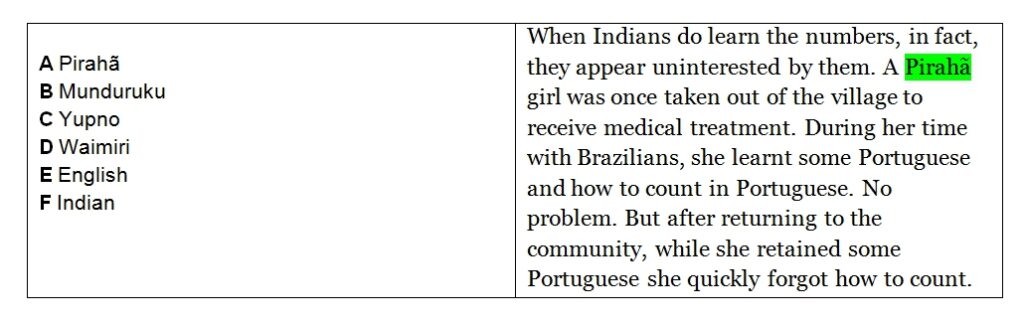
Step 3. Read about each name in the list. Match them with the statements.
The next step is to read about each group in the passage and try to match them with the statements. Be careful at this stage, because the information in the text is usually paraphrased, i.e. you will not read the same words. It is a good idea to work on your paraphrasing skills during your IELTS preparation as well.
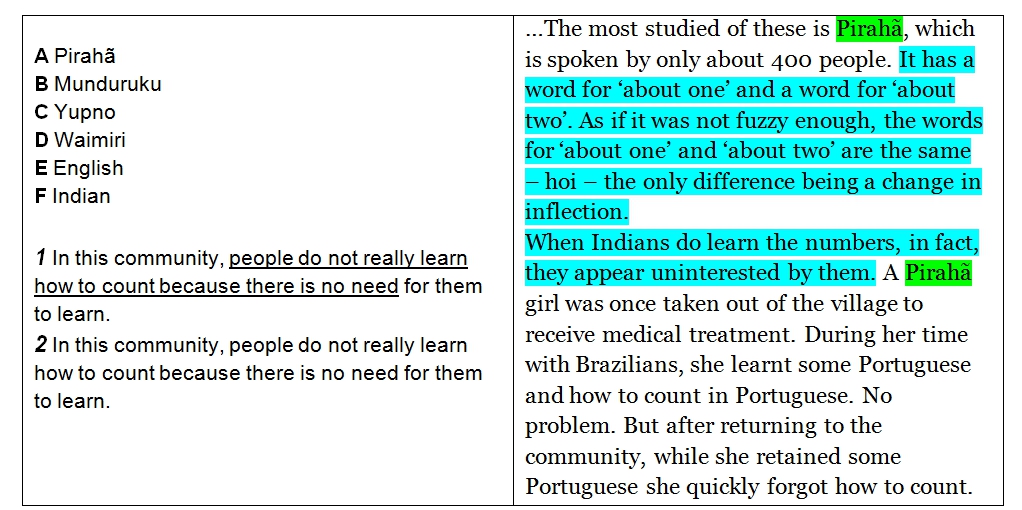
Remember, if matching features is the first task in IELTS Reading, read the passage quickly to get the general idea and see how it is organized like you do for other types of questions in the Reading sections.
If you still can’t match the correct option to a statement, use the elimination technique. As soon as you’ve matched all the statements to the corresponding options, review your answers and revise them if necessary.
During your IELTS prep, utilize these test-taking strategies when doing practice tests. You will find more strategies and tips for each type of questions in our online self-study course. We have done everything to boost your exam preparation and be 100% IELTS-ready.
Subscribe to our IELTS digest
Many students and test-takers get cold feet when they see this task in the IELTS Reading section on the day of the exam. Matching headings seems to be one of the trickiest types of questions in the IELTS Academic exam besides those where you have to answer multiple choice and true or false questions. Today, we are going to share an action plan with you so that you could solve this type of task more easily.
In the task, you will see a list of headings with Roman numbers, and a number of questions at the bottom. You need to find a suitable heading for each section. Sometimes, a section is a paragraph, or it may include several paragraphs. And, you there are always more headings than sections, for example, seven sections and eight headings or eight sections and nine headings. This also means that some headings will not be used. Remember, you can use each heading only once.

This type of question tests if you are able to understand the main idea of each paragraph. This suggests that in this question type you have to match each paragraph in the reading text to one heading, based on the general information in the text.
Take IELTS with confidence
Start your IELTS Grade online course
Matching headings type of questions may cause difficulties for many test-takers for a number of reasons:
Read further, and we will go through the action plan that will help you match headings more successfully step by step.
READ ABOUT: How to check your IELTS writing
In order to answer matching headings questions, you have to be good at skimming. This means you have to able to read a text quickly to get a general idea of its meaning. The answer strategy we offer explains how you can utilize skimming skills to tackle this question type.
Step 1. Quickly read the title and the text.
If matching headings goes as the first task, you will need to read the title and the passage quickly to get the general gist of what the text is about. You should not worry about the words you do not understand.
Step 2. Check how many headings and paragraphs you have in the task.
Remember, there are always more headings than paragraphs, so find out how many of them you will not need to use. For example, in the task below there are 8 headings and only 5 paragraphs, i.e. there are 3 extra headings:
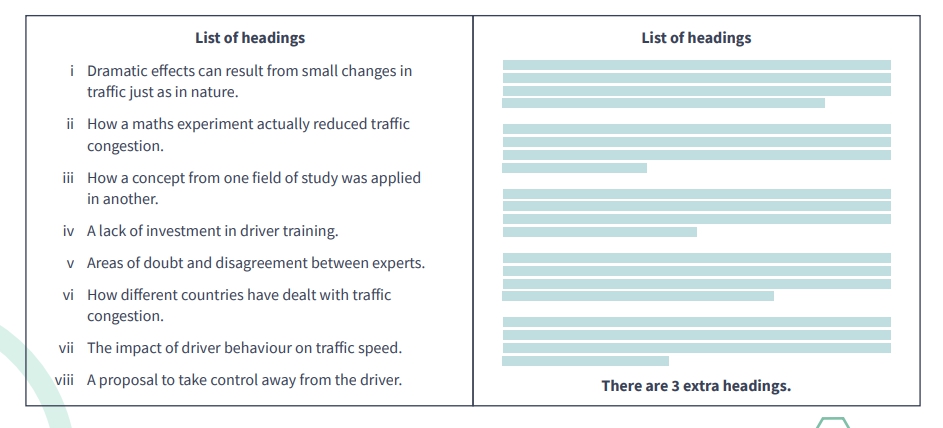
Step 3. Cross out the example paragraph and heading.
There is sometimes an example given for you. Do not waste your time on it, cross it out from the headings and the passage.
Step 4. Read the headings and underline the keywords.
You need to completely understand the meaning of each heading. This can be made easier by paraphrasing, i.e. if difficult, ‘translate’ the heading into simple English.
Underline the keywords in each heading. They are names, places, dates, and nouns, once you have read them thoroughly. This step will help you connect the correct heading to the appropriate paragraph.
READ ABOUT: Tips for note completion questions in IELTS Listening
Step 5. Read the first paragraph quickly. Underline the main ideas. Choose the best heading.
Your aim is to identify the main idea of the paragraph. As a rule, the first one or two sentences and the last sentence introduce and summarise this main idea. Remember, you do not need to know the detail for this type of question. However, the headings are usually worded in such a way that you need to know that thing right in the middle of the paragraph to find the answer.
Next, briefly sum up the main idea of the paragraph in your own words as if you were writing your own heading. Do it in just a few words or a short phrase at the most. You can write this beside it.
The key words are the clues but also synonyms are very likely to be used. When choosing a heading do not just select the first one that seems to match as there may be two that are very similar in meaning. Pay attention to the meaning.
The same words in headings and paragraphs may distract you. However, the similar idea in the paragraph may only be a detail, not the main idea. When matching a heading, ask yourself if it is the main idea of the paragraph.
Step 6. Do the same for all other paragraphs.
The next step is to do the same for all paragraphs that are left. Keep in mind that you can use the same heading only once. If it is difficult to decide on a heading, write several possible ones and a question mark, and move on to the next paragraphs. When you finish with the rest, there will be only a few headings left, so it will be easier for you to choose. Once you have finished the first round, you have read the whole passage, come back to the questions you could not answer. If you were hesitating between two options, it is likely that you have already used one of them for another section or paragraph, i.e. the answer becomes obvious.
When you are reading a paragraph, focus on the main ideas, not minor details or the same words.
In our IELTS Grade online course, we explore examples and provide you with strategies to deal with each type of questions of the IELTS Reading section as well as practice tasks and valuable feedback. It is a complete IELTS Academic self-study course with an extensive Writing practice and detailed analysis, automated instant feedback on writing using artificial intelligence, video comments and a full mock test imitating the conditions of a real exam. You can try the free version to feel the benefits of the course.
Subscribe to our IELTS digest
READ IN OUR BLOG:
– 8 strategies to achieve a perfect score in IELTS Listening
– What to expect at the IELTS Speaking test
– 25 phrasal verbs to avoid in IELTS Academic Writing
Most of the students and candidates consider this type of questions in IELTS Reading to be the trickiest. Have you already guessed which one it is? They are ‘True-False-Not Given’ or ‘Yes-No-Not Given’ questions. You must admit that it would be good if there were only true and false statements. However, what shall we do with the third option? Such questions often cause problems because of the difficulty in understanding the difference between answers that are ‘false’ or ‘not given’. Today, we are going to share some tricks and show some patterns that will help you find answers to those questions without much effort.
Almost all tests contain such questions, and chances are high that you will have them in your reading exam as well. Usually, True-False-Not Given questions come in the first passage, which is believed to be the easiest one, or sometimes in the second. Yes-No-Not Given questions appear in the second or the third passage most of the time. There are 3 to 5 questions of this type in a set, and you have to use all the answers.
What do we have to do for this type of questions? In the exam, you will get the paper where there will be the article you need to read and the questions. Here is the official sample task from the IELTS Academic exam.

READ ABOUT: How to deal with multiple choice questions in IELTS Reading
As you can see, each question is a statement. You need to look at that statement, read through the passage, and decide if this information is in the passage:
One more thing to remember is that ‘True-False-Not Given’ questions are about factual information while the ‘Yes-No-Not Given’ questions are all about the writer’s opinion.
Those are the basic requirements of this type of questions. Read further, and we will look at the difference between ‘True’, ‘False’ and ‘Not Given’ as well as at some examples.
Take IELTS with confidence
Start your IELTS Grade online course
The action plan for tackling ‘Yes-No-Not Given’ and ‘True-False-Not Given’ questions is exactly the same.
This is a step for all types of questions in IELTS Reading if they go first in the passage. It helps you find answers to questions in it more easily later on when you will need to read in detail the part of the text where you think the answer is.
For example: Marie became interested in science when she was a child.
For this, you will need to scan the text and find similar words and synonyms in it. The same words help locate facts in the passage. Synonyms help us choose the answer.
The only paragraph where we can read about her childhood, goes like this:

Now, let us read more carefully and watch out for the synonyms or the opposite meanings to choose the answer.
‘From childhood’ has the same meaning as ‘when she was a child’. Then we read about ‘medical studies’ which is also related to ‘interested in science’. However, does this information coincide with what we read in the statement? No, it doesn’t. Does the passage say anything that contradicts with our statement? Not really. What we can learn about Marie as a child is that she ‘was remarkable for her prodigious memory’, and it was her sister whose medical studies Marie financed. Can we find any information about what she was interested in when she was younger? No, we can’t. What does this mean? The answer is simply NOT GIVEN in the reading passage.
After you have chosen the answer, return to Step 2 with the rest of the statements and follow the same procedure.
In our course, we look at more examples in detail and analyse various answers for this type of questions in the IELTS Reading exam. Our IELTS experts share other useful tips on tackling ‘True-False-Not Given’ questions. Join our course if you want to know all of them and skyrocket your IELTS result.

Recently we have written about checking you IELTS Writing.
Subscribe to our IELTS digest
In the IELTS Reading exam, there are several types of questions. Multiple choice are one of them. They regularly appear in both modules of the test: General and Academic. Most candidates tackle them with no effort. However, they might be quite tricky. That is why it does not take much effort for candidates and students of IELTS to pick up the wrong answer.
Today, we will look at some useful tips that will help you find correct answers and achieve high score at the IELTS Reading exam.
In such type of task, you will have to read the first half of a sentence, a statement or a question about the text, and choose the most appropriate sentence ending, response or answer from a choice of a number of options (usually 4 or 7). The instructions can be set out like this:

This type of question tests if you can:
The answers for such type of questions in the Reading sections are very likely to come in order. Bare this in mind when reading the questions and scanning for information. Therefore, the strategy you will need to use is scanning. If more than one answer is possible, read in detail.
Tip # 1. Read the passage quickly. Spend around 2 minutes on this. It will help you get general idea, and look at the organization of the paragraph, especially if multiple choice questions are the first questions to a passage.
Tip # 2. Read the questions/ statements/ incomplete sentences. However, do not read the options yet. Next, underline the keywords in it and ‘translate’ it into simple English. What does this mean? Make sure you understand the question.
For example:
TASK
Choose the correct letter, A, B, C or D.
One of the facts provided in David Storey’s study suggests that …
Take IELTS with confidence
Start your IELTS Grade online course
READ ABOUT: 6 typical mistakes in IELTS essays
Tip # 3. Scan the passage and locate the question. Use quick reading, keywords and proper names from the question to look for the information in the text.
For example:
TASK
Choose the correct letter, A, B, C or D.
One of the facts provided in David Storey’s study suggests that …
TEXT
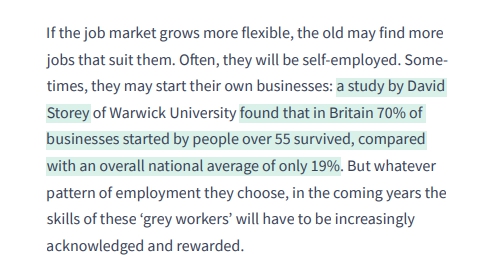
If the job market grows more flexible, the old may find more jobs that suit them. Often, they will be self-employed. Sometimes, they may start their own businesses: a study by David Storey of Warwick University found that in Britain 70% of businesses started by people over 55 survived, compared with an overall national average of only 19%. But whatever pattern of employment they choose, in the coming years the skills of these ‘grey workers’ will have to be increasingly acknowledged and rewarded.
Tip # 4. Look for the answer to the question in the passage. Once you have found it, underline it. You will need it further.
READ ABOUT: 25 phrasal verbs to avoid in IELTS Academic Writing
Tip # 5. Return to the options. Now, it is time to read the options that the task suggests and compare them with the answer you have underlined in the passage. Choose the one you think is the best.
Tip # 6. If in doubt, check all the options critically. You might still hesitate. So, it’s a good idea to think why the other options are wrong and cross them out. These options are, as a rule, not related to the topic.
Tip # 7. Watch out for distractors. In the Reading section of the IELTS, they are the same words that you can see in the options and in the paragraph. In fact, they may be there only to distract you. The meaning of the sentence that contains such words is usually different from the correct answer.
Now you know how to tackle multiple choice questions in IELTS Reading. You may use our tips as an action plan even if you have to choose more than one option. In this case, go through steps 1 – 4. Next, read the options. Compare with the passage. Choose the number of options you need. After that proceed with steps 6 and 7.
In our course, we will explore multiple choice questions in more detail, look at examples and work out more useful tips. You will save all the advice you get in a Knowledge Bank, receive instant feedback, develop other skills like listening, speaking and extensively work on your academic writing, track your progress and a full mock Speaking and Writing tests with a detailed feedback from IELTS preparation experts.
Recently, we have written about IELTS Reading key facts.
Subscribe to our IELTS digest
Many candidates and students struggle with the IELTS Reading section. Difficulties appear because they might not be aware of the essentials of the Reading test, such as time, number of questions and types of texts, and some other basic, but indispensable facts. However, good news is if you are reading this blog, you still have some time to correct your mistakes and change the route of your preparation towards passing the IELTS exam successfully. Below, we are going to discuss everything you need to know about IELTS Reading as well as everything you need not to get lost on the day of the exam.
1. The tasks are different in each module of the IELTS test: General and Academic. You will take the exam together with other candidates regardless the module. As you already know, you will do the Listening section in the same room. Right after that, you will remain seated and proceed with the Reading and Writing sections. Candidates do not change the rooms until the end of the test.
2. The types of questions in both modules of IELTS Reading are basically the same. This means that the IELTS Reading sections in general and academic modules differ only in contents. For example, you may need to:
We will look specifically at all question types and give you lots of useful tips in our course.
Take IELTS with confidence
Start your IELTS Grade online course
3. The duration of the IELTS Reading test is 60 minutes. You have to manage your time properly in order to complete all tasks. Try to spend no more than 20 minutes on each part of the test (there are 3 of them). However, you will notice that the first part is usually shorter. So, it is recommended to spend less time on it if you want to complete the rest of the tasks in time.
4. In IELTS Reading, you have to answer 40 questions. All of them are divided into several texts with different levels of difficulty. That is why some of the questions might seem easier, and others will look more difficult. Your task is to answer all of them.
5. Texts for IELTS General Training and Academic Training come from different sources. If you are taking IELTS Academic, you should get used to reading texts from books, journals, magazines and newspapers written for a non-specialist audience. At least one text contains detailed logical argument. They may also contain non-verbal materials such as diagrams, graphs or illustrations. If texts contain technical terms, a simple glossary is provided. That is because most IELTS Academic test-takers enter undergraduate or postgraduate courses or seek professional registration, and they are going to deal with these kinds of texts further in their studies or work.

READ ABOUT: IELTS Reading tips and resources
Those who take IELTS General should prepare themselves for ‘social survival’, i.e. you have to understand general factual information, such as timetables or notices. The texts are also about ‘workplace survival’ where you have to read a job description or staff development materials, for example. And the last part involves reading newspapers, magazines and fictional and non-fictional book extracts, i.e. is about general context.
6. You will have no extra time to transfer your answers. Remember that you have to do everything in 60 minutes. Be very attentive when writing answers on the answer sheet as poor spelling and grammar are penalised.
7. You can get a maximum of 40 points for IELTS Reading. Each correct answer is worth 1 mark. After that they are translated into IELTS 9 band scale. In the tables below you can see the average number of marks required to achieve a particular band score in Academic Reading and General Training Reading.
|
Academic Reading |
|
|
Band score |
Raw score out of 40 |
|
5 |
15 |
|
6 |
23 |
|
7 |
30 |
| 8 |
35 |
and
|
General Training Reading |
|
|
Band score |
Raw score out of 40 |
|
4 |
15 |
|
5 |
23 |
| 6 |
30 |
| 7 |
34 |
| 8 |
38 |
Now, when you are already aware of the structure of the IELTS Reading test and know what to expect, here are some helpful tips from our IELTS experts:
Tip #1. You should read not only the texts but also the instructions. Always check how many words you need to write, and how many options to choose in each question.
Tip #2. Do not even try to understand every single word. You will waste precious time and fail to find the answers to the questions, which is your goal, isn’t it? It’s a good idea to scan the text and find the necessary information such as keywords. Then, read this part of the text more carefully.
Tip #3. Do not get stuck if you can’t find the answer. If you spend too much time on the question you cannot answer, you are likely not to finish in time. Simply skip it and return to it later.
Tip #4. Do not leave blank answers. You have to answer all 40 questions. You will not get any penalties for choosing the wrong answer. If you are not sure, try any option that seems most appropriate. Chances are you can get it right.
Tip #5. Complete the answer sheet after each part. Once you are done with the first text, for example, transfer your answers. Then, proceed to the next task. This will help you save time and finish your test before it’s too late.
You will learn more useful tips and tricks in our complete IELTS Academic Writing self-study course with video lessons on all parts of the test, including reading strategies, sample tasks, feedback from IELTS experts, and a detailed self-study plan from 1 week to 2 months. Register for a free trial now or buy the full course and get access to all parts of the IELTS preparation.
Subscribe to our IELTS digest
READ ABOUT: 6 typical mistakes in IELTS essays
Self-preparation for IELTS includes working on all parts of the test. Where and how can one better get ready for IELTS Reading?
Both IELTS tests, academic and general, check different reading skills, such as reading for gist, understanding main ideas, details, recognizing authors’ attitudes, how the argument develops in the text, and so on.
IELTS uses different texts to test these skills. You can see such texts as articles from periodicals, professional magazines, books and newspapers at IELTS Academic. Texts related to daily life, work and general interests, such as announcements, booklets, leaflets, handbooks, notes, newspaper and magazine articles could be seen at IELTS General.
We suggest using a number of resources to develop your English reading skills. These materials are very well suited as samples for IELTS Reading.
Reading Practices from IELTSLiz will help you familiarize yourself with the texts and tasks for IELTS Reading. These are not test samples but lessons designed specifically for reading practice. There are lessons for different levels with different types of tasks and answers to them.
IELTSBuddy offers a series of lessons that cover all types of questions you might encounter in the IELTS Academic test. Each lesson includes reading with 600 to 800 words, questions and answer keys.
IELTS-up offers a series of lessons and reading exercises. This site also has IELTS Reading practice tests.

In addition to doing IELTS practice tests or lessons, you should regularly read in English. Of course, do not limit yourself to IELTS hands-on materials. Reading English newspapers and magazines is a great way to develop reading skills. Many texts for IELTS Reading have been selected from the following sources.
Take IELTS with confidence
Start your IELTS Grade online course

IELTS Online Tests.com offers a few good trial tests of IELTS Reading. Most candidates take General IELTS, but you may need Academic IELTS for certain professions and university programs. IELTS General Training and IELTS Academic Training can be practiced on this site.
TakeIELTS is an official website of the British Council, where you can take a reading test. Just choose general or academic. You will have 1 hour to complete all 3 sections of the IELTS Reading section.
IELTS-Exam is a test sample resource for all IELTS skills. Also on this site you will be able to take the Mock Test, which will not only introduce you to the IELTS format, but also give you an idea of how you will take the test. In one hour, you will pass a full test, which will improve your time management skills and identify realistic expectations of your potential results.
Subscribe to our IELTS digest
Read More: