
Here are suggested study plans for you
to make the most of the course
If you want to do well in the Reading section of the IELTS Academic test, make sure you practice doing different tasks: matching features, matching headings, true or false questions, multiple-choice, etc. Among more than ten question types you can be given in the IELTS Reading section note completion is one of the most frequently seen ones. Therefore, it is advisable to understand how to deal with such a type of question if you get in your test. In our today’s blog, we are going to guide you through the process of answering note completion questions step by step.
In this type of task, you will have to complete a summary of some information in the text you will read. This summary may look like this:
Take IELTS with confidence
Start your IELTS Grade online course
You will have to fill in the gaps with the words and/or numbers from a part of the text. The task tests your ability to understand the details or main ideas of the reading passage. It is also required that you to know what type of words will fit into a given gap (for example, whether it is a noun or a verb, adjective or adverb, etc).
The passages for such types of questions are usually descriptive. The answers might occur in the same order as in the passage, but not necessarily. However, they will usually come from one part of the passage rather than being spread across the entire text.
READ ABOUT: How are IELTS Listening and Reading scores calculated?
Step 1. Quickly read the title and the text.
You shouldn’t spend much time on this. Reading the text quickly will allow you to gain an idea of what it is about. Don’t worry about the words you don’t understand.
Step 2. Check the instructions.
The instructions not only give us a clue that you need to fill in the blanks, but they also provide us with very important information regarding the number of words you have to write in your answer. In addition, make sure you know what you can and cannot write for each gap.
For example, you can see the instructions worded like these:
If the instruction says, ‘WRITE NO MORE THAN TWO WORDS’ and you write three, the answer will be incorrect, and you will not get any points.
Step 3. Read the sentences. Underline keywords in them.
Keywords will allow you to understand the focus of the questions. They can include names, places, figures, nouns, verbs, adjectives, etc.
Step 4. Use the keywords to find the part of the text you need.
You will have to scan the text to find the right information for each sentence from the task starting from the first one.
Step 5. Predict what kind of word(s) you need for the gap.
By looking at the words before and after the gap, you can work out what part of speech is missing, whether it is a noun or a verb, an adjective or an adverb, etc. Try to predict the answer. After that, read the part of the passage attentively paying attention to the keywords.
Step 6. Find the word(s) for the gap.
As you read the paragraph, you will notice the keywords and some of them will be paraphrased. As you find the word in the text, copy it into the gap exactly as it is in the text. Check you spell it correctly because answers with the wrong spelling are counted as wrong ones.
Step 7. Read the sentence again.
Finally, you have to read the sentence again and check if it is grammatically correct. Make sure it makes sense. If so, move on to the next sentence and do steps 3 to 7.
READ ABOUT: How to prepare for IELTS Speaking and get the highest score
In summary completion, you will have to fill in the gaps in a summary that is a short text giving the main information about a longer text without giving all the detail. In order to complete the task, you should understand the main points of the text. The information in the summary may be about one paragraph or about a longer part of the text, but not about the whole passage.
The steps and tips for summary completion are pretty the same as the ones you have to do for sentence completion questions above.
However, sometimes, in summary completion, you have to use the words not from the passage, but from a list of suggested options.

In this case, you need to follow all the same steps as with the sentences or a simple summary completion. However, once you found the answer in the passage, compare it with the suggested options and choose a synonym.
There is another timesaving trick. You can predict the answers before reading the passage more easily. If you see that you are running out of time, this may be very handy.
Anyway, it is highly recommended that you read the passage and make sure you have answered correctly.
There are other types of completion: table, flow-chart, and diagram. Nevertheless, the same strategies that we’ve just learnt can easily be applied to them. Of course, some peculiarities depend on the type of visual you get. Go to our online complete IELTS Academic self-study course, if you want to do a detailed analysis of all types of IELTS Academic Listening, Reading, Writing and Speaking tasks, do sample IELTS tasks, practice tasks with an automated checking system, get access to the exclusive Facebook community where we share more life-saving tips and tricks for IELTS Academic.
Subscribe to our IELTS digest
READ IN OUR BLOG:
The IELTS Listening section is the same in both general and academic training exams. It lasts for 30 minutes and includes 40 questions that are split into 4 parts. Questions tend to get more complicated as you progress through the test. You need to answer 30 questions correctly to get band 7, or 35 questions to get an 8. Sounds a bit tough, doesn’t it? However, if you learn how to manage your time effectively during the exam, and what mistakes to avoid, you will be able to answer more questions regardless of the version of the exam you are planning to take: paper or computer-based.
Candidates very often waste their time and lose points just because they do not know what to do, what to look at, where to write their answers etc. In order to avoid this, during your preparation make sure you learn:
You can learn all of these things in our online self-study IELTS Academic preparation course. We will take you through all types of tasks step by step, teach you tips and useful strategies, and give you immediate feedback.
It is advisable to practice doing past papers and mock exams, which is also a part of our self-study course.
Take IELTS with confidence
Start your IELTS Grade online course
You never know exactly what information you will need to answer the questions. For the questions like form-filling, for example, you need to listen carefully for things like names, dates, time, or other details. For multiple-choice questions, you have to understand the general idea of the conversation. Not following the instructions might cost you too much. To avoid this, there are a few steps to do before you start listening to the recording:
What happens if you do not follow these steps? For example, you might be asked to circle more than one answer. If you circle only one, the answer will be incomplete, i.e. incorrect. Do exactly what the instructions say. In the other case, the instructions can tell you how many words you should write in the answer, e.g. ‘NO MORE THAN TWO WORDS AND / OR A NUMBER’. It is highly recommended to read the word-count instructions very carefully. If the instruction says ONE word and you write ‘the gym’, the answer will be marked as incorrect, even though ‘gym’ is the correct word.
READ ABOUT: Key facts you need to know about the IELTS Listening test

It is true that you have to know and apply a certain strategy for answering each type of question in the IELTS Listening section. Poor skills in particular question types create a huge challenge to IELTS candidates in labeling maps, for example. If you are unfamiliar with this question type, it will be really difficult to get the right answer. The best solution is to understand all the question types and learn strategies on how to answer them. We cover and practice using all strategies in our online course.
Similarly, it is important to pay attention to the keywords. How does it work? You will have some time to read the questions before listening to the audio passage. Look for keywords in the questions, underline them and listen to them carefully in the passage. This will not only give you the idea of what the passage is going to be about but help you not to lose focus while listening to longer conversations or a lecture.
Losing focus is a real problem for many students and candidates: this can happen at specific places, and they miss important information for the following questions. However, you can avoid this problem if you listen for signpost words as well. These are the words the speakers use to indicate the different stages of the talk. For example, if the speaker wants to compare two things or talk about something different, you might hear ‘On the one hand / on the other hand’, ‘Another point to consider is…’, ‘However,…’, etc. When he or she is summarizing information, you might hear ‘Finally’, or ‘To summarize…’, ‘Lastly’, etc.
You will know what information is coming next, and this will help you follow what the speaker is talking about.
READ ABOUT: How are IELTS Listening and Reading scores calculated?
In IELTS paper-based test, you will write your answers on question sheets, and then you will get extra ten minutes to transfer your answers into the answer sheet. If you take a computer-based exam, you answer directly on the screen, so you do not need those ten minutes. You will have only two. In the computer-delivered test, the questions you have answered will be highlighted.
Make sure you do not leave any blank spaces. In IELTS Listening you do not lose marks for wrong replies. The power of probability can be applied by guessing where there is a possibility that the supposed answers might be right.
Check your spelling. If you make spelling mistakes, your answer counts as the wrong one and you do not get any points for it. Make sure you can spell commonly used words correctly, e.g. library, environment, street, avenue, professor, names of city or country or address, etc.
Check your grammar. Pay attention to singular and plural nouns, verb forms. The sentences always have to be grammatically correct. For example:
In the note completion questions, read the sentence to see if it is grammatically correct. This is how you can check yourself.
The last but not least, make sure you put the right answers in the right place. This might happen when candidates do a paper-based test and transfer their answers to the answer sheet. It’s always good to double-check.
Subscribe to our IELTS digest
IELTS two-views-and-opinion essay tips
Tips on matching features in IELTS Reading
How to avoid repetition at the IELTS Speaking test
The Speaking section of the IELTS Academic is without doubt considered to be quite a complicated part of the test. Candidates never know for sure what questions the examiner will ask them. However, if you clearly understand the format and how your response is evaluated, and if you know some useful tips and strategies, you can reduce the stress and perform excellently.
Today, we are offering you a word of advice on how to prepare for the Speaking section of the IELTS Academic.
For example, in Part 1, the examiner will ask you some simple personal questions on everyday familiar topics such as work, study, where you live, food, holidays, friends, going out, festivals, sports, schools and public transport. The examiner usually reads these questions from the script.
In Part 2, the examiner will give you a topic on a card, and you will have to speak about it for about 2 minutes. You will have 1 minute to prepare. You can take some notes. Usually such tasks ask the candidate to talk about personal experiences such as a significant person in your life or a memorable event. After you finish speaking, the examiner can ask you one or two follow-up questions.
Part 3 of the Speaking test is called a discussion. It is related to the topic from Part 2. However, the examiner will ask you more complicated questions. You will have to justify various opinions and views, evaluate, make predictions and talk about your preferences connected to the issue.
Take IELTS with confidence
Start your IELTS Grade online course
It is a good idea to have someone you can practice the speaking part of the exam with because you can get the feedback. You also practice giving feedback and have a better understanding of what is required in the test.
Even if you already have a study partner, try recording you answers and analyze them. For example:
— Did I paraphrase the question?
— Did I use the variety of lexis and grammar?
— Did I repeat myself?
By recording yourself, you receive an important tool of self-awareness – understanding your own strengths and weaknesses that stimulates further learning.
READ ABOUT: How to avoid repetition at the IELTS Speaking test

Recently we have launched the Speaking unit of our IELTS Academic self-study course where you can practice answering all types of questions, get feedback on your responses, and listen to sample responses accompanied by the teacher’s comment. Finally, you will go through a full imitation of the Speaking test and, once again, get detailed feedback and see sample responses.
As you know, in IELTS Speaking Part 2, you are supposed to speak for 2 minutes. While preparing for the exam, use a timer. By doing so, you will understand how much you have to say and develop the feeling of time, i.e. how long these two minutes are. On the day of the exam, the examiner will stop you when the time is over.
In the second task, you can take notes, so learn how to do this effectively:
— don’t write in full sentences;
— form the main ideas for all prompts;
— think about approximately three details for each prompt that you would like to mention;
— develop your own system of shortening symbols, abbreviations etc.;
— write down your ideas.
These phrases will provide a structure to your response and help you organize it. By doing so, you will shape your answer, and the examiner will follow your thoughts without any effort. For example: I am going to talk about…, The reason why this person is so significant is …, Moving on to the question… etc.
You can do this with a study partner or by recording your own answers. In such way you can evaluate whether you covered all the points that you were asked to, whether you covered them well enough or not. Sometimes candidates concentrate only on two cues and do not cover the rest at all. Be careful with this too.

READ ABOUT: How not to pass IELTS Speaking: common mistakes made by candidates
It is important to notice the words you require to complete the task. For example, if you need to describe a place, think about the words and phrases you want to tell about it. If you do not know how to say this in English, look up in a dictionary, learn, and use in sentences. It will be good to prepare a few phrases for each topic, but do not just learn them to impress the examiner.
This is an important part of your preparation. There are some typical questions you will have to answer in Part 3. They are:
— questions about your opinion, e.g. What do you think…?
— evaluation questions, e.g. What do you think about this or that opinion?
— making predictions, e.g. What do you think will happen…. in the future?
— questions about cause and effect, e.g. What caused ‘this’ and/or what effects has ‘it’ had?
— questions about unreal or imaginary situations where you have to make a hypothesis, e.g. Imagine you…., What would you do …?
— comparing and contrasting, e.g. What are the differences / similarities between …?
— questions about the past and present, e.g. How were things different in the past and how have they changed?
When recording yourself think if you use those and think what you could have used instead. This will help the examiner to assess you based on your fluency. For those who speak English as a native tongue, linking words or idioms come without any effort. However, if you are a non-native speaker, you have to learn them and practice using.
You will need this vocabulary in Part 3 of your Speaking test. It is advisable to brush up this functional language.
On our platform, you have a possibility to do tasks related to these aspects, record yourself and check your speaking performance via self-assessment checklist. This helps you better understand where you are now in terms of your speaking performance. We have also designed speaking practice tests that are to be recorded by users and then listened to by IELTS professionals who will check them and provide feedback with the aim of giving a clear picture of what is done effectively and what still should be improved. On top of that, we offer tasks that focus on improving your own language and learning chunks that will help not only win some time on the day of the exam, but shape the response and make it more automatic.
Subscribe to our IELTS digest
MORE TO READ IN OUR BLOG:
How to avoid repetition at the IELTS Speaking test
Tips for writing advantages and disadvantages essays
How to do multiple choice tasks in IELTS Listening
How to deal with multiple choice questions in IELTS Reading
You will definitely do better in the Writing section of IELTS Academic if you take some time to familiarize yourself with different types of essays that can appear in the exam, learn and practise useful tips and strategies for each of them.
Students and candidates might often find it difficult to distinguish between two-views-and-opinion essays, opinion essays or advantage and disadvantage essays . However, if you read the task carefully, you will easily identify which type of essay you are supposed to write because questions for two-views-and-opinion essays can be worded in several different ways. For example:

What does this mean? In this type of task, you will have to complete three different tasks:
For example:

The task above looks at two views:
That is why you have to write why people think students should spend equal amount of time on different subjects, and why others consider that it is advisable to spend more time on favourite subjects. Finally, you have to choose one of these opinions and provide reasoning.
It is likely that you will use the wrong structure for your essay if you misidentify the type of the question. It is also one of the reasons why many candidates do not give their opinion, do not provide arguments for both views, or they do not develop both sides of the arguments appropriately, i.e. to an equal extent. These are considered blunders because the question clearly states that one has to give their opinion. Regardless which side you take, give equal attention to both. Providing more weighty reasons for the view you prefer leads to a badly balanced essay and high chances of poor task achievement, i.e. your lower score.
READ ABOUT: How to link ideas in IELTS essays
You might have read about different ways to write a two-views-and-opinion essays but the one we are offering will make you write your essay in a few simple steps.
Step 1. Analyse the task.
As we have mentioned above, you have to read the task carefully. Next, underline the key information in the topic. By doing so you will have a better understanding of what to write about and what you do not need to do.
After that, try to paraphrase the statement for yourself using simple language in order to understand it better.
Take IELTS with confidence
Start your IELTS Grade online course
Step 2. Map out your essay.
It is important to plan your essay in detail. This will help you outline it properly and provide a good score for the structure and organization.
Since you are going to write about two different views, it is a good idea to brainstorm details and examples to support both sides. These should be reasons to support the views and some examples.
Next, decide on your own opinion. You have to choose whether you support view 1 or view 2. If you can’t choose, go for a balance. Think of details and examples for your opinion as well.
Step 3. Write your essay.
First, write the introduction where you have to introduce the topic, the issue, state your opinion and what will be discussed.
The main body should include 3 paragraphs:
Finally, write the conclusion where you need to summarize views 1 and 2, and restate your opinion.

Step 4. Check your essay.
First of all, pay attention to spelling mistakes. Next, read your essay and look for mistakes you typically make. After that, make sure you do not repeat yourself too much and use proper linking devices to receive a high score for the criterion of Coherence and Cohesion.
READ ABOUT: How to check your IELTS writing
If you use our tips for writing your two-views-and-opinion essay, it will have the following structure:
INTRODUCTION:
|
| MAIN BODY:
Paragraph 1:
Paragraph 2:
Paragraph 3:
|
CONCLUSIONS:
|
In our course , we you will learn how to build all possible types of essays step by step. You will practise brainstorming ideas and writing different parts of the essay, learn useful language to present your ideas and make your essay well-organized and coherent. You will do a lot of writing practice and receive feedback from our IELTS experts. Finally, you will take a mock test that will allow you to feel the taste of a real exam.
Subscribe to our IELTS digest
READ ABOUT: 5 easy steps to complete IELTS Academic Writing Task 1
There are more than 10 different types of questions you can receive in the Reading section of the IELTS Academic exam. Moreover, there are 3 reading passages with 40 questions you have to answer in an hour. This means that you will deal with up to 4 questions of different types per passage, and it is good to know how to deal with them. Matching features type of question is one of the types of tasks at the IELTS exam that most students struggle with. However, regular practice and a good strategy will help you to tackle it without efforts.
On the day of the exam, you will have your passages on the separate page, and the instructions, the features and the list will be on the other page. This type of question will ask you to match a numbered list of factual statements or opinions to features. Usually, the features are taken from the text, i.e. you will have to be able to identify these opinions or features and recognize the connections between these aspects of the passage.
In this task, you will often have to match a list of people’s names to a list of statements using the information in the text to make the correct matches. For example, the names of researchers, experts or scientists. The statements will normally be research findings, theories, dates with events, places, facilities etc.
Take IELTS with confidence
Start your IELTS Grade online course

For example, in the task above, you see the list of cultures and the statements. You have to match each statement with the correct culture. In other words, you need to read the text and find out who does/did what. For each question, you will need to write the letter of the feature which matches the statement. Make sure you put the letter, not the name of a person or place.
READ ABOUT: How to deal with multiple choice questions in IELTS Reading
Tip #1. Keep in mind that the statements, or items, do not usually come in the same order as in the text, but the people or things in the list do. Remember this when you look for the answers in the passage.
Tip #2. The number of letters in the list can sometimes be bigger than the number of statements. In this case, you do not need to use all of them. Some are odd.
Tip #3. It is possible that you will have to use the same letter more than once. Do not worry if you use letter B twice, i.e. if you match it with two different statements. This does not mean you have made a mistake. It is possible that some options in the list will not be used, and others may be used more than once.
Tip #4. Do not write any names or words in your answer sheet. Remember that your answer is one of the letters from the list. Do not mix it up with the letter of the paragraph where you find the answer (if the passage contains several paragraphs, they are also named with letters A, B, C etc.).
READ ABOUT: Useful tips to tackle true or false questions in IELTS Reading
Matching features task in IELTS checks your ability to determine specific crucial moments in the text as well as distinguish the connections between opinions and facts. You can easily walk through the task if you follow our practical advice during your preparation for IELTS Academic.
Step 1. Read and paraphrase the statements.
First of all, you have to understand the statements, so try to “translate” them into simple English. Some statements might be longer, i.e. they have more keywords and it may be more difficult to understand them. It is important to examine the statements and look for names, dates, and other critical points in them. We highly recommend not to skip this step.
Step 2. Locate the options form the list and underline them.
After you have processed all statements, move on to the list of options with letters. You have look through the text and find these options in the passage in front of you. When you find them, underline or highlight.
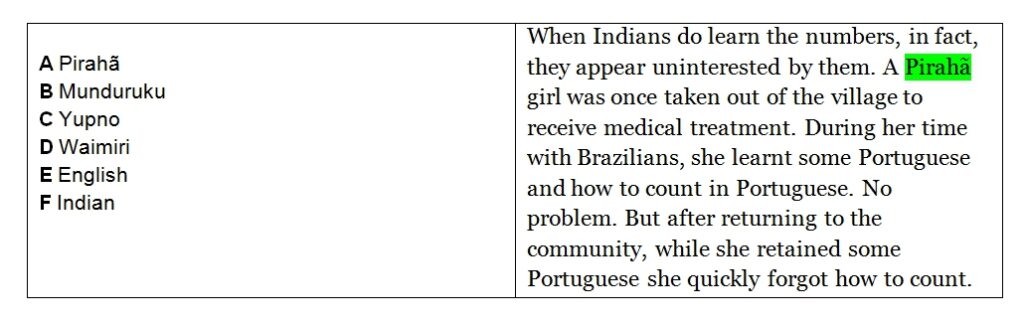
Step 3. Read about each name in the list. Match them with the statements.
The next step is to read about each group in the passage and try to match them with the statements. Be careful at this stage, because the information in the text is usually paraphrased, i.e. you will not read the same words. It is a good idea to work on your paraphrasing skills during your IELTS preparation as well.
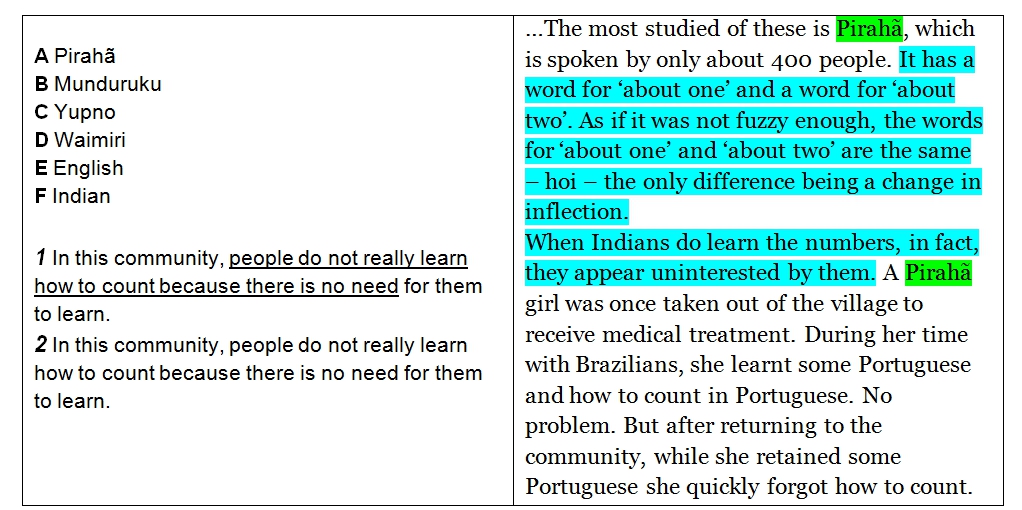
Remember, if matching features is the first task in IELTS Reading, read the passage quickly to get the general idea and see how it is organized like you do for other types of questions in the Reading sections.
If you still can’t match the correct option to a statement, use the elimination technique. As soon as you’ve matched all the statements to the corresponding options, review your answers and revise them if necessary.
During your IELTS prep, utilize these test-taking strategies when doing practice tests. You will find more strategies and tips for each type of questions in our online self-study course. We have done everything to boost your exam preparation and be 100% IELTS-ready.
Subscribe to our IELTS digest
IELTS is a multilevel exam designed to assess what candidates can do in English rather than measure them against a standard they may have not yet reached. For example, those with B2 level of English according to CEFR “can understand the main ideas of complex text on both concrete and abstract topics, including technical discussions in his/her field of specialization; can interact with a degree of fluency and spontaneity that makes regular interaction with native speakers quite possible without strain for either party etc.” In the IELTS exam, you will get a score between 1 and 9 for each section: Speaking, Listening, Reading and Writing. The average of those makes your overall band score. Unlike the Writing and Speaking sections, in which your skills are marked against a number of criteria, including ‘fluency and coherence’, ‘lexical resource’, ‘pronunciation’, ‘grammatical range’ and ‘accuracy’ , your answers are either correct or incorrect in the Listening and Speaking sections, i.e. the marking is quite different.
READ ABOUT: How is IELTS Writing assessed?
Take IELTS with confidence
Start your IELTS Grade online course
There are 40 questions in the reading section. This part of the exam uses various types of questions such as multiple choice, matching headings, True-False-Not Given, sentence completion. You have to answer all the questions to get a higher score. However, your answers are either correct or incorrect. Each correct answer gives you one mark. The total number of marks determines your band score. You do not get any penalties if your answer is wrong.
Below you can see that the number of marks required to achieve a certain band score is different for the IELTS Academic Reading and IELTS General Reading.
General Reading:
| Band score / 9 | Raw score / 40 |
| 9 | 40 |
| 8.5 | 39 |
| 8 | 37-38 |
| 7.5 | 36 |
| 7 | 34-35 |
| 6.5 | 32-33 |
| 6 | 30-31 |
| 5.5 | 27-29 |
| 5 | 23-26 |
| 4.5 | 19-22 |
| 4 | 15-18 |
| 3.5 | 12-14 |
| 3 | 9-11 |
| 2.5 | 6-8 |
Academic Reading:
| Band score / 9 | Raw score / 40 |
| 9 | 40-39 |
| 8.5 | 38-37 |
| 8 | 36-35 |
| 7.5 | 34-33 |
| 7 | 32-30 |
| 6.5 | 29-27 |
| 6 | 26-23 |
| 5.5 | 22-19 |
| 5 | 18-15 |
| 4.5 | 14-13 |
| 4 | 12-10 |
| 3.5 | 9-8 |
| 3 | 7-6 |
| 2.5 | 5-4 |
You can also use an online IELTS calculator to know your approximate score.
READ ABOUT: Which IELTS should you take: general or academic?
There are 40 questions and 4 parts of the Listening test, 10 questions per each part. There are some common types of questions you may come across and need to know how to answer such as matching, multiple choice, note completion, labeling a plan or a map etc. Each type of questions requires the knowledge of certain strategies from you. However, your answers can be correct or incorrect like in the Reading section of the exam.
Although there are two modules of the IELTS test: General and Academic, the Listening section will be the same for all candidates. Each of your correct answers brings you one mark, i.e. you can get maximum 40. The raw score is converted into IELTS band from 1 to 9:
| Band score / 9 | Raw score / 40 |
| 9 | 39-40 |
| 8.5 | 37-38 |
| 8 | 35-36 |
| 7.5 | 32-34 |
| 7 | 30-31 |
| 6.5 | 26-29 |
| 6 | 23-25 |
| 5.5 | 18-22 |
| 5 | 16-17 |
| 4.5 | 13-15 |
| 4 | 11-12 |
The marking and scoring of the computer-based IELTS exam is the same as paper-based IELTS.
READ ABOUT: How computers grade your IELTS Reading and Speaking
In our course, you will learn about the types of questions, analyse the strategies and practise completing the tasks in the Reading and Listening sections of the exam. You also receive a downloadable summary of the main strategies and examples that will help you perform better.
Subscribe to our IELTS digest
Do you agree that IELTS preparation can be nerve-racking, time-consuming and expensive? Nevertheless, you have to take this exam if you want to get a degree from an English-speaking university or pursue a career where you need to have some academic background. Being an IELTS preparation centre for more than 10 years, we have had a lot of experience helping students pass the exam and have seen what difficulties our students face and what they lack in order to get their desirable score. Writing has always been the most challenging part of the test and usually it is Writing where students have had lower scores than in the other sections of the test. A few years ago, this urged us to launch a project helping learners get the most of their preparation time and together with improving their test performance get what they aim at. Today, the insiders, creators and coordinators of IELTS Grade self-study course, Andrii Pigariev and Anfisa Kramarenko, are sharing their insights and ideas to give you a better understanding of what IELTS Academic preparation is and how to make it more effective.
Andrii: Of course, an online is not a face-to-face course with a tutor who could identify and fix your weak areas, but the idea we had was to develop a course that would provide well-rounded preparation that could help learners understand all the varieties of tasks and train completing them within the allotted exam time. Therefore, we started with Writing and then focused on other parts of the test so that our students could receive everything they need in one place.
Anfisa: When creating and upgrading tasks in the course, we are usually guided by the general principles of communicative approach. We also tap into our experience in observing teaching and, more importantly, learning that happens in the classroom, individually and distantly. Insights from all of these environments help us make the experience of our students online more meaningful and effective. One of the most important sources of information on how exactly this or that task should address students’ needs is testing with real users.
Andrii: There are more than 500 tasks in the course and they are different, but there is one thing they have in common – they aim at helping our students go through all the steps of preparation and do this in an interactive way. For example, in order to understand the task, one should answer the questions based on a task, fill in the gaps or match.
Anfisa: Talking about the types of tasks, I would divide them into those where there are definite answers (filling the gaps, matching items, multiple choice questions) and those where students can do a ‘freer’ practice, for instance in writing and speaking, then check their work by themselves, get feedback from tutors and analyse sample responses on the same tasks.
Take IELTS with confidence
Start your IELTS Grade online course
Anfisa: Regarding teaching methods, I would look at them from the perspective of a learner, first of all. The logic behind the tasks is aimed at helping students understand and ‘feel’ the exam format, notice and experience difficulties of dealing with exam tasks, learning strategies and useful language to cope with these difficulties, and practice doing it many times to develop a reliable habit for the real test.
Andrii: We don’t provide the materials in lectures or long texts to read – mastering information in this way is time-consuming and the level of retaining isn’t very high. While doing the tasks that we have designed, students learn quicker and process information in more depth – this results in better understanding what to do and remember what has been done, which is an added plus of the course. Being actively involved in the process helps them master the course much more effectively.
READ ABOUT: What to expect at the IELTS Speaking test

Anfisa: From the very beginning, our goal was to assist future candidates in the areas where they feel the most vulnerable. According to our teaching experiences, these were primarily Writing and Speaking — what we call ‘productive’ skills (by contrast with ‘receptive’ Listening and Reading). Therefore, the Writing section is dealt with extremely thoroughly and meticulously. We wanted to really equip our students with strategies and even algorithms of completing exam tasks, and make them follow these algorithms many times during timed practice on the platform, so that they could come into the test room being calm and confident. Right now, we are working on upgrading the Speaking section to a similar level of rigorous and at the same time fulfilling training.
Andrii: In order to get a high score in IELTS, it is important to master certain skills, for instance, in essay writing, it is crucial to understand what the task requires us to do. This seems to be a rather obvious thing; however, there are many details that remain neglected by the eye of an untrained student, which automatically leads to a lower score and a lost opportunity. While designing writing and speaking tasks, we focused on the specific of each types of task and explored the skills that have to be mastered for achieving a higher score. In addition, we did our best to provide sufficient practice of these skills, including the language necessary to complete and speaking tasks. In this way, we could say what we’ve developed provides well-rounded preparation starting with a clear understanding of what should be done and how to practicing completing these tasks under exam conditions, and all of this is supported by endless comments, feedback and guidance.
Anfisa: The types of tasks you have just mentioned are aimed at giving students an immediate response on questions, drilling their writing habits, and practicing following their writing plan step by step. Now, this may sound a bit boring, and probably strange, because I know that many people are convinced that writing is about creativity. Not that we are against creativity as it is, — on the contrary, we embrace it — but writing for the test has a lot of strict logic behind it. Exam tasks and requirements to complete them in a certain way are given by the authors of the test for a reason, and exam writing is a clear logical process, rather than a creative ‘stream of consciousness’.
Andrii: It is impossible to answer this question just by saying ‘yes’ or ‘no’ as the automated checking system and the teacher’s role on the platform are quite different and both of these have their advantages for learners. Taking the automated system first, its main advantage is speed – one can submit their written tasks and receive a score instantly, and a great benefit of this is the reliability of the result. The thing is that an AI principle is used in the core of this system and the program learns from one writing to another providing an accurate account of the writing performance.
The teacher’s role, however, lies in that a lot of detailed feedback with useful examples and guidance provided at the end of each task and students have another try with the help of prompts. This ensures a great learning effect similar to the one received by students in the classroom, where a teacher guides them towards a better result.
Anfisa: At the moment, we provide video tutorials on reading. During these tutorials, students learn about the types of tasks they will get in the test, analyse the strategies on completing each type of tasks, and practice completing the tasks ‘together with the video presenter’. Afterwards, the answer to each question in the task is explained. Having watched one tutorial, the student gets a downloadable summary of the main strategies and examples for the type of tasks discussed in it.
READ ABOUT: Tips to tackle true or false questions in IELTS Reading

Anfisa: Listening is dealt with in the same way as reading. Strategies are introduced through examples of exam questions. While trying the tasks themselves during the video tutorials. students notice what aspects are challenging and how strategies help them perform better.
Andrii: In many ways. First of all, recording themselves and assessing own performance. Obviously, students cannot be objective when listening to their recorded responses but this does give an important tool of self-awareness – understanding own strengths and weaknesses, which stimulates further learning. Then, speaking tasks focus on peculiarities of tasks from each part of the test – from common questions about the weather, which seems to be an easy topic to talk about, but sometimes challenging, as not much can be said about it if this is not a topic of interest, to more complicated and abstract topics in the final part, which require a range of skills to provide a logically organized and meaningful spontaneous response. To some extent, what is done on the platform teaches to frame the mind and express ideas in a logical and clear way – thinking skills are the focus as well. On top of that, there are tasks that focus on improving own language and learn chunks that will help not only win some time to thing, but shape the response and make it more automatic. And finally, since this is a course preparing for the exam, there are numerous opportunities to practice exam tasks and feel the real exam – we are talking about timing here and progressively difficult tasks.
Anfisa: At the moment, in the Speaking section students learn the main information about speaking and what is important for a better speaking performance. Then, they practice answering all types of questions, get feedback on their responses, and listen to sample responses accompanied by the teacher’s comment. Finally, they go through a full imitation of the Speaking test and, once again, get detailed feedback and see sample responses.
Andrii: Pronunciation, including fluency, as well as range of language, are the areas of language that aren’t easy to self-assess, and usually we need a teacher or someone who is competent in this sphere to help us. At the same time, some aspects could become more accessible if to make aware of them. For example, if we are explained what fluency is, how to speak so that our speech is fluent and what to do to practice fluency, then it’s quite possible to understand how fluency our speech is. However, this would hardly be possible without recording our own voice and listening to it. The same is true about a range of language. Keeping this in mind, we have focused on these aspects while dealing with the speaking section: our users have a possibility to do tasks related to these aspects, record themselves and check their speaking performance via self-assessment checklist, which will help them better understand where they are now in terms of their speaking performance. In addition, we have designed speaking practice tests which are to be recorded by users and then listened to by IELTS professionals who will check them and provide feedback with the aim of giving a clear picture of what is done effectively and what still should be improved.
Anfisa: In the feedback students get on their answers, their speaking skills are assessed according to all the exam criteria. The feedback is provided in the format of a band + comment on each aspect as well as the total band for the speaking performance.
IELTS Grade is a full-fledged IELTS Academic exam preparation course that has everything you need to get the results you want and not waste your precious time looking for materials, tutors, strategies, or mock exams. We have already done it for you. All you have to do is enjoy learning!
Subscribe to our IELTS digest
READ IN OUR BLOG:
Repeating vocabulary in production is a common problem for both students and candidates taking IELTS. You should not repeat vocabulary words in IELTS Speaking or Writing. Even if you have some high-level and impressive words and phrases in your vocabulary, but keep saying them again and again, your score cannot go beyond band 6 in the IELTS Speaking section. In this blog post, we are giving some tips on how to eliminate repetition in the IELTS Speaking test.
As we mentioned before, fluency and coherence is one of the criteria according to which the examiner assesses your response in the IELTS Speaking section. Let us have a closer look at IELTS Speaking Band Descriptors:

The learners of English often misunderstand fluency because they tend to think about it as the speed at which you can speak. However, it is ability to maintain a flow of proper language without unnecessary hesitations, i.e. you can naturally make some pauses or stops between certain words or even sentence using, for example, fillers like native speakers do.
Coherence is about how you connect every part of your answer with another sentence, i.e. how logically your talk is arranged. If you do not speak with coherence, the listener will have a difficulty with understanding and following what you say.
Overall, if you speak fluently and coherently, you do it without hesitation, logically connect your ideas and clearly express your thoughts using wide range of vocabulary. It does take time to practice fluency and coherence, but with our useful advice, you will be able to do it easily.
READ ABOUT: Which part of IELTS Speaking is most important?
Take IELTS with confidence
Start your IELTS Grade online course
Tip #1. Record yourself speaking. If you have the recording of how you speak, this will allow you to listen and find out if you really repeat the vocabulary and how often you do it. When you hear such words, write them down.
Tip #2. Try paraphrasing the sentences using synonyms. They are the words that have the same or nearly the same meaning. Luckily, there are many synonyms in the English language because its vocabulary is huge. For example:
Interesting — fascinating, engaging, sharp, keen, bright, intelligent, animated, spirited, attractive, inviting, intriguing, provocative, though-provoking, challenging, inspiring, involving, moving, titillating, tantalizing, exciting, entertaining, piquant, lively, racy, spicy, engrossing, absorbing, consuming, gripping, arresting, enthralling, spellbinding, curious, captivating, enchanting, bewitching, appealing.
This allows adding colour to your language while speaking or writing. Although natives use synonyms unconsciously, it takes a great effort for those who learn English to use them in the sentences on purpose.
What you can do is :
► Learn new words in context. For example, when you are reading or listening to the text, you can come across the unknown words. Try to guess their meaning, look up in a dictionary, and check. If you know a simple synonym to it, write it down. Keep your vocabulary organized.
► Search for synonyms when you need them. We also need to use synonyms when writing. They keep the reader interested and engaged. Think about the person who is going to read or listen to you, look up for synonyms in the dictionary. This will make your writing fresh, and you will remember more engaging language, vocabulary and, expressions.
► Expose yourself to different varieties of English. You might know that there are such varieties of English as American, Australian, British etc., and that many common words in them have different meanings. However, there are many differences between regional varieties too.

READ ABOUT: What to expect at the IELTS Speaking test
Tip #3. Use pronouns. They are a great tool for back referencing, i.e. talking about something you have already mentioned before without having to repeat the same vocabulary (e.g. it, they, these, those, he, she etc.). How you refer back to the things you have just written or said is an important way of creating a natural flow to your language. Sometimes it is the simplest way to avoid repetition, especially if you cannot find synonyms. Do not try to look smart – try to be talkative. When you are having a conversation with your friend, you hardly ever run out of things to say. Talking to a friend is easier than presenting smart ideas, so try to speak quite simply but fluently. Once you start hesitating and pausing, looking for complex words and grammar to impress an examiner, you score tends to decrease. If you use pronoun reference, it improves your Coherence score as well, in both Speaking and Writing. This one of the skills examiners look for.
Tip #4. Use various forms of the words. There are many different forms of the words in English such as nouns, verbs, adjectives and adverbs. When learning the new vocabulary, look for them as well. For example: beauty (noun) – beautify (verb) – beautiful (adjective) – beautifully (adverb). Look how we can use these in the sentences:
This is an area of outstanding natural beauty.
Local citizens have raised money to beautify the area.
This is an area with breathtakingly beautiful scenery.
We are staying in a beautifully designed and peaceful area.
Our tips will help you at the IELTS Speaking exam if you practice a lot. In our IELTS Grade self-study course, you will find more tips and examples of how to respond to the examiner’s questions. You will be able to explore IELTS Speaking topics and questions for the interview, long turn and the discussion. There are video lessons for you to learn strategies and tips as well as the diagnostic speaking test with feedback from one of our IELTS tutors.
Subscribe to our IELTS digest
READ ABOUT: Common mistakes made by candidates in IELTS Speaking
Many students and test-takers get cold feet when they see this task in the IELTS Reading section on the day of the exam. Matching headings seems to be one of the trickiest types of questions in the IELTS Academic exam besides those where you have to answer multiple choice and true or false questions. Today, we are going to share an action plan with you so that you could solve this type of task more easily.
In the task, you will see a list of headings with Roman numbers, and a number of questions at the bottom. You need to find a suitable heading for each section. Sometimes, a section is a paragraph, or it may include several paragraphs. And, you there are always more headings than sections, for example, seven sections and eight headings or eight sections and nine headings. This also means that some headings will not be used. Remember, you can use each heading only once.

This type of question tests if you are able to understand the main idea of each paragraph. This suggests that in this question type you have to match each paragraph in the reading text to one heading, based on the general information in the text.
Take IELTS with confidence
Start your IELTS Grade online course
Matching headings type of questions may cause difficulties for many test-takers for a number of reasons:
Read further, and we will go through the action plan that will help you match headings more successfully step by step.
READ ABOUT: How to check your IELTS writing
In order to answer matching headings questions, you have to be good at skimming. This means you have to able to read a text quickly to get a general idea of its meaning. The answer strategy we offer explains how you can utilize skimming skills to tackle this question type.
Step 1. Quickly read the title and the text.
If matching headings goes as the first task, you will need to read the title and the passage quickly to get the general gist of what the text is about. You should not worry about the words you do not understand.
Step 2. Check how many headings and paragraphs you have in the task.
Remember, there are always more headings than paragraphs, so find out how many of them you will not need to use. For example, in the task below there are 8 headings and only 5 paragraphs, i.e. there are 3 extra headings:
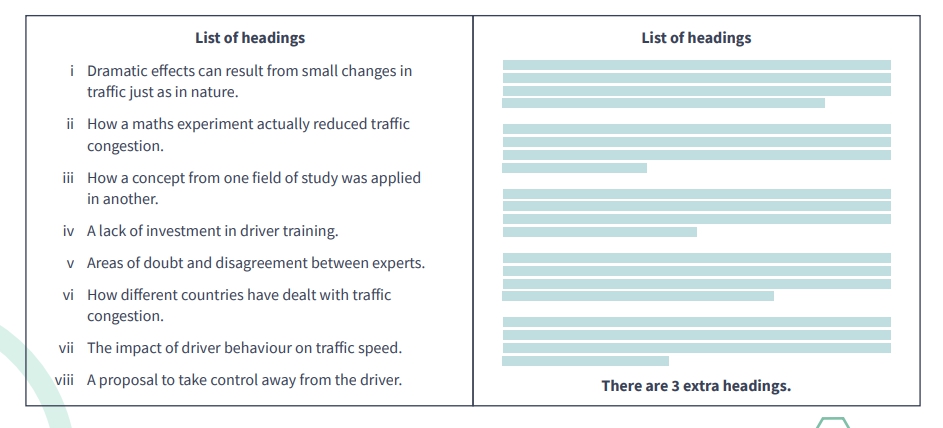
Step 3. Cross out the example paragraph and heading.
There is sometimes an example given for you. Do not waste your time on it, cross it out from the headings and the passage.
Step 4. Read the headings and underline the keywords.
You need to completely understand the meaning of each heading. This can be made easier by paraphrasing, i.e. if difficult, ‘translate’ the heading into simple English.
Underline the keywords in each heading. They are names, places, dates, and nouns, once you have read them thoroughly. This step will help you connect the correct heading to the appropriate paragraph.
READ ABOUT: Tips for note completion questions in IELTS Listening

Step 5. Read the first paragraph quickly. Underline the main ideas. Choose the best heading.
Your aim is to identify the main idea of the paragraph. As a rule, the first one or two sentences and the last sentence introduce and summarise this main idea. Remember, you do not need to know the detail for this type of question. However, the headings are usually worded in such a way that you need to know that thing right in the middle of the paragraph to find the answer.
Next, briefly sum up the main idea of the paragraph in your own words as if you were writing your own heading. Do it in just a few words or a short phrase at the most. You can write this beside it.
The key words are the clues but also synonyms are very likely to be used. When choosing a heading do not just select the first one that seems to match as there may be two that are very similar in meaning. Pay attention to the meaning.
The same words in headings and paragraphs may distract you. However, the similar idea in the paragraph may only be a detail, not the main idea. When matching a heading, ask yourself if it is the main idea of the paragraph.
Step 6. Do the same for all other paragraphs.
The next step is to do the same for all paragraphs that are left. Keep in mind that you can use the same heading only once. If it is difficult to decide on a heading, write several possible ones and a question mark, and move on to the next paragraphs. When you finish with the rest, there will be only a few headings left, so it will be easier for you to choose. Once you have finished the first round, you have read the whole passage, come back to the questions you could not answer. If you were hesitating between two options, it is likely that you have already used one of them for another section or paragraph, i.e. the answer becomes obvious.
When you are reading a paragraph, focus on the main ideas, not minor details or the same words.
In our IELTS Grade online course, we explore examples and provide you with strategies to deal with each type of questions of the IELTS Reading section as well as practice tasks and valuable feedback. It is a complete IELTS Academic self-study course with an extensive Writing practice and detailed analysis, automated instant feedback on writing using artificial intelligence, video comments and a full mock test imitating the conditions of a real exam. You can try the free version to feel the benefits of the course.
Subscribe to our IELTS digest
READ IN OUR BLOG:
– 8 strategies to achieve a perfect score in IELTS Listening
– What to expect at the IELTS Speaking test
– 25 phrasal verbs to avoid in IELTS Academic Writing
When it comes to answering multiple-choice questions in the IELTS Listening sections, many students and candidates tend to overcomplicate it. There are at least two things you can do to make it more complicated for yourself: trying to read all the questions and all the choices and trying to remember all the options. What can you do to avoid this? How can you keep it simple and give the correct answer to get an excellent score in IELTS?
In IELTS Listening, there are two variations of this task: with one or several correct answers. You will see immediately which one it is. If you have a question and three options A, B, C — you need to choose one correct answer. If there are many options, you should choose two or three of them — check the instructions to learn how many. For example:

Multiple choice questions are common for parts 2, 3 and 4 of IELTS Listening test. You can expect to have 2 – 4 speakers, and it is always in a general or academic context. This means you might hear: students discussing a presentation, a tutor giving feedback to a student, group mates planning a project etc. Sometimes the speakers agree or disagree, or they might change their minds as they are speaking.
Take IELTS with confidence
Start your IELTS Grade online course
What is the most confusing for test-takers is that there is too much text to read. What is more, there are three possible options in the question. The speakers often mention information and say vocabulary from all of them. For example, the answer may be B, but you can hear vocabulary from A and C as well. These are called distractors.
In IELTS, the purpose of multiple choice questions is to test a wide range of skills. You may be required to have a detailed understanding of specific points or an overall understanding of the main points of the listening text.
Before you listen, you will have some time to prepare yourself. There are two steps you have to make before your start listening and before you hear the recording. They are very important.
Step 1. Look at the title and questions quickly.
This will allow you to become familiar with the topic, i.e. you will understand better what the conversation is going to be about. You will also prepare yourself and scaffold your listening.
Step 2. Read the questions and options, and underline keywords in them.
Keywords are important words that will draw your attention while you listen to the audio recording. Generally, you will want to avoid underlining adverbs, pronouns, or basic adjectives.
Focus on the meaning of these keywords. You do not have much time: around thirty seconds or so. If you need to, try to say the keywords in simple English to yourself. Your aim is to get to the meaning of the questions and options.
READ ABOUT: Tips for note completion questions in IELTS Listening

Now, you will listen to recording, and here are the next steps to follow.
Step 3. Listen to the introduction to the recording to understand the context better.
Do not skip the introduction — it will tell you a bit more about the conversation. For example, in this introduction the speaker will say, ‘You will hear a customer arranging with a shipping agent to send a large box overseas.’
Step 4. Listen further and answer the questions.
Now, you will hear the conversation. It is time to answer the questions. Always think about one question, but also keep an eye on the next one. You never know when the information about it will begin. As you hear the options mentioned, cross out obvious distractions. It is very important. All options may be mentioned, but only one of them is correct.
Remember that in IELTS Listening almost everything is paraphrased. What you read in questions and what you hear will come in different words. Listen for the same meaning, not only the same words.
For example:
| You will see:
|
You will hear: |
| Choose the correct letter, A, B or C.
9 Type of insurance chosen
A Economy (I’ve been stung before with economy insurance) B Standard C Premium (I’ll go for the highest) |
A OK right. Now obviously insurance is an important thing to consider and our companies are able to offer very good rates in a number of different all-inclusive packages.
B Sorry, could you explain a bit more?
A Yes, sorry, um. There’s really three rates according to quality of insurance cover – there’s the highest comprehensive cover which is Premium rate, then there’s standard rate and then there’s economy rate. That one will only cover the cost of the contents second hand.
B Oh I’ve been stung before with economy insurance so I’ll go for the highest. |
| 10 Customer wants goods delivered to
A port (The port’d be fine – I’ve got transport that end.) B home C depot |
A Mh’hm and can I just check would you want home delivery or to a local
depot or would you want to pick it up at the nearest port?
B The port’d be fine – I’ve got transport that end.
A Fine and will you be paying by credit card?
B Can I pay by cheque? |
Step 5. Check that you have answers to all questions.
If have not answered all the questions, do guesswork. Don’t leave any blank answers. Chances are you will choose the correct answer and get a better score for the listening section.
Go to our course that provides you not only with examples, but teaches you strategies for all the parts of IELTS Academic. You will learn and practise step by step, save all the tips and tools in your personal Knowledge Bank, get 24/7 support and instant feedback from our IELTS experts. Depending on how much time you have, we provide you with a study-plan that will help you manage your IELTS preparation.
Subscribe to our IELTS digest
READ MORE:
Can computers really grade your IELTS Writing and Speaking?
Useful tips to tackle true or false questions in IELTS Reading
What to expect at the IELTS Speaking test