
Here are suggested study plans for you
to make the most of the course
Most questions in the IELTS Academic Writing section fit into a few categories such as opinion essays, discussion essays, problem solution essays, double question essays, advantages & disadvantages essays. What do you have to do if you get the last one? How should you approach advantages & disadvantages essays in the IELTS Writing test? What is the essay structure and the main tips to write it?
You will notice that questions for IELTS advantages and disadvantages essays can be worded in several different ways. However, all of them test your ability to analyse the benefits and drawbacks of a particular matter or problem. For example, you can come across such wordings:
Generally, we can divide advantages & disadvantages essays in two types:
Type 1 asks you to simply discuss the advantages and disadvantages.
Type 2 asks you to discuss the advantages and disadvantages AND give your opinion on whether the advantages outweigh the disadvantages or vice versa.

Task 1 does not ask for our opinion, so you should not include this information in your answer. In Task 2, you have to say if the advantages are stronger than the disadvantages. For example, there are a huge number of advantages to learning the news online, but there is one huge disadvantage (reliability and accuracy of information) that stops most people from reading them that way and therefore the disadvantages outweigh the advantages. Each of the types of essays requires a different approach.
READ ABOUT: How to link ideas in IELTS essays
There are at least two different ways to write an advantages and disadvantages essay. However, we suggest the best and the easiest ones to complete the task if you get in your IELTS exam.
Do not start writing immediately. First, read the statement and underline key information. This will help you to better understand what you have to write about and what you don’t have to do, i.e. focus on the specific issue.
Next, paraphrase the statement for yourself to understand it better — at this point you can use simple language.
Take IELTS with confidence
Start your IELTS Grade online course
In both cases you will have to brainstorm the ideas for your essay. Think about the benefits and drawbacks of the issue that you have to write about. Write them down using bullet points. Spend a few minutes on this.
Now, you can choose between thinking about details/examples to illustrate your ideas or starting to write your essay. If you do not have to write about your opinion, you can continue to the next step – writing. However, if you are to give your opinion, think about details/examples to illustrate the advantages and disadvantages, and decide on your opinion as to whether the advantages outweigh the disadvantages or vice versa, or they are equally important. It is important to decide what you think before you start writing.
While writing the first type of advantages and disadvantages essay, where you only have to discuss them, you can keep looking back at the task and your plan to give relevant ideas. Choose the best ones only, i.e. those that you can support with details and provide good examples.
First, write the introduction where you have to paraphrase the statement and write what the essay will discuss. For the second type of essay, give your opinion in the introduction as well.
Next, write the main body:
Finally, write the conclusion where you have to summarise advantages and disadvantages. For the second type of essay, restate your opinion as well.

You should look for spelling mistakes, mistakes that you typically make, repetition of vocabulary and linkers etc. Recently, we have written about how to check your IELTS writing and shared a checklist for efficiently editing your writing. It is the fastest way to improve your band score within a few minutes.
READ ABOUT: 6 typical mistakes in IELTS essays
What will your essay look like if you follow our advice? Here are the two possible essay structures for your advantages and disadvantages essay:
| Type 1 | Type 2 |
| INTRODUCTION:
– Paraphrase of the statement – What will be discussed
MAIN BODY: Body paragraph 1 – Topic sentence for advantages – Advantage 1 + Detail/Example – Advantage 2 + Detail/Example
Body paragraph 2 – Topic sentence for disadvantages – Disadvantage 1 + Detail/Example – Disadvantage 2 + Detail/Example
CONCLUSIONS: – Summary of advantages and disadvantages
|
INTRODUCTION:
– Paraphrase of the statement – What will be discussed – Opinion
MAIN BODY: Body paragraph 1 – Topic sentence for advantages – Advantage 1 + Detail/Example – Advantage 2 + Detail/Example
Body paragraph 2 – Topic sentence for disadvantages – Disadvantage 1 + Detail/Example – Disadvantage 2 + Detail/Example
CONCLUSIONS: – Summary of advantages and disadvantages – Opinion |
In our course, we outline the possible structures of different types of essays, provide real examples and model answers. You will also learn and practise writing different parts of the essays step by step. Finally, you will write your own essays and get immediate feedback from our IELTS experts.
Now that you are more confident about IELTS advantages and disadvantages essays, you can practise with our platform and reach the desired band score.
Subscribe to our IELTS digest
READ ABOUT:
– Useful tips to tackle true or false questions in IELTS Reading
– Tips for note completion questions in IELTS Listening
– Which part of IELTS Speaking is most important?
Artificial Intelligence (AI) touches many parts of our daily life. Chatbots, voice assistants, robots give us extra support when we need it. They are no more a part of sci-fi. Information and communications technology has also changed the way we teach and learn languages. Students can attend classes and access learning materials remotely. This has made education more affordable and flexible. More engaging digital textbooks that contain hyperlinks, interactive presentations, and videos are replacing paper-based textbooks. Digital learning environment also allows students to set their own pace of study and teachers to track students’ progress more efficiently.
In fact, artificial intelligence algorithms make it possible to advance eLearning in every field. How does AI work in English language assessment? Can it really improve and test productive skills such as speaking and writing that we need for IELTS exam and that have always been assessed by humans?
Automated scoring technology has already gained global acceptance since Ellis Batten Page argued for the possibility of scoring essays by computer, and in 1968 published his successful work with a program called Project Essay Grade (PEG). Optical mark recognition and bubble-card reader popularized in the early 1970s caused a dramatic shift in testing reading and listening skills through multiple-choice item type. The terms automated essay grading (AEG) and automated essay scoring (AES) were introduced in the 1990s and typically refer to computer scoring of writing in high-stakes tests.
In order to have the writing scored, the test-taker needs to type at a computer. Depending on the purpose of the test, an AES system might need to process the essay before evaluating it. For example, if the candidate has written an essay in capital letters, they will be turned into small letters in order not be perceived as acronyms. In addition, spelling dictionaries will ensure that “organise” and “organize”, for example, are both scored as correct in international tests of English such as IELTS.
There are two typical AES models:
| Prompt-specific AES
|
Generic AES |
| Each prompt or essay title must be administered to test-takers from the target population in order to collect a sample of responses representing the entire range of ability/performance. These responses will be used to develop the scoring model. It make take 100 – 1,000 responses depending on the complexity of the writing task, the rating scales, and the type of modeling techniques. Expert judges assign rubric-based scores to each response in the training set, and the model is optimized to predict these scores.
A unique combination of features is developed to optimally predict human scores for each prompt. Prompt-specific models can more accurately evaluate such concepts as content of the essay, completion of the task, organization and coherence, appropriacy of register and authorial voice. |
These models are trained only once and apply to all essay prompts; they apply the same set of features and feature-weighting to score every prompt on some pre-determined scale. Generic models tend to rely more on surface features such as frequency of grammar errors, punctuation errors, number and location of discourse markers, metrics of sentence complexity, word frequency etc. |
In order to build the scoring model, it is necessary to take the three steps. First, it is needed to identify a set of variables relevant to the construct that is going to be assessed. For, example, we can use such variable as lexical density to score a feature called “Vocabulary range and accuracy”. Next, it is necessary to analyse and decompose a large number of training essays into a set of statistics. What does this mean? The number of words in the top 1,000 frequency level, the 2,000 level and so on. Third, use the statistics in models in order to find out how well they predict the expert human scores. After that, the best combination of variables and their weightings are identified.
Take IELTS with confidence
Start your IELTS Grade online course
According to a recent survey, modern AES systems try to score different dimensions of an essay’s quality in order to provide feedback to users. These dimensions include the following items:
Such kind of feedback intends to help the writer identify which aspects of the essay need improvement.
How come it comes under Artificial Intelligence? The time, machine can grade human written essays, which requires some expertise, we can tell that this is Artificial Intelligence. Machine learning is an application of artificial intelligence (AI) that provides systems the ability to automatically learn and improve from experience without being explicitly programmed. Machine learning focuses on the development of computer programs that can access data and use it learn for themselves.
The underlying idea of this approach relies on training of binary classifiers to distinguish “good” from “bad” essays and on using the scores to rank essays and assign grades to them. The process consists of two steps: a training phase, in which the grading rules are acquired using various algorithms, and a testing phase, in which the rules gathered in the first step are used to determine the most probable grade for a particular essay. A larger set of documents enables the acquisition of a larger set of rules during the training phase, thus a higher accuracy in grading. A major part of these techniques, giving training to the systems and later stage, making the systems to learn from new essays or experience is nothing but machine learning.
A growing number of statistical learning methods have been applied to solve the problem of automated text categorization in the last few years, including regression models, nearest neighbor classifiers, Bayes belief networks, decision trees, rule learning algorithms, neural networks and inductive learning systems.
In our IELTS Academic self-study course , we use AI to check and evaluate your reports and essays. You also receive immediate feedback on your writing as you submit it to us. Our automated checking system checks all of your practice tasks as you proceed and gives you instant feedback on the issues you have to improve.

READ ABOUT: Tips for note completion questions in IELTS Listening
While automated systems for evaluation of writing, reading and listening skills have been available for some time, systems that evaluate speaking are only now becoming more common. How do they work? Can they really evaluate competencies we need for spoken communication?
In such test as IELTS, the Speaking section is delivered through face-to-face communication of the examiner and the candidate. Most of Cambridge exams still need two examiners who will test two candidates at the same time. Cambridge English is also exploring the option to deliver direct oral proficiency interviews remotely using video-conferencing technology. However, how can one prepare for such exams and get instant feedback on speaking if the speaking partner is not available? Automated scoring of speaking will help. Such systems can evaluate what was said and how it was said unlike the systems for evaluation and remediation of pronunciation.
There are three models that can make automated scoring possible and accurate together with test and task design.

READ ABOUT: The most important part of IELTS Speaking
It is important to remember that automated scoring technology does not make computers behave like humans. Rather, we can program the machines to identify and quantify some features in speaking and writing, combine them and weight them according to multiple dimensions, and identify which specific features and their weightings best predict the score a human teacher or examiner would provide. Thus, using AI has some benefits.
Considering your needs. Thanks to using an AI for learning languages and exam preparation, we can take into consideration the needs of a bigger number of IELTS candidates. Our AI-powered language learning platform allows you to work at your own pace, repeating topics and emphasizing things you need to improve, engaging you with the tasks you’re best at. Data also allows our IELTS teachers to understand what is going on in the minds of our students and predict their future performance.
Providing instant feedback. With AI exam preparation, feedback comes immediately. This is quite beneficial because you do not need to wait for a few days for the results. It allows you to see the mistakes you made, and you will remember how and realize why you made them. Our platform evaluates essays and reports automatically right after you have turned them in, pointing out errors and suggesting ways to avoid them in the future. This allows you to correct your mistakes, improve your writing shortly and do better in future tests. This also allows our IELTS teachers to see if you need additional guidance.
No fears. When preparing for IELTS or any other exam, most students are afraid of failing it. When failing, we often feel ashamed and demotivated. AI doesn’t reprimand or criticize learners, it evaluates you without judging. When you get your feedback, you know what and how to work on. Additionally, knowing your drawbacks, you can have a Skype session with the IELTS tutor. However, most of the routines are done by the platform.
Teachers become guides and advisers. Our IELTS teachers have more time for analyzing and using the data gained from your learning process to improve the course and the platform, coordinate your learning process and give you more support as all of the grading and the paperwork are done by the AI.
Flexibility. Thanks to using AI on our platform, you are able to study and prepare for your IELTS from any place in the world at your own pace, set your own goals, and follow a study-plan. We offer a study plan to organise and guide your IELTS Academic preparation process.
We believe that the fast and powerful tool such as AI combined with the human judgment of examiners, annotators, assessment experts, data analysts and teachers will reduce costs, save your time, improve efficiency and give you a faster turnaround for your desired IELTS results.
Subscribe to our IELTS digest
READ ABOUT: How to check your IELTS writing
Most of the students and candidates consider this type of questions in IELTS Reading to be the trickiest. Have you already guessed which one it is? They are ‘True-False-Not Given’ or ‘Yes-No-Not Given’ questions. You must admit that it would be good if there were only true and false statements. However, what shall we do with the third option? Such questions often cause problems because of the difficulty in understanding the difference between answers that are ‘false’ or ‘not given’. Today, we are going to share some tricks and show some patterns that will help you find answers to those questions without much effort.
Almost all tests contain such questions, and chances are high that you will have them in your reading exam as well. Usually, True-False-Not Given questions come in the first passage, which is believed to be the easiest one, or sometimes in the second. Yes-No-Not Given questions appear in the second or the third passage most of the time. There are 3 to 5 questions of this type in a set, and you have to use all the answers.
What do we have to do for this type of questions? In the exam, you will get the paper where there will be the article you need to read and the questions. Here is the official sample task from the IELTS Academic exam.

READ ABOUT: How to deal with multiple choice questions in IELTS Reading
As you can see, each question is a statement. You need to look at that statement, read through the passage, and decide if this information is in the passage:
One more thing to remember is that ‘True-False-Not Given’ questions are about factual information while the ‘Yes-No-Not Given’ questions are all about the writer’s opinion.
Those are the basic requirements of this type of questions. Read further, and we will look at the difference between ‘True’, ‘False’ and ‘Not Given’ as well as at some examples.
Take IELTS with confidence
Start your IELTS Grade online course
The action plan for tackling ‘Yes-No-Not Given’ and ‘True-False-Not Given’ questions is exactly the same.
This is a step for all types of questions in IELTS Reading if they go first in the passage. It helps you find answers to questions in it more easily later on when you will need to read in detail the part of the text where you think the answer is.
For example: Marie became interested in science when she was a child.
For this, you will need to scan the text and find similar words and synonyms in it. The same words help locate facts in the passage. Synonyms help us choose the answer.
The only paragraph where we can read about her childhood, goes like this:

Now, let us read more carefully and watch out for the synonyms or the opposite meanings to choose the answer.
‘From childhood’ has the same meaning as ‘when she was a child’. Then we read about ‘medical studies’ which is also related to ‘interested in science’. However, does this information coincide with what we read in the statement? No, it doesn’t. Does the passage say anything that contradicts with our statement? Not really. What we can learn about Marie as a child is that she ‘was remarkable for her prodigious memory’, and it was her sister whose medical studies Marie financed. Can we find any information about what she was interested in when she was younger? No, we can’t. What does this mean? The answer is simply NOT GIVEN in the reading passage.
After you have chosen the answer, return to Step 2 with the rest of the statements and follow the same procedure.
In our course, we look at more examples in detail and analyse various answers for this type of questions in the IELTS Reading exam. Our IELTS experts share other useful tips on tackling ‘True-False-Not Given’ questions. Join our course if you want to know all of them and skyrocket your IELTS result.

Recently we have written about checking you IELTS Writing.
Subscribe to our IELTS digest
In the IELTS Listening test, there are questions where you need to complete gaps in a form, a table or notes. These types of questions usually appear in Parts 1 and 4 of the Listening section. This means, there are very high chances you can get them in your test, and it is important to know how to deal with them in order to get a higher score.
They can appear in many different forms but will always be a gap fill activity of some sort where you have to fill in missing words. Today, we will look closer at notes, sample questions, and give you some strategies and tips for note completion questions in IELTS Listening.
In real life, we often take notes to remember information, which is important to us. Talking about the IELTS Listening section, if you take notes you will know what the speakers have discussed and you will be able to provide the right answers. So, what kind of things should we write down? Notes contain such things as:
What they do not contain is full sentences. Often, notes are grammatically incorrect or awkward as they do not conform to the rules or principles of grammar or accepted usage.
In the IELTS Listening section, the note/table is usually about the main points discussed in the conversations or monologues. For example, in part 4, the main points are often important academic concepts and details.
READ ABOUR: Key facts you need to know about IELTS Listening
Take IELTS with confidence
Start your IELTS Grade online course
This is the very first thing you have to do in order to complete this type of task. Look at the title, the information in the form, and the instructions. You will learn many things by doing so. You should read the instructions very carefully as the number of words or numbers you should write might vary. For example:
Let us have a look at the Listening sample task below and think what we can learn from the form:

Taken from https://www.ielts.com
From the title of the form, we know that the conversation is going to be between a customer and a manager, and the customer probably wants to send something in the container. In the form, we also read about details such as name, address, size of the container and cost. The instructions say that we can write up to three words and / or a number. Can we write 4 words in the gap? The answer is ‘No’.
READ ABOUT: IELTS Academic Writing topics in 2020
After you have got the general idea about the conversation, it is time to look closer at the gaps you have to fill. Look at the words on the left and on the right, and try to predict the answer. This will help you stay more focused while listening and select the appropriate information.
For example:
Sounds easy, doesn’t it?

READ ABOUT: Get ready for IELTS Listening
Listen carefully to the conversation and complete the gaps. Remember, in such type of task you have to write the exact words or numbers you hear. Don’t forget to check that they fit the gap: the right meaning and the right grammar. Here are some tips to help you.
width → 0.75 metres wide
height → 0.5 metres high or deep
If you have time before the recording starts, identify key words or phrases in the question that are likely to be replaced by synonyms and think of some that might be used.
June — JUNE
Smith — SMITH
Thousands are written with a comma: 1,000.
Fractions are used with a full stop: 0.5 / 0.75.
Dates can be written in many ways, but we recommend that you choose the easiest correct format: day — month — year, for example, 15 July 2003, without ‘th’ at the end of fifteen.
Measurements can be written in short: ‘m’ for metres, km for kilometres, kg for kilograms.
In our course, we will provide you with all the necessary tips to complete this type of task and you will do a lot of listening practice. You will also save all the tips in a Knowledge Bank and will be able to return to them any time you want. Our experts will explain all the nuances of notes completion in video lessons, so you will be confident about scoring high at IELTS Listening.
This is the shortest but the most important step. Do not leave blank answers. Even if the exam looks difficult, choose your best guess and maximize your chances of scoring high.
Recently, we have written about 8 strategies to achieve a perfect score in IELTS Listening.
Subscribe to our IELTS digest
Suppose you have finished writing Task 1 and Task 2 on the day of the IELTS exam in less than 60 minutes. Even so, have you completed the IELTS Writing? The answer is ‘no’ unless you have checked your writing for mistakes. This step is crucial in completing IELTS Writing tasks. It is also one of the most effective ways to improve your band score. Why? Within a few minutes, you can correct your mistakes or change sentences you have written. You are able to fix these mistakes if you know what to look for. Here is the checklist for efficiently editing your writing.
The list of items is/are on the desk.
If you know that ‘list’ is the subject, then you will choose ‘is’ for the verb.
When performance on a regular basis, such workouts allow people to strong their immune system and increase metabolism, thus becoming healthier.
‘Performance’ is a noun. However, in the sentence above it was used as a verb instead of ‘perform’. ‘Strong’ is a noun, but the candidate has used it instead of a verb ‘strengthen’.
READ ABOUT: 6 typical mistakes in IELTS essays
Take IELTS with confidence
Start your IELTS Grade online course
The British and American spellings of many English words are also different. For instance:
colour (BrE) — color (AmE)
centre (BrE) — center (AmE)
litre (BrE) — liter (AmE)
theatre (BrE) — theater (AmE)
neighbor (BrE) — neighbor (AmE)
While both of them are equally correct, choose one and stick to it.
READ ABOUT: 10 typical mistakes in IELTS Academic Writing Task 1

Candidates often skip this important aspect of their writing and simply do not check it. However, it accounts for a large part of your score.
READ ABOUT: How to link ideas in IELTS essays
If you know that you often make some kind of mistakes, check your writing for them too. Be sure you check for one type of mistake at a time, because you might get confused if you check all of them at once.
Spend from 3 to 5 minutes at the end of the IELTS Writing section. That is because while writing, we tend not to see our mistakes.
In our course, we have included every single type of IELTS Academic Writing task. Each is followed by a certain strategy — you learn what to do step by step (analyse the task, plan your response, write, and check). You also develop your other skills necessary for the IELTS exam. At the end of the course, do a full mock test in Writing and Speaking and get feedback from one of our IELTS experts.
Subscribe to our IELTS digest
A lot of test-takers and students preparing for IELTS have been asking this eternal question. They visit IELTS forums, ask their tutors and other candidates, and often receive contradictory answers. Some believe that Part 3 is the most important part if the IELTS Speaking test, others consider Part 1 to be a warm-up before the second and the third parts of the exam, which are crucial. In fact, there are four aspects that influence your band for IELTS Speaking, and the examiner will grade your performance in all parts of the test.
This is the first aspect of your speaking that examiners pay attention to. In other words, they listen for HOW we speak. That is why it is very important not to keep silent and answer questions thoroughly. You should not worry if you cannot think of many ideas. Unlike IELTS Writing, this part of the test assesses your English language, not the ideas you express. It is a good idea to give examples and detailed explanations in Part 3, and answer in full sentences in Part 1 of the IELTS Speaking test. By doing so, you offer the examiner with a wide range of language to assess. This means, even you struggled to answer one question, this will not influence your score if you did well in the rest of questions.
In your answer, ideas have to be organised logically and linked together. It has to be easy for examiner to follow your thought. All this is called coherence. To make your answer more coherent, use different discourse markers and linking words.
One more thing you should not do is repeating or correcting yourself too much.
Also, avoid pauses to search for words. Pausing affects your fluency and also the amount of time you actually spend speaking in the test, so you should not overdo it.
Take IELTS with confidence
Start your IELTS Grade online course
READ ABOUT: IELTS Speaking test format and assessment criteria
What stands behind the second aspect? Let us have a look at the following example. This is a question from Speaking Part 3:
What can elderly people learn from the young?
This is the script of the answer given by a candidate:
It shows a wide range of words, collocations and idiomatic language e.g.: springs to mind, make effective use of, survive and thrive, the new digital world, living for the moment. Less common academic vocabulary is also used, e.g., state-of-the-art, technological advancements. It is also important that the candidate uses all this vocabulary appropriately.
This means that you can definitely boost your score if you provide the examiner with:
In our online self-study course, we look at more examples, compare worse and better answers, explore each criterion for different skills. Moreover, you are going to try doing Speaking part 2 yourself and get feedback from one of our IELTS tutors.
READ ABOUT: Helpful idioms for IELTS Speaking

This is the third aspect that will influence your score. You need to use various tenses, grammatical structures and complex sentences. What is more, they have to be appropriate and correct. However, they should not be memorized. Otherwise, they will not make any sense, and will not get you any points.
The truth is, the examiner has no model answer to assess your speaking. Every response given by different candidate will differ, and their language varies too. Your score depends on the language you produce at the exam, range and accuracy of structures you use.
That is why, before answering the question, think about grammar you will apply. For example, if you are asked to talk about if your hometown has changed much since you were a child, use the following structures to talk about the past: ‘used to be’, ‘would do’, and the present: ‘has become’, ‘tends to’. Other structures, such as comparisons ‘way better’ and ‘far more + adjective’, and a conditional sentence could beused for a good effect.
READ ABOUT: Which IELTS should you take: general or academic?
The last criterion is pronunciation. Here, you should pay attention to intelligibility, that is how clear your pronunciation is to the examiner, how well they can understand what you say.
Do not speak very fast. IELTS does not test the maximum speed you can speak at. Choose a natural pace.
Examiners also listen to your intonation, and whether you pronounce words and put stress correctly.
Your accent does not have to be British English, but for a score higher than 7, your mother tongue does not have to affect clarity. If your accent is so heavy that the examiner cannot understand what your are saying, it will affect the score. If it does not take much effort to understand your pronunciation, you can get a high band score.
Now you know what you should pay attention to at the IELTS Speaking test and what to work on. Get more practice and a full mock Speaking and Writing tests with a detailed feedback from IELTS preparation experts in our course.
Subscribe to our IELTS digest
READ MORE: 6 typical mistakes in IELTS essays
In the IELTS Reading exam, there are several types of questions. Multiple choice are one of them. They regularly appear in both modules of the test: General and Academic. Most candidates tackle them with no effort. However, they might be quite tricky. That is why it does not take much effort for candidates and students of IELTS to pick up the wrong answer.
Today, we will look at some useful tips that will help you find correct answers and achieve high score at the IELTS Reading exam.
In such type of task, you will have to read the first half of a sentence, a statement or a question about the text, and choose the most appropriate sentence ending, response or answer from a choice of a number of options (usually 4 or 7). The instructions can be set out like this:

This type of question tests if you can:
The answers for such type of questions in the Reading sections are very likely to come in order. Bare this in mind when reading the questions and scanning for information. Therefore, the strategy you will need to use is scanning. If more than one answer is possible, read in detail.
Tip # 1. Read the passage quickly. Spend around 2 minutes on this. It will help you get general idea, and look at the organization of the paragraph, especially if multiple choice questions are the first questions to a passage.
Tip # 2. Read the questions/ statements/ incomplete sentences. However, do not read the options yet. Next, underline the keywords in it and ‘translate’ it into simple English. What does this mean? Make sure you understand the question.
For example:
TASK
Choose the correct letter, A, B, C or D.
One of the facts provided in David Storey’s study suggests that …
Take IELTS with confidence
Start your IELTS Grade online course
READ ABOUT: 6 typical mistakes in IELTS essays
Tip # 3. Scan the passage and locate the question. Use quick reading, keywords and proper names from the question to look for the information in the text.
For example:
TASK
Choose the correct letter, A, B, C or D.
One of the facts provided in David Storey’s study suggests that …
TEXT
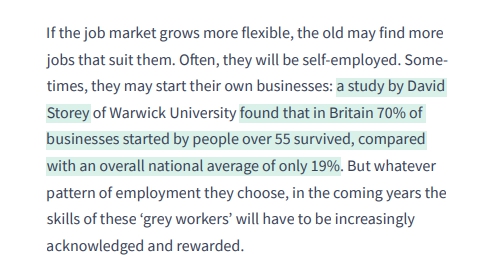
If the job market grows more flexible, the old may find more jobs that suit them. Often, they will be self-employed. Sometimes, they may start their own businesses: a study by David Storey of Warwick University found that in Britain 70% of businesses started by people over 55 survived, compared with an overall national average of only 19%. But whatever pattern of employment they choose, in the coming years the skills of these ‘grey workers’ will have to be increasingly acknowledged and rewarded.
Tip # 4. Look for the answer to the question in the passage. Once you have found it, underline it. You will need it further.
READ ABOUT: 25 phrasal verbs to avoid in IELTS Academic Writing
Tip # 5. Return to the options. Now, it is time to read the options that the task suggests and compare them with the answer you have underlined in the passage. Choose the one you think is the best.
Tip # 6. If in doubt, check all the options critically. You might still hesitate. So, it’s a good idea to think why the other options are wrong and cross them out. These options are, as a rule, not related to the topic.
Tip # 7. Watch out for distractors. In the Reading section of the IELTS, they are the same words that you can see in the options and in the paragraph. In fact, they may be there only to distract you. The meaning of the sentence that contains such words is usually different from the correct answer.
Now you know how to tackle multiple choice questions in IELTS Reading. You may use our tips as an action plan even if you have to choose more than one option. In this case, go through steps 1 – 4. Next, read the options. Compare with the passage. Choose the number of options you need. After that proceed with steps 6 and 7.
In our course, we will explore multiple choice questions in more detail, look at examples and work out more useful tips. You will save all the advice you get in a Knowledge Bank, receive instant feedback, develop other skills like listening, speaking and extensively work on your academic writing, track your progress and a full mock Speaking and Writing tests with a detailed feedback from IELTS preparation experts.
Recently, we have written about IELTS Reading key facts.
Subscribe to our IELTS digest
Students and candidates who prepare for IELTS know that you get scores for each part of the test. What is your perfect score in IELTS Listening? Of course, you aim at 7+, and it is trouble-free if you know the strategies to achieve it.
Test-takers also believe that the challenge of the Listening test is increasing as you progress through it. To some extent, it does. What is the catch then? Candidates make many mistakes in part 1, which seems to be the less complicated. This is because there you need to write down the exact information such as numbers or names, or dates or spell words correctly. So, this increase in the level of difficulty is quite disputable. This means you should be attentive in each part of the test. And here comes our foremost strategy for the IELTS Listening test.
Take IELTS with confidence
Start your IELTS Grade online course
Unlike Reading or Writing sections of the IELTS Academic, you will not have time to think about what you have read, written or heard. You will hear the recording only once, so you won’t have a chance to hear what was said again.
Moreover, while listening, you will have to read the questions and give your answers. Here you have to be on your toes, because you will often hear a paraphrased version of what you read in the questions, i.e. you will read the different words, but the meaning will be the same. If you do not catch it, you will not be able to match it with the questions.
The truth is you will do a monumental work for around 30 minutes by paraphrasing and answering questions. But now, you know the tip.
In our course, we will teach you how to paraphrase, and you will learn how you can benefit from paraphrasing at the exam.
At the beginning of part 1, the speaker on the recording will tell some information. You will also hear, ‘now you have some time to look at Part 1’. You do not need to wait for this command. Instead, start reading the questions immediately.
As soon as you have answered the questions from the previous part, do so in each part of the Listening test. Before anything else, focus on keywords such as nouns, verbs, adjectives that carry the meaning (underline them in the paper-based version).
Also, try to predict the answers. If the task is to fill in the gaps, try to guess what type of word is missing. In a map, look at all the objects that have names, and think what names you could give to other objects.
Once you have read the task, try to remember about it while answering. The most common mistakes happen due to lack of attention. For example, the candidates forget the number of options they have to choose, or how many words they should write in a gap, or even if they have to write numbers or letters. You do not need to spend too much time on reading the instructions, but check up on what to do.
They are wrong answers that are similar to the correct ones, designed to see whether the person being tested can notice the difference. For example, there is one form of distractor that is very common in part 1 of the IELTS Listening test. This is when you hear a speaker correct him/herself, or the other speaker will correct them. In order to avoid mistakes, do not assume the first thing you hear as the answer is the actual answer – listen carefully to what comes after that.
When you are listening for one question, you never know when the information about it will start and when it will finish, and the speaker will move on to the next question. In order not to miss this transition, always keep in mind two questions that go one after another.
READ ABOUT: What to expect at the IELTS Speaking test

Don’t keep thinking about the previous question even if you’re not sure about the answer you’ve given. The speaker is already talking about another one. If you continue thinking about the previous questions, chances are you will not answer the following ones and lose your scores.
Even if you have selected a wrong answer, but listen further, there is more chance for you to score higher, than if you keep thinking about the same question and lose track of the recording.
Sometimes test-takers do not hear all the answers. If this happens to you, apply your logic. There might be hints in speaker’s intonation, for example. Very often speakers use linking devices that help you follow their thoughts. Even you are not sure, answer ALL questions. What if the answer you write turns to be correct? Candidates are not penalized for the wrong ones.
At the end of the test, you will have from 2 to 10 minutes to look through your answers, depending on the version of the IELTS exam you choose. Use this time to scan your answers for grammar mistakes and spelling. If you do not spell the words correctly, or, for example, write a singular noun instead of plural, you will lose points.
These were the basic strategies on IELTS Listening. They are easy to follow. However, in our course we give candidates more specific guidance on each question type. Join us to get more confidence, learn more tips and tricks, do practice tasks and get feedback from experienced IELTS tutors.
Subscribe to our IELTS digest
We also recommend you reading:
Key facts you need to know about the IELTS Listening test
6 typical mistakes in IELTS essays
Helpful idioms for IELTS Speaking
Speaking is truly considered to be quite a complicated part of the test. Candidates never know what questions exactly they will hear. However, if you have a clear understanding of the format and how your response will be evaluated, if you know some tips and useful strategies, you can perform really well.
If you’re wondering how you could improve your IELTS Speaking in a limited period of time and what to focus on in your preparation, join our free webinars on November 19th and 20th!
We’re going to cover the following things at the webinar:
— the format of the Speaking part;
— useful tips on how to prepare effectively before the test;
— effective strategies you can use during the test;
— how your response is assessed and evaluated.
We’ll also take a look at IELTS speaking band descriptors, ways of how to structure your response and useful phrases that will help you sound more naturally.
Take IELTS with confidence
Start your IELTS Grade online course
Who the webinar is for:
— IELTS Academic test takers
— students preparing to take IELTS in the future
— teachers providing IELTS preparation classes
— anyone wishing to improve their speaking skills for international exams.
By the end of the webinar you will have a clear understanding of the test format and assessment criteria and you’ll be equipped with effective techniques and strategies to use during IELTS Speaking test.
Speaker:
Olena Bochkariova — Academic Director, teacher with more than 19 years of experience and international teaching qualifications (CELTA, Delta), IELTS certified tutor and course consultant. Olena has been involved in IELTS preparation courses and running various training and academic programmes, creating materials, delivering workshops and webinars.
Register here:
November 19th, 5 pm – 6 pm (UTC +2)
https://us02web.zoom.us/meeting/register/tZMrfuCurzwvHdbI8mfaiuo-Tw8vZCeggFI4
November 20th, 3 pm – 4 pm (UTC +2)
https://us02web.zoom.us/meeting/register/tZ0qd–rrzwpHtUuFFmzIgXnXR-xarCx0z22
You will spend an hour going through IELTS Speaking tips and strategies. You will also get a special bonus offer that will help you build rock solid skills to achieve the desired band score in IELTS.
Subscribe to our IELTS digest
Many experts say that knowing what to do and how is a powerful tool in any exam, which is especially true for IELTS. Even though it’s possible to pass it without preparation, for an untrained eye all the variety of tasks in Writing task 1 presents an unbelievable challenge and all the data is seen as a mess of disconnected figures or objects. However, understanding different kinds of tasks and, more importantly, knowing how to describe different graphs, charts or diagrams boost candidate’s confidence and increase the chances of getting a higher score. In the webinar, we will be dealing with these aspects of preparation.
Join the free webinar on IELTS Academic Writing Task 1 preparation on October 22nd and 23d if you want to:
— learn about different kinds of visuals they might have in the IELTS exam;
— practice ‘reading’ graphs, charts and tables and understanding information in them;
— get to know how to organise their responses logically and in line with assessment criteria;
— practice planning descriptions based on exam tasks.
As well as that, actionable tips and strategies will be provided to help approach Writing task 1 effectively and make the experience of preparation clearer and more meaningful to everyone interested.
Take IELTS with confidence
Start your IELTS Grade online course
Who the webinar is for:
— IELTS Academic test takers
— students preparing to take IELTS in the future
— teachers providing IELTS preparation classes
— anyone wishing to improve their speaking skills for international exams
Everyone attending the webinar will have a chance to study various examples of visuals in IELTS Academic Task 1, get practical tasks that will help improve writing skills and plan the response in order to create a structure of the sample answer.
Speaker:
Andrii Pigarev — Academic Director, teacher with more than 10 years of experience and international qualifications (CELTA, Delta), co-author of IELTS Grade course, IELTS certified tutor, CELTA trainer, International Speaking Examiner. Andrii has been involved in exam preparation and various teacher training programs, organising and running courses for teachers online and offline.
Register for the webinar:
October 22nd 6pm – 7 pm (UTC +2)
https://us02web.zoom.us/meeting/register/tZAqdOyoqD4pHNK5D_-UefPaMoAVZIqfpJYy
October 23d 4pm – 5 pm (UTC +2)
https://us02web.zoom.us/meeting/register/tZ0rceCgrD8oHdfV50f6ziYcpwNVNx24sWyP
Spend 60 minutes practising and improving writing skills, becoming more confident in IELTS Academic.
Besides, you will also get a special bonus offer that will help you upgrade your IELTS band score.
Subscribe to our IELTS digest