
Here are suggested study plans for you
to make the most of the course
Most candidates think of IELTS Writing when they hear this word combination. Spelling mistakes influence your score in this section. However, it is often a surprise for test-takers that spelling really matters for the IELTS Listening section as well. To tell the truth, spelling mistakes can ruin your score in this section. While you are still preparing for the IELTS exam, it is a good idea to learn the most common mistakes made by candidates and avoid them.
Where can you make spelling mistakes? In IELTS Listening there are various types of questions such as multiple choice, note completion, matching, labeling a plan or a map, etc. In IELTS Listening, you are given one mark for each correct answer, i.e. the correct spelling matters. You have to be all ears in all parts of the Listening section but spelling mistakes are often made when candidates write their answers to labeling and note completion questions. You might have to write down such things as key words/phrases, lists, headings/subheadings, numbers/bullet points, names/surnames, places/times/prices, addresses, telephone numbers, stages, etc. We have grouped spelling mistakes by different types.
Candidates are often confused under pressure and they might make this mistake when they are not sure how many letters to write: one or two. This group of words is the largest. Here are some examples:
Take IELTS with confidence
Start your IELTS Grade online course
In English there are many letters that are not pronounced in words. However, you have to write them:
When it comes to the combination of these two letters, even advanced learners often make spelling mistakes. However, you can easily remember how to write the words properly with the help of the following mnemonic: ‘I before E except after C’. For example:
Of course, there are exceptions to every rule in English:
Watch out when you write the following words:
READ ABOUT: 8 strategies to achieve a perfect score in IELTS Listening
These are the words that sound the same. However, their spelling is different. Here are the most common pairs of words:
accept – except
plain – plane
peace – piece
scene – seen
stationary – stationery
steal – steel
sauce – source
sore – soar
for – four – fore
their – there – they’re
hour – our
band – banned
capital – capitol
chili – chilly
choral – coral
cite – site – sight
council – counsel
die -dye
discreet – discrete
daft – daught
flue – flew -flu
genes – jeans
hole – whole
marshal – martial
weather – whether
whose – who’s
you’re – your
loose – lose
affect – effect
principle – principal, and many others.
READ ABOUT: How to organize your responses on the IELTS speaking exam?

Many English words are spelled differently when they become another part of speech or when verbs are used in different tenses. For example:
benefit – beneficial
influence – influential
circumstance – circumstantial
pronunciation – pronounce
argue – argument
decide – decision
refer – referring
frolic – frolicking
occur – occurred
unity – unify
justice – justify
significant – signify
maintain – maintenance
violent – violence, etc.
While preparing for IELTS, you can still learn how to avoid making spelling mistakes. Here are some tips to help you:
Tip #1. Watch out for words with double letters. If you are not sure about the spelling, double check.
Tip #2. Always make sure you use the correct form of the verb.
Tip #3. Know which word you want to use. Check the meaning in the dictionary.
Tip #4. Watch where you place the apostrophe.
Tip #5. Don’t write what you hear. Check the spelling if you are not sure.
Subscribe to our IELTS digest
RECOMMENDED READING:
Many students who choose to take IELTS wonder whether they can see the questions in the Listening section. IELTS has a great advantage over the other international language exams because candidates have an opportunity to read the questions before they can hear the track. If one chooses to do the paper-based IELTS, the questions will be printed in the question booklet. In the computer-delivered IELTS, the questions are displayed on the screen, and you have to answer them as you listen to the audio. In this blog post, we are going to give some tips on how to exploit this opportunity – benefit from displayed questions in the Listening section.
Usually, we listen to the audio to find the answers to the questions. However, the questions can also tell us a lot about the audio before we listen to it. For example, look at the following IELTS listening task:

If you read the information in the questions, you will know that the audio you are going to listen to will be discussing different cultural events: an opera, a film, and an art exhibition. What is more, you can predict that the speaker is going to talk about when and where the events will take place, and how much the tickets cost. Probably, the speaker will mention different types of arts or make recommendations about places to visit depending on the tastes in arts.
Aren’t you more confident enough now about what you are going to hear? This tip will surely help you with comprehension.
Take IELTS with confidence
Start your IELTS Grade online course
This might sound crystal clear because you will pay attention to the information that will help you answer the questions you have read. What is meant by ‘paying attention to information is being more specific about what you have to listen for. By reading the questions you can sharpen your ears, become more selective and choose only the information that provides or is the answer to the question.
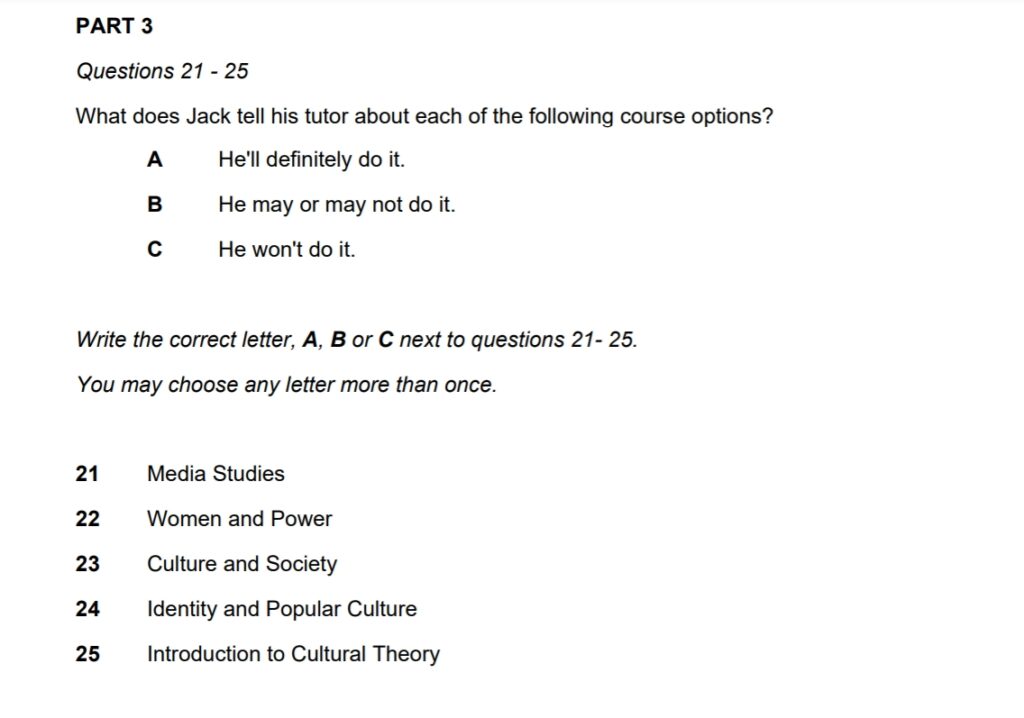
In the task above, you have only three options for answer. It is obvious that Jack will be talking to the tutor about all courses, but you will have to choose only the option (A, B, or C) which is his final decision for each of the courses (21-25). This means that you can repeat the answer if, for example, he decides not to do two of them, etc. So you know you have to listen for words and phrases that either mean he agrees, refuses or hasn’t decided yet (hesitates). Or the speaker can first decide to do the course and then change his mind. So, listen for the final decision.
Reading questions before listening is, of course, beneficial. However, reading too much is also not very good for you. In the IELTS exam, there can be two sets of questions that refer to the same lecture or conversation. These questions are usually of different types. However, each set of questions is based on a separate part of the conversation or lecture. This means that there are two separate audios as well. That is why it is not a good idea to read all sets of questions before listening because you might get lost and will not remember what to focus on. This automatically will lead you to making mistakes and losing scores.
Read only the list of questions based on the part of a lecture or conversation you are going to hear. How do you know? The instructions are played before every part, and the numbers of questions you have to answer are specified.
Of course, questions in the next parts of the IELTS Listening section become longer, and candidates do not have much time to read and analyse every word. We recommend skimming the questions for keywords and phrases that will help select the most important things and concentrate while listening. To learn the strategies for each question type and to practise with instant feedback from IELTS experts join our online IELTS Academic preparation course.
Subscribe to our IELTS digest
READ IN OUR BLOG:
The IELTS Listening section is the same in both general and academic training exams. It lasts for 30 minutes and includes 40 questions that are split into 4 parts. Questions tend to get more complicated as you progress through the test. You need to answer 30 questions correctly to get band 7, or 35 questions to get an 8. Sounds a bit tough, doesn’t it? However, if you learn how to manage your time effectively during the exam, and what mistakes to avoid, you will be able to answer more questions regardless of the version of the exam you are planning to take: paper or computer-based.
Candidates very often waste their time and lose points just because they do not know what to do, what to look at, where to write their answers etc. In order to avoid this, during your preparation make sure you learn:
You can learn all of these things in our online self-study IELTS Academic preparation course. We will take you through all types of tasks step by step, teach you tips and useful strategies, and give you immediate feedback.
It is advisable to practice doing past papers and mock exams, which is also a part of our self-study course.
Take IELTS with confidence
Start your IELTS Grade online course
You never know exactly what information you will need to answer the questions. For the questions like form-filling, for example, you need to listen carefully for things like names, dates, time, or other details. For multiple-choice questions, you have to understand the general idea of the conversation. Not following the instructions might cost you too much. To avoid this, there are a few steps to do before you start listening to the recording:
What happens if you do not follow these steps? For example, you might be asked to circle more than one answer. If you circle only one, the answer will be incomplete, i.e. incorrect. Do exactly what the instructions say. In the other case, the instructions can tell you how many words you should write in the answer, e.g. ‘NO MORE THAN TWO WORDS AND / OR A NUMBER’. It is highly recommended to read the word-count instructions very carefully. If the instruction says ONE word and you write ‘the gym’, the answer will be marked as incorrect, even though ‘gym’ is the correct word.
READ ABOUT: Key facts you need to know about the IELTS Listening test

It is true that you have to know and apply a certain strategy for answering each type of question in the IELTS Listening section. Poor skills in particular question types create a huge challenge to IELTS candidates in labeling maps, for example. If you are unfamiliar with this question type, it will be really difficult to get the right answer. The best solution is to understand all the question types and learn strategies on how to answer them. We cover and practice using all strategies in our online course.
Similarly, it is important to pay attention to the keywords. How does it work? You will have some time to read the questions before listening to the audio passage. Look for keywords in the questions, underline them and listen to them carefully in the passage. This will not only give you the idea of what the passage is going to be about but help you not to lose focus while listening to longer conversations or a lecture.
Losing focus is a real problem for many students and candidates: this can happen at specific places, and they miss important information for the following questions. However, you can avoid this problem if you listen for signpost words as well. These are the words the speakers use to indicate the different stages of the talk. For example, if the speaker wants to compare two things or talk about something different, you might hear ‘On the one hand / on the other hand’, ‘Another point to consider is…’, ‘However,…’, etc. When he or she is summarizing information, you might hear ‘Finally’, or ‘To summarize…’, ‘Lastly’, etc.
You will know what information is coming next, and this will help you follow what the speaker is talking about.
READ ABOUT: How are IELTS Listening and Reading scores calculated?
In IELTS paper-based test, you will write your answers on question sheets, and then you will get extra ten minutes to transfer your answers into the answer sheet. If you take a computer-based exam, you answer directly on the screen, so you do not need those ten minutes. You will have only two. In the computer-delivered test, the questions you have answered will be highlighted.
Make sure you do not leave any blank spaces. In IELTS Listening you do not lose marks for wrong replies. The power of probability can be applied by guessing where there is a possibility that the supposed answers might be right.
Check your spelling. If you make spelling mistakes, your answer counts as the wrong one and you do not get any points for it. Make sure you can spell commonly used words correctly, e.g. library, environment, street, avenue, professor, names of city or country or address, etc.
Check your grammar. Pay attention to singular and plural nouns, verb forms. The sentences always have to be grammatically correct. For example:
In the note completion questions, read the sentence to see if it is grammatically correct. This is how you can check yourself.
The last but not least, make sure you put the right answers in the right place. This might happen when candidates do a paper-based test and transfer their answers to the answer sheet. It’s always good to double-check.
Subscribe to our IELTS digest
IELTS two-views-and-opinion essay tips
Tips on matching features in IELTS Reading
How to avoid repetition at the IELTS Speaking test
When it comes to answering multiple-choice questions in the IELTS Listening sections, many students and candidates tend to overcomplicate it. There are at least two things you can do to make it more complicated for yourself: trying to read all the questions and all the choices and trying to remember all the options. What can you do to avoid this? How can you keep it simple and give the correct answer to get an excellent score in IELTS?
In IELTS Listening, there are two variations of this task: with one or several correct answers. You will see immediately which one it is. If you have a question and three options A, B, C — you need to choose one correct answer. If there are many options, you should choose two or three of them — check the instructions to learn how many. For example:

Multiple choice questions are common for parts 2, 3 and 4 of IELTS Listening test. You can expect to have 2 – 4 speakers, and it is always in a general or academic context. This means you might hear: students discussing a presentation, a tutor giving feedback to a student, group mates planning a project etc. Sometimes the speakers agree or disagree, or they might change their minds as they are speaking.
Take IELTS with confidence
Start your IELTS Grade online course
What is the most confusing for test-takers is that there is too much text to read. What is more, there are three possible options in the question. The speakers often mention information and say vocabulary from all of them. For example, the answer may be B, but you can hear vocabulary from A and C as well. These are called distractors.
In IELTS, the purpose of multiple choice questions is to test a wide range of skills. You may be required to have a detailed understanding of specific points or an overall understanding of the main points of the listening text.
Before you listen, you will have some time to prepare yourself. There are two steps you have to make before your start listening and before you hear the recording. They are very important.
Step 1. Look at the title and questions quickly.
This will allow you to become familiar with the topic, i.e. you will understand better what the conversation is going to be about. You will also prepare yourself and scaffold your listening.
Step 2. Read the questions and options, and underline keywords in them.
Keywords are important words that will draw your attention while you listen to the audio recording. Generally, you will want to avoid underlining adverbs, pronouns, or basic adjectives.
Focus on the meaning of these keywords. You do not have much time: around thirty seconds or so. If you need to, try to say the keywords in simple English to yourself. Your aim is to get to the meaning of the questions and options.
READ ABOUT: Tips for note completion questions in IELTS Listening

Now, you will listen to recording, and here are the next steps to follow.
Step 3. Listen to the introduction to the recording to understand the context better.
Do not skip the introduction — it will tell you a bit more about the conversation. For example, in this introduction the speaker will say, ‘You will hear a customer arranging with a shipping agent to send a large box overseas.’
Step 4. Listen further and answer the questions.
Now, you will hear the conversation. It is time to answer the questions. Always think about one question, but also keep an eye on the next one. You never know when the information about it will begin. As you hear the options mentioned, cross out obvious distractions. It is very important. All options may be mentioned, but only one of them is correct.
Remember that in IELTS Listening almost everything is paraphrased. What you read in questions and what you hear will come in different words. Listen for the same meaning, not only the same words.
For example:
| You will see:
|
You will hear: |
| Choose the correct letter, A, B or C.
9 Type of insurance chosen
A Economy (I’ve been stung before with economy insurance) B Standard C Premium (I’ll go for the highest) |
A OK right. Now obviously insurance is an important thing to consider and our companies are able to offer very good rates in a number of different all-inclusive packages.
B Sorry, could you explain a bit more?
A Yes, sorry, um. There’s really three rates according to quality of insurance cover – there’s the highest comprehensive cover which is Premium rate, then there’s standard rate and then there’s economy rate. That one will only cover the cost of the contents second hand.
B Oh I’ve been stung before with economy insurance so I’ll go for the highest. |
| 10 Customer wants goods delivered to
A port (The port’d be fine – I’ve got transport that end.) B home C depot |
A Mh’hm and can I just check would you want home delivery or to a local
depot or would you want to pick it up at the nearest port?
B The port’d be fine – I’ve got transport that end.
A Fine and will you be paying by credit card?
B Can I pay by cheque? |
Step 5. Check that you have answers to all questions.
If have not answered all the questions, do guesswork. Don’t leave any blank answers. Chances are you will choose the correct answer and get a better score for the listening section.
Go to our course that provides you not only with examples, but teaches you strategies for all the parts of IELTS Academic. You will learn and practise step by step, save all the tips and tools in your personal Knowledge Bank, get 24/7 support and instant feedback from our IELTS experts. Depending on how much time you have, we provide you with a study-plan that will help you manage your IELTS preparation.
Subscribe to our IELTS digest
READ MORE:
Can computers really grade your IELTS Writing and Speaking?
Useful tips to tackle true or false questions in IELTS Reading
What to expect at the IELTS Speaking test
Students and candidates who prepare for IELTS know that you get scores for each part of the test. What is your perfect score in IELTS Listening? Of course, you aim at 7+, and it is trouble-free if you know the strategies to achieve it.
Test-takers also believe that the challenge of the Listening test is increasing as you progress through it. To some extent, it does. What is the catch then? Candidates make many mistakes in part 1, which seems to be the less complicated. This is because there you need to write down the exact information such as numbers or names, or dates or spell words correctly. So, this increase in the level of difficulty is quite disputable. This means you should be attentive in each part of the test. And here comes our foremost strategy for the IELTS Listening test.
Take IELTS with confidence
Start your IELTS Grade online course
Unlike Reading or Writing sections of the IELTS Academic, you will not have time to think about what you have read, written or heard. You will hear the recording only once, so you won’t have a chance to hear what was said again.
Moreover, while listening, you will have to read the questions and give your answers. Here you have to be on your toes, because you will often hear a paraphrased version of what you read in the questions, i.e. you will read the different words, but the meaning will be the same. If you do not catch it, you will not be able to match it with the questions.
The truth is you will do a monumental work for around 30 minutes by paraphrasing and answering questions. But now, you know the tip.
In our course, we will teach you how to paraphrase, and you will learn how you can benefit from paraphrasing at the exam.
At the beginning of part 1, the speaker on the recording will tell some information. You will also hear, ‘now you have some time to look at Part 1’. You do not need to wait for this command. Instead, start reading the questions immediately.
As soon as you have answered the questions from the previous part, do so in each part of the Listening test. Before anything else, focus on keywords such as nouns, verbs, adjectives that carry the meaning (underline them in the paper-based version).
Also, try to predict the answers. If the task is to fill in the gaps, try to guess what type of word is missing. In a map, look at all the objects that have names, and think what names you could give to other objects.
Once you have read the task, try to remember about it while answering. The most common mistakes happen due to lack of attention. For example, the candidates forget the number of options they have to choose, or how many words they should write in a gap, or even if they have to write numbers or letters. You do not need to spend too much time on reading the instructions, but check up on what to do.
They are wrong answers that are similar to the correct ones, designed to see whether the person being tested can notice the difference. For example, there is one form of distractor that is very common in part 1 of the IELTS Listening test. This is when you hear a speaker correct him/herself, or the other speaker will correct them. In order to avoid mistakes, do not assume the first thing you hear as the answer is the actual answer – listen carefully to what comes after that.
When you are listening for one question, you never know when the information about it will start and when it will finish, and the speaker will move on to the next question. In order not to miss this transition, always keep in mind two questions that go one after another.
READ ABOUT: What to expect at the IELTS Speaking test

Don’t keep thinking about the previous question even if you’re not sure about the answer you’ve given. The speaker is already talking about another one. If you continue thinking about the previous questions, chances are you will not answer the following ones and lose your scores.
Even if you have selected a wrong answer, but listen further, there is more chance for you to score higher, than if you keep thinking about the same question and lose track of the recording.
Sometimes test-takers do not hear all the answers. If this happens to you, apply your logic. There might be hints in speaker’s intonation, for example. Very often speakers use linking devices that help you follow their thoughts. Even you are not sure, answer ALL questions. What if the answer you write turns to be correct? Candidates are not penalized for the wrong ones.
At the end of the test, you will have from 2 to 10 minutes to look through your answers, depending on the version of the IELTS exam you choose. Use this time to scan your answers for grammar mistakes and spelling. If you do not spell the words correctly, or, for example, write a singular noun instead of plural, you will lose points.
These were the basic strategies on IELTS Listening. They are easy to follow. However, in our course we give candidates more specific guidance on each question type. Join us to get more confidence, learn more tips and tricks, do practice tasks and get feedback from experienced IELTS tutors.
Subscribe to our IELTS digest
We also recommend you reading:
Key facts you need to know about the IELTS Listening test
6 typical mistakes in IELTS essays
Helpful idioms for IELTS Speaking
Students and test-takers find Listening to be a rather difficult part of IELTS. However, knowing what to expect when you get into the room on the day of your IELTS exam is your major advantage. We have collected the key information about the format of the test, question types, marking tips and scoring of the IELTS Listening test to give you more confidence about it. In this article, you will learn how much time IELTS Listening takes, number of questions and parts, what happens in each part and how listening is scored.
There are two modules of the IELTS test: General and Academic. Regardless of the module, the Listening test will be the same. The candidates who take either module of the IELTS exam arrive at the same venue on the same day, and sit the exam in the same room. They also listen to the same recordings and fill out the same answer sheets. Both modules differ in content only in the Writing and Reading sections of the test. That is why the assumption that IELTS General is easier is partially wrong.
Take IELTS with confidence
Start your IELTS Grade online course
The duration of the Listening section is 30 minutes. However, candidates who have chosen paper-based test will have 10 minutes to transfer their answers into the answer sheet. In a computer-based test, you will have 2 minutes to check your answers.
In IELTS Listening you have to answer 40 questions. There are 40 questions and 4 parts of the Listening test, 10 questions per each part. Before 2020, parts of Listening used to be called sections. That is why you may still see this word in practice tests. However, you don’t need to worry, the difference is only in the name.
You are not expected to have a detailed knowledge of the topics. Many candidates fear to fail because they do not know anything about engineering, pharmacology or paleontology, for instance. However, IELTS checks your listening skills, not your knowledge of the topic:
· your ability to understand main ideas and detailed factual information;
· if you can differentiate opinions and attitudes of speakers;
· if you understand the purpose of an utterance;
· your ability to follow the development of ideas.
READ ABOUT: Which IELTS should you take: general or academic?

Each part has a fixed format. First two parts of the test relate to social situations, while parts three and four relate to educational and training situations.
In Part 1, you will hear a conversation between two speakers on a general topic. For example, someone wants to buy a house or someone is applying for a job.
Part 2 has a monologue, again on a general situation from real life. For instance, a person is giving instructions to new company employees, or a guide is telling people about a museum.
In Part 3, there is a conversation with up to 4 people involved. They talk on an academic topic, for instance, the professor and the students discuss the project they are working on as a part of studies.
In Part 4, you will listen to a lecture. One person will be talking about a scientific or academic subject, for example, about the impact of global warming etc.
There are certain types of questions in IELTS Listening. Tasks you can get in each part of this section may differ. There are some common types of questions you may come across and need to know how to answer:
· Matching
· Multiple choice
· Note, form, table, diagram or flow-chart completion
· Sentence completion
· Summary completion
· Short answer questions
· Labeling a plan or a map
READ ABOUT: How to get ready for IELTS Listening
You have time to read the questions before listening. Once the Listening test starts you will open your test paper and read the instructions. They are short, clear and easy to follow. Read them carefully. Many of them state the number of words you have to write. For example:
Write ONE WORD AND/OR A NUMBER
or
Write ONE WORD ONLY
or
Write NO MORE THAN TWO WORDS.
You will also have some time to read the questions before you actually listen to the recording. This is one of the advantages of the IELTS test. However, don’t read too far ahead. You should read only the questions for the part of the audio you are about to listen to. Moreover, in the recording, you will also hear what questions you have to answer.
At the end of each part of the IELTS Listening test, you’ll hear the following instruction: ‘You now have half a minute to check your answers.’ Use this time to read the questions of the part that follows.
Candidates can get maximum 40 points for the Listening test. One mark is awarded for each correct answer in the 40-item test. Write your answers carefully on the answer sheet because poor spelling and grammar are penalized and are likely to reduce your score.
The table below indicates the average number of marks required to achieve a particular band score in Listening:
| Band score | Raw score out of 40 |
| 5 | 16 |
| 6 | 23 |
| 7 | 30 |
| 8 | 35 |
Now, you are aware of what the IELTS Listening test is like, and you are already at an advantage. To get more confidence, learn more tips and tricks, do practice tasks and get feedback from experienced tutors join our IELTS Academic Writing self-study course and get access to Listening, Speaking and Reading preparation parts as soon as the course updates are released.
Recently, we have written about mobile apps for IELTS preparation.
Subscribe to our IELTS digest